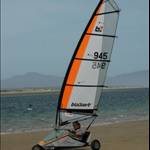
Blokarts on the plane

> 10 years ago
Reply
Register to post, see what you've read, and subscribe to topics.
sabydent
sabydent
360 posts
360 posts
20 Jan 2013 6:56pm
I am considering getting a Blokart so I can travel with a landyacht. what are your experiences with checking a Blokart with your luggage?

Brian
cisco
cisco
QLD
12367 posts
QLD, 12367 posts
21 Jan 2013 12:27pm
I believe the fold up and bag configuration of the blokart was intended to enable them to be carried aboard air craft as luggage.

I seem to recall somebody having some problems with this though. No doubt it will be costly and you should check with the airlines.

You might try PM to djb or BarakBBB for answers to the question.
wokelliott
wokelliott
WA
179 posts
WA, 179 posts
21 Jan 2013 11:11am
When my daughter travels each direction Melbourne - Perth via Quantas or Virgin aircraft she has to book her folded-up baby pram (in a purpose made pram cover) in through a separate office to the usual baggage/ticket book-in desk. I guess the purpose of this is to give it a special XRay viewing.

It doesn't count as part of her allowable baggage weight allowance as prams. strollers, carseats, high chairs etc go for free. (That bit really surprises me...so keep it quiet and below the radar ) No doubt different airline companies vary with their allowances so a simple phone call wiil set you right.
daisygirl
daisygirl
QLD
109 posts
QLD, 109 posts
21 Jan 2013 10:19pm
I am a travel agent and have travelled several times with our karts using domestic airlines.

Most airlines except Jetstar use the system of one bag up to 23 kg if purchasing the fare with luggage included. Extra bags are approx $20 per bag each direction.

We have flown several times to Mackay from Brisbane and our breakdown is:
One kart in bag incl tyres and pod frame and screen = 23kg incl with airfare
One sailbag with 3-4 sails and a few clothes = approx 15kg (need a bigger sailbag) = $20 prepaid
One carryon bag with clothes, helmet, etc = approx 8kg free with airfare

So far no damage or any problems
daisygirl
daisygirl
QLD
109 posts
QLD, 109 posts
21 Jan 2013 10:21pm
Sorry just saw you are in Canada so you will need to check with your local airline but generally domestic fares in Canada inc no luggage except for 2 cabin bags up to 10kg each. Checked in bags are normally approx $25 per bag each direction
wokelliott
wokelliott
WA
179 posts
WA, 179 posts
21 Jan 2013 10:04pm
And just a reminder, deflate your tyres or they will probably explode.
sn
sn
WA
2775 posts
sn sn
WA, 2775 posts
21 Jan 2013 10:36pm
wokelliott said...
And just a reminder, deflate your tyres or they will probably explode.


you beat me to it,
I was just about to ask if you should remove the valve stems from the tubes, in case high altitude = low air pressure, caused air inside the tyres to expand.

stephen
Arjay
Arjay
VIC
267 posts
VIC, 267 posts
22 Jan 2013 11:39am
deflate the tyres so they fit easily in the bag. I have had about 25psi in mine in a plane and had no problems. Someone I am sure could work out whether the tyres would pass bursting point.
wokelliott
wokelliott
WA
179 posts
WA, 179 posts
23 Jan 2013 2:41pm
Just looking at a few atmospheric pressure/height graphs via Mr Google, it seems that at 11 000metres (typical passenger plane heights) the pressure is about one fifth that at ground level so the tyre pressure would be 5 times that on the ground. (5 x 25 = 125 psi)

However the temperature at 11 000m is about -60C which is about 80C lower than when the wheels are packed. Mr Boyle could tell us about that result.

I think the lowered temperature would offset any danger of the wheels going over-pressure. Deflate tyres to reduce bulk is wise but I wonder how tyre materials and plastic rims enjoy -60C . Do planes control their own tyre pressures?, doubt it.....w
cisco
cisco
QLD
12367 posts
QLD, 12367 posts
24 Jan 2013 9:07am
wokelliott said...

Mr Boyle could tell us about that result.


That would be:- P1 V1 over T1 = P2 V2 over T2

So the internal volume of the tyre remains the same(fixed by the shape of the tyre) and the variables are temperature and pressure. If at ground level the pressure is 30 psi and the temperature is 30 degrees C and at 11,000 metres it is - 60 degrees C, the temp differential is 90.

Take ground temp at 90 and altitude temp at 1 and therefore pressure at altitude is 1/3 psi which may keep the tyre at volume.

Edit:- Almost forgot. The other variable is the ambient air pressure. Assume 14.5 psi at ground level and for arguement's sake 0 psi at altitude. The most the tyre pressure could get to would be about 14.8 psi which would not burst the tyre.

Mr Boyle was one of my ancestors so I have been told by another family member.
Please Register, or first...
Topics Subscribe Reply