Does every point on earth receive.....

> 10 years ago
Reply
Register to post, see what you've read, and subscribe to topics.
Sandfoot
Sandfoot
VIC
573 posts
VIC, 573 posts
21 Mar 2014 10:26pm

The same amount of daylight hours.....

When you think the poles get 24 hours of sun in summer and then no sun in winter....

I tried to google this but couldn't find and answer.

I think the answer is yes with exception of shadows.


Ian K
Ian K
WA
4170 posts
WA, 4170 posts
21 Mar 2014 7:54pm
Sandfoot said..


The same amount of daylight hours.....

When you think the poles get 24 hours of sun in summer and then no sun in winter....

I tried to google this but couldn't find and answer.

I think the answer is yes with exception of shadows.


Whenever anywhere on earth is in sunlight its antipode is in darkness so the average of sunlight for one antipode = the average for darkness at the other. From there it's a quick jump to annual daylight = annual darkness, for all places on earth and that's 12 hrs per day.
Toph
Toph
WA
1890 posts
WA, 1890 posts
21 Mar 2014 8:06pm
Except for some East Coast states. They have daylight savings which gives them an extra hour of daylight. Or does daylight 'savings' mean they are saving an hour hour of daylight meaning they then have an extra hour of darkness. I'm so confused.
Sandfoot
Sandfoot
VIC
573 posts
VIC, 573 posts
21 Mar 2014 11:10pm
Thanks Ian,

But in aussie surfers language ha ha ...Yes, all points do receive 12 hours per day, as we live on a near perfectly round ball.

Is there info on the web to prove this mate.

Cheers.
d1
d1
WA
304 posts
d1 d1
WA, 304 posts
21 Mar 2014 8:49pm
The expression 'daylight' needs a fairly rigid definition here. There are atmospheric phenomena such as "white nights" that may skew the insolation equilibrium. Also, Earth is not near perfectly round ball, it is squashed at the poles, so, theoretically, they get somewhat less exposure.
Mr Milk
Mr Milk
NSW
3139 posts
NSW, 3139 posts
22 Mar 2014 12:32am
Does it count as daylight if the sky is blue, but you are in a shadow? I seem to remember hearing about some incredibly cold town in northern Russia which is in a highland valley, so it only gets a few hours of sun a day at the height of summer. They tried to fix the problem by mounting mirrors on the mountains. Better than nothing, I suppose, but it's not really sunlight
sausage
sausage
QLD
4874 posts
QLD, 4874 posts
21 Mar 2014 11:43pm
Well today here on the tropic of Capricorn we got exactly 12 hours of sunlight as it's the autumn equinox today. Reciprocally it's the Spring equinox in the northern hemisphere. From tomorrow our Daylight hours will now be getting less than 12 hours per day. Of course the daylight hours have been getting shorter since the summer solstice on the 21st of December when in the southern hemisphere you receive the max amount of daylight hours - the further south you are from the equator the greater this amount is but is indirectly proportional to the amount you receive once the earth has done half an orbit around the sun - this is when the winter solstice occurs (21 June).

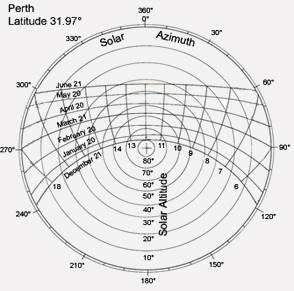
Here's a solar chart for perth - these are a very useful tool for designing buildings and are incredibly accurate. e.g. if you look at the 21 March sun path and draw a line from the centre out to say where it touches the outer circle that is the bearing at either sunrise (exactly due east) or sunset (exactly due west) with the total sunlight hours being 12 (6am to 6pm). it also gives you the sun's altitude in the sky e.g. at 11 oclock today the sun was at approx 27degrees East of North at an horizontal altitude of 55deg . You can actually see just how large the spread is from Summer sunrise/sunset position to winter sunrise/sunset position respectively.

These diagrams are specific for latitude so I cannot use Perth's one for say Darwin.


Argh hang on you're in Victoria on daylight saving so you get an extra hour of sunlight each day
RiffRaff
RiffRaff
WA
265 posts
WA, 265 posts
21 Mar 2014 10:05pm
No
billykiter
billykiter
WA
303 posts
WA, 303 posts
21 Mar 2014 10:59pm
No they don't. The one simple answer is refraction. The poles will never have the same amount of light as the tropics because of the way light bends through the atmosphere.
Razzonater
Razzonater
2224 posts
2224 posts
21 Mar 2014 11:11pm
No, places such as Finland have midnight sun, then darkness in winter, it doesn't even out over the year to be the same as Australia for example
Mark _australia
Mark _australia
WA
23688 posts
WA, 23688 posts
22 Mar 2014 9:35am

Aren't we talking about the same number of light HOURS. Not intensity (refraction) or how hot it is (closer to sun at equator). Hours.


I say not quite, as it is not a sphere.
(Oblate spheroid, if anyone cares)

But so damn close we may as well call it equal
sausage
sausage
QLD
4874 posts
QLD, 4874 posts
22 Mar 2014 11:45am
Having reread your original query (and I see Mark A above has beat me to it), am I right in assuming you meant the total accumulated hours of sunlight falling anywhere on earth would be equal for a calendar year i.e. the equator gets an even spread of 12 hours x 365days which equals 4380 hours of sunlight, whereas for the sake of this exercise the poles gets an irregular spread and say an average of 24hours x 182.5days which equals 4380hours of sunlight. So interpolating between the poles and the equator one could assume this may be the case. It's an interesting question but I'm not sure my unscientific theory has any validity.
Toph
Toph
WA
1890 posts
WA, 1890 posts
22 Mar 2014 10:27am
From Wiki

The naive expectation is that, for every place on Earth, the Sun will appear to be above the horizon for exactly half the time. Thus, for a standard year consisting of 8760 hours, apparent maximal daytime duration would be 4380 hours. However, there are physical and astronomical effects which change that picture. Namely, atmospheric refraction allows the Sun to be still visible even when it physically sets below the horizon line. For that reason, average daytime (disregarding cloud effects) is longest in polar areas, where the apparent Sun spends the most time around the horizon. Places on the Arctic Circle have the longest total annual daytime of 4647 hours, while the North Pole receives 4575. Because of elliptic nature of the Earth's orbit, the Southern Hemisphere is not symmetrical: Antarctic Circle at 4530 hours receives 5 days less of sunshine than its antipodes. The Equator has the total daytime of 4422 hours per year.[2]


It does then go on to talk about definitions and measurements in a practical sense using sunshine hours as oppose to sunlight hours - using a device called, wait for it........ a sunshine recorder- to take into account visible sunlight due refraction and other bits and pieces. But I think on strict terms based on Sandfoots original question, this is the answer.


I was surprised that the poles got more sunlight on average then the equator...


Toph
Toph
WA
1890 posts
WA, 1890 posts
22 Mar 2014 10:28am
this is the link

en.wikipedia.org/wiki/Sunshine_duration

Mark _australia
Mark _australia
WA
23688 posts
WA, 23688 posts
22 Mar 2014 1:33pm
^^^ very interesting.

I also liked the bits about how often it is sunny


Since sunshine duration depends chiefly on concentration of clouds and fog in the observed area, locations with arid climate naturally correlate with high sunshine duration values, and, conversely, lowest values of sunshine duration are encountered in areas with wet, west-coast oceanic climate.

The two areas with highest sunshine duration in the World, measured as annual average, are southwestern United States (Arizona and Nevada) and northeastern Africa (Egypt, Sudan and Chad).[4] The city claiming the title of the sunniest in the World is Yuma, Arizona, with over 4,000 hours (90% of time) of bright sunshine annually.[4][5] The sunniest month in the World is May in the base of Eureka in the far north of Canada, which receives 16.5 hours of bright sun daily

evlPanda
evlPanda
NSW
9207 posts
NSW, 9207 posts
22 Mar 2014 6:56pm
sausage said..

Well today here on the tropic of Capricorn we got exactly 12 hours of sunlight as it's the autumn equinox today. Reciprocally it's the Spring equinox in the northern hemisphere. From tomorrow our Daylight hours will now be getting less than 12 hours per day. Of course the daylight hours have been getting shorter since the summer solstice on the 21st of December when in the southern hemisphere you receive the max amount of daylight hours - the further south you are from the equator the greater this amount is but is indirectly proportional to the amount you receive once the earth has done half an orbit around the sun - this is when the winter solstice occurs (21 June).


Everywhere has 12 hours of sunlight today.


Everywhere has the same amount of sunlight each year. The angle differs, as does the weather, and you won't get any sunlight if you live down a mine, but everywhere gets the same amount of sun in the sky each year.
Ian K
Ian K
WA
4170 posts
WA, 4170 posts
22 Mar 2014 4:47pm
evlPanda said..


Everywhere has 12 hours of sunlight today.


Everywhere has the same amount of sunlight each year. The angle differs, as does the weather, and you won't get any sunlight if you live down a mine, but everywhere gets the same amount of sun in the sky each year.


I've given you a green thumb to cancel out the red one Evil. Of course everyone gets 12 hours today. The original question was geometric, everyone knows the earth is perfectly round and the sun is a point source at infinity. If you reckon you only got 11hrs 58mins today you're living down a mineshaft with apostrophe man.

NotWal
NotWal
QLD
7436 posts
QLD, 7436 posts
22 Mar 2014 6:50pm
^ Yes but the intensity (photons per unit area) in the tropics is much higher than the intensity in the arctic/antarctic.
In the land of the midnight sun the sun is never far above the horizon. It's like a six month long late afternoon followed by six months of night.
Your SolaRez wouldn't work. Chewing gum probably would.
dinsdale
dinsdale
WA
1227 posts
WA, 1227 posts
22 Mar 2014 8:49pm
Sandfoot said..
... as we live on a near perfectly round ball.
Cheers.

No we don't!! We live on an oblate spheroid, or even more accurately, a geoid. "Near perfectly round" it most definitely ain't!
NotWal
NotWal
QLD
7436 posts
QLD, 7436 posts
22 Mar 2014 11:58pm
dinsdale said..

Sandfoot said..
... as we live on a near perfectly round ball.
Cheers.

No we don't!! We live on an oblate spheroid, or even more accurately, a geoid. "Near perfectly round" it most definitely ain't!


There's only 42 km difference between the equatorial diameter and the polar diameter. That's 0.33% off perfectly spherical (ignoring surface roughness). I think that can be reasonably described as "near perfectly round"
Mark _australia
Mark _australia
WA
23688 posts
WA, 23688 posts
22 Mar 2014 10:53pm


^^^ didn't I say whaaaaay back that it is an oblate spheroid, but the difference from a sphere is negligable.
Geez people, switch on


Now Notwal if you are going to bring up 'surface roughness', that affects circumference, which means gravity varies, and light will bend................
Poodle
Poodle
WA
868 posts
WA, 868 posts
22 Mar 2014 11:47pm
RiffRaff said..

No


No.
Mark _australia
Mark _australia
WA
23688 posts
WA, 23688 posts
22 Mar 2014 11:50pm
Poodle said..
RiffRaff said..


No

No.


Or in WA...

"yeaahh, nahhh"

evlPanda
evlPanda
NSW
9207 posts
NSW, 9207 posts
24 Mar 2014 11:36am
Ian K said..

evlPanda said..


Everywhere has 12 hours of sunlight today.


Everywhere has the same amount of sunlight each year. The angle differs, as does the weather, and you won't get any sunlight if you live down a mine, but everywhere gets the same amount of sun in the sky each year.


I've given you a green thumb to cancel out the red one Evil. Of course everyone gets 12 hours today. The original question was geometric, everyone knows the earth is perfectly round and the sun is a point source at infinity. If you reckon you only got 11hrs 58mins today you're living down a mineshaft with apostrophe man.


And now you had two red thumbs?

The original question was...

Does every point on earth receive the same amount of daylight hours?


If it's not a trick question involving mountain ranges, mine shafts and clouds then the answer is a simple "Yes".

___

While on the topic of spheres I saw a great analogy on how to understand if space is curved or flat.

The sum of the angles that make up a triangle always add to 180 degrees.
However, if you make a large enough triangle on the surface of the earth that's not the case.

From the North Pole draw a line straight down to the equator.
Then turn left 90 degrees
Go around the equator 1/4 of the way around the Earth.
Turn left 90 degrees.
Go all the way back up to the North Pole.

You have 3x 90 degree angles.

The Earth therefore is not flat. I thought this was kinda cool : \
billykiter
billykiter
WA
303 posts
WA, 303 posts
24 Mar 2014 1:28pm
evlPanda said..
Ian K said..


evlPanda said..


Everywhere has 12 hours of sunlight today.


Everywhere has the same amount of sunlight each year. The angle differs, as does the weather, and you won't get any sunlight if you live down a mine, but everywhere gets the same amount of sun in the sky each year.


I've given you a green thumb to cancel out the red one Evil. Of course everyone gets 12 hours today. The original question was geometric, everyone knows the earth is perfectly round and the sun is a point source at infinity. If you reckon you only got 11hrs 58mins today you're living down a mineshaft with apostrophe man.


And now you had two red thumbs?The original question was...
Does every point on earth receive the same amount of daylight hours?


If it's not a trick question involving mountain ranges, mine shafts and clouds then the answer is a simple "Yes".

___

While on the topic of spheres I saw a great analogy on how to understand if space is curved or flat.

The sum of the angles that make up a triangle always add to 180 degrees.

However, if you make a large enough triangle on the surface of the earth that's not the case.

From the North Pole draw a line straight down to the equator.

Then turn left 90 degreesGo around the equator 1/4 of the way around the Earth.

Turn left 90 degrees.Go all the way back up to the North Pole.

You have 3x 90 degree angles.

The Earth therefore is not flat. I thought this was kinda cool : \


No they don't. Refraction causes light to bend. I was wrong with what i previously said before as the poles actually get more light due to refraction not the other way around. this is the amount of day light, I'm not talking about the intensity of light. refraction means that the sun may be over the horison however because the atmoshere makes light bend, you will still be able to see the sun. if light wasn't effected by the atmoshere (refraction) then the answer to the question would be yes. Understand? this is another reason why the moon is large when you see it just over the horizon and also the reason why the sun appears to set very quickly compared the usual speed it moves across the sky.
sausage
sausage
QLD
4874 posts
QLD, 4874 posts
24 Mar 2014 3:47pm
billykiter said..
this is another reason why the moon is large when you see it just over the horizon and also the reason why the sun appears to set very quickly compared the usual speed it moves across the sky.


Refraction has nothing to do with it - I think you'll find that the moon looks large on the horizon because there are reference points such as islands etc to compare but high in the sky the human eye has nothing to scale it against. Next time the moon is on the horizon hold your arm out full stretch and pinch your fingers together and then do the same when high in the sky - not exactly scientific but you'll find it no smaller than when you measured it on the horizon. en.wikipedia.org/wiki/Moon_illusion

The same goes for the speed of the sun setting - it's travelling no faster at sunrise or sunset than during the other times of day - it's just that you have a horizon to reference the earth's spin on its axis.

PS - I would have thought light refraction should in fact (infinitesimally) slow the rate of sunrise /sunset relative to the observer.

interesting link re: original topic en.wikipedia.org/wiki/Day_length
Mark _australia
Mark _australia
WA
23688 posts
WA, 23688 posts
24 Mar 2014 2:26pm
Toph said..
this is the linken.wikipedia.org/wiki/Sunshine_duration


did everyone miss this???
Chris6791
Chris6791
WA
3271 posts
WA, 3271 posts
24 Mar 2014 5:04pm
evlPanda said..

Ian K said..

evlPanda said..


Everywhere has 12 hours of sunlight today.


Everywhere has the same amount of sunlight each year. The angle differs, as does the weather, and you won't get any sunlight if you live down a mine, but everywhere gets the same amount of sun in the sky each year.


I've given you a green thumb to cancel out the red one Evil. Of course everyone gets 12 hours today. The original question was geometric, everyone knows the earth is perfectly round and the sun is a point source at infinity. If you reckon you only got 11hrs 58mins today you're living down a mineshaft with apostrophe man.


And now you had two red thumbs?

The original question was...

Does every point on earth receive the same amount of daylight hours?


If it's not a trick question involving mountain ranges, mine shafts and clouds then the answer is a simple "Yes".

___

While on the topic of spheres I saw a great analogy on how to understand if space is curved or flat.

The sum of the angles that make up a triangle always add to 180 degrees.
However, if you make a large enough triangle on the surface of the earth that's not the case.

From the North Pole draw a line straight down to the equator.
Then turn left 90 degrees
Go around the equator 1/4 of the way around the Earth.
Turn left 90 degrees.
Go all the way back up to the North Pole.

You have 3x 90 degree angles.

The Earth therefore is not flat. I thought this was kinda cool : \

If I understand you right you aren't drawing a two dimensional triangle with all angles adding up to 180 degrees, you are actually drawing a funky triangle that is actually three dimensional, more like the shape of a Dorito? Or, if you are slicing through the earth from your three points to get a flat triangle, and if that's the case your angles aren't 90 degrees each anymore.
Please Register, or first...
Topics Subscribe Reply