Is a Human Powered Helicopter Possible?

> 10 years ago
Reply
Register to post, see what you've read, and subscribe to topics.
evlPanda
evlPanda
NSW
9207 posts
NSW, 9207 posts
12 Jul 2013 6:07pm
Yes.

smicko
smicko
WA
2503 posts
WA, 2503 posts
12 Jul 2013 4:32pm
**** me Macro's gonna have his surfcat in the stratosphere in no time, imagine if you made the blades out of solar panels AND had nutri grain for breakie!!!
Chris6791
Chris6791
WA
3271 posts
WA, 3271 posts
12 Jul 2013 5:29pm
Nifty little science project, I'm impressed.
youngbull
youngbull
QLD
826 posts
QLD, 826 posts
12 Jul 2013 7:33pm
Not picking.

Its a multi-rotor not a true helicopter.
Good on them for their hard work and effort.

IMO the record is still unbroken as a few fellow enthusiast will know what I mean.
Stuthepirate
Stuthepirate
SA
3591 posts
SA, 3591 posts
12 Jul 2013 8:02pm
Awesome.
I can see that saving me parking space and commute time in the city.
Mark _australia
Mark _australia
WA
23680 posts
WA, 23680 posts
12 Jul 2013 6:55pm
Leonardo just had an orgasm.

Macroscien
Macroscien
QLD
6809 posts
QLD, 6809 posts
12 Jul 2013 9:10pm
As a proof of concept two counter rotating wings could be enough.

Theoretically if human could power airplane why not small helicopter. (?) We could generate 700W of power for an extended time.

That is pity. $250,000 prize money gone I was sure my catamaran could fly

As for my catamaran I tough one day that having hovercraft capability could be quite convenient on Gold Coast. I recently (last weekend) stack on the sand bar in 10 cm deep water but because whole thing is extremely light ( 120 kg) there wasn't big problem to drag it over sand bar to another side.

There are still some money waiting for us : Kremer prize for human powered flight

There are currently three Kremer Prizes that have not yet been awarded, for a total of ?150,000.
26 mile Marathon course in under an hour (?50,000),
Sporting aircraft challenge stressing maneuverability (?100,000),

FormulaNova
FormulaNova
WA
15101 posts
WA, 15101 posts
12 Jul 2013 10:18pm
Macroscien said..

As a proof of concept two counter rotating wings could be enough.

Theoretically if human could power airplane why not small helicopter. (?) We could generate 700W of power for an extended time.


Well, in that video, it was in a controlled environment with a really efficient setup, with a very strong cyclist, so I am not sure it is really very easy at all.

I can't remember the exact figures, but trying to continuously provide an reasonable amount of power for a long time is very difficult. A quick google tells me that your guess of producing 700w for an extended time is way off.

The cycling machines at the local gym tell you how much energy you are using and I remember thinking that the output a good cyclist can produce was way different to what I could do.

Macroscien
Macroscien
QLD
6809 posts
QLD, 6809 posts
13 Jul 2013 2:29am
FormulaNova said..


I can't remember the exact figures, but trying to continuously provide an reasonable amount of power for a long time is very difficult. A quick google tells me that your guess of producing 700w for an extended time is way off.


Normally we could output 1/3 to 1-2 of that 700W but as you could see on the video guy doesn't look like during Olympic sports event.;

Another one the flew over English channel also managed to deliver over extended period of time.
So 150-250W would be appropriate, but if you are properly motivated I guess we could produce much more for longer.

75W is average useful output for laborer in 8 hour shift.

Peak power for 30 second for normal healthy men 909W , and double that for pro athlete.

Good physical exercise : 500W including produced heat and you could sustain is for an hour.


I wonder how much energy if cost me sailing for 1 hour on slalom board On ordinary free ride I could sail for hours but on slalom I am completely flat out after just one
FormulaNova
FormulaNova
WA
15101 posts
WA, 15101 posts
13 Jul 2013 12:56am
Macroscien said..

FormulaNova said..


I can't remember the exact figures, but trying to continuously provide an reasonable amount of power for a long time is very difficult. A quick google tells me that your guess of producing 700w for an extended time is way off.


Normally we could output 1/3 to 1-2 of that 700W but as you could see on the video guy doesn't look like during Olympic sports event.;

Another one the flew over English channel also managed to deliver over extended period of time.
So 150-250W would be appropriate, but if you are properly motivated I guess we could produce much more for longer.

75W is average useful output for laborer in 8 hour shift.

Peak power for 30 second for normal healthy men 909W , and double that for pro athlete.

Good physical exercise : 500W including produced heat and you could sustain is for an hour.


I wonder how much energy if cost me sailing for 1 hour on slalom board On ordinary free ride I could sail for hours but on slalom I am completely flat out after just one


I even doubt the abilities of most people to put out 200W for a sustained period. I can't quite understand your comment about Olympics, but that guy is certainly a cyclist and not some random guy chosen off of the street. He has the legs of a cyclist.

Where are you getting your figures from for peak power? Are they the total energy a person expends or just the amount of energy they can put into a bike? They sound way too high.

Also, the amount of energy needed for a helicopter would be way more than for an aeroplane.
Craig66
Craig66
NSW
2466 posts
NSW, 2466 posts
13 Jul 2013 9:22am
FormulaNova said..


Macroscien said..


FormulaNova said..


I can't remember the exact figures, but trying to continuously provide an reasonable amount of power for a long time is very difficult. A quick google tells me that your guess of producing 700w for an extended time is way off.


Normally we could output 1/3 to 1-2 of that 700W but as you could see on the video guy doesn't look like during Olympic sports event.;

Another one the flew over English channel also managed to deliver over extended period of time.
So 150-250W would be appropriate, but if you are properly motivated I guess we could produce much more for longer.

75W is average useful output for laborer in 8 hour shift.

Peak power for 30 second for normal healthy men 909W , and double that for pro athlete.

Good physical exercise : 500W including produced heat and you could sustain is for an hour.


I wonder how much energy if cost me sailing for 1 hour on slalom board On ordinary free ride I could sail for hours but on slalom I am completely flat out after just one


I even doubt the abilities of most people to put out 200W for a sustained period. I can't quite understand your comment about Olympics, but that guy is certainly a cyclist and not some random guy chosen off of the street. He has the legs of a cyclist.

Where are you getting your figures from for peak power? Are they the total energy a person expends or just the amount of energy they can put into a bike? They sound way too high.

Also, the amount of energy needed for a helicopter would be way more than for an aeroplane.


FormulaNova you are missing the point


"Macroscien said
As for my catamaran I tough one day that having hovercraft capability could be quite convenient on Gold Coast. I recently (last weekend) stack on the sand bar in 10 cm deep water but because whole thing is extremely light ( 120 kg) there wasn't big problem to drag it over sand bar to another side."

You are in a debate with a guy that not only has the skill to push heavy objects but also has a tallent of parking said heavy object on a sand bar.

He is just like me, Not very bright but can lift heavy weights

Ps great video Panda
deejay8204
deejay8204
QLD
557 posts
QLD, 557 posts
13 Jul 2013 9:24am
youngbull said..

Not picking.

Its a multi-rotor not a true helicopter.
Good on them for their hard work and effort.

IMO the record is still unbroken as a few fellow enthusiast will know what I mean.


Yep definitely not a true helicopter. but a really good multi-rotor. If they were to be able to store the energy by attaching to a flywheel of some sort he would be able to take a short break between cycling to conserve his energy.
Craig66
Craig66
NSW
2466 posts
NSW, 2466 posts
13 Jul 2013 9:31am
deejay8204 said..


youngbull said..

Not picking.

Its a multi-rotor not a true helicopter.
Good on them for their hard work and effort.

IMO the record is still unbroken as a few fellow enthusiast will know what I mean.


Yep definitely not a true helicopter. but a really good multi-rotor. If they were to be able to store the energy from the cyclist he would be able to take a short break between cycling. or have it attached to a flywheel of some sort.


Here's a thought, if they could in some way change the shape a little, put a motor in it, say a few seats, the cyclist could go on a scenic flight with a peddling at all
Ian K
Ian K
WA
4169 posts
WA, 4169 posts
13 Jul 2013 8:48am
FormulaNova said...

Also, the amount of energy needed for a helicopter would be way more than for an aeroplane.


Not necessarily? It's all about optimising lift, drag and the speed of the wing. No good having great lift to drag if you have to move the wing too fast. Power = drag X velocity. It's also a battle between the size and weight of the wing vs. fragility. Maybe that's why regular helicopters go for small wings and high power. Fast planes also have small wings, but that doesn't matter because they get there quicker. The regular pedal powered plane loses because you have the drag of the wing plus the drag to turn the propellor. The helicopter wins because it doesn't need the propellor but loses because some parts of the wing move faster than optimum and others slower. The pedal helicopter also loses because it doesn't go anywhere. But maybe that's not important, it's the getting off the ground that matters.

(And of course it's a helicopter. Saying a helicopter stops at 2 rotors is just being sexist)
FormulaNova
FormulaNova
WA
15101 posts
WA, 15101 posts
13 Jul 2013 9:24am
Ian K said..

FormulaNova said...

Also, the amount of energy needed for a helicopter would be way more than for an aeroplane.


Not necessarily? It's all about optimising lift, drag and the speed of the wing. No good having great lift to drag if you have to move the wing too fast. Power = drag X velocity. It's also a battle between the size and weight of the wing vs. fragility. Maybe that's why regular helicopters go for small wings and high power. Fast planes also have small wings, but that doesn't matter because they get there quicker. The regular pedal powered plane loses because you have the drag of the wing plus the drag to turn the propellor. The helicopter wins because it doesn't need the propellor but loses because some parts of the wing move faster than optimum and others slower. The pedal helicopter also loses because it doesn't go anywhere. But maybe that's not important, it's the getting off the ground that matters.

(And of course it's a helicopter. Saying a helicopter stops at 2 rotors is just being sexist)


Ian you are one of the people on this forum that I would never argue physics with!

I assumed that a plane would require less energy to lift off, although, now I am not sure
Macroscien
Macroscien
QLD
6809 posts
QLD, 6809 posts
13 Jul 2013 12:04pm
Ian K said..

FormulaNova said...

Also, the amount of energy needed for a helicopter would be way more than for an aeroplane.


Not necessarily?

I agree.
IMO, Flight will be trade of air resistance and lifting force.
All power is provided by human muscle. Say 500W. Some is spent on fighting air resistance and one small component on fighting gravitational force. Because plane needs wings plus needs also propeller the total air resistance should be much higher as the total surface and weight, plus things that make some parts of machine less effective.
IMO properly design two long wings counter rotating on the rotor should do the trick of being the most efficient flying machine ( unfortunately for lifting only not horizontal flight) .
As to helicopter blades - because angular speed is always the same some parts work at optimal ratio - lift to drag, the rest doesn't and create more drag then lift.
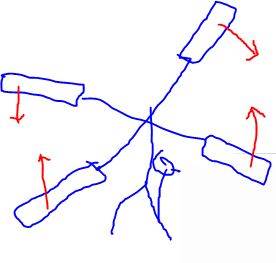
If I could built such helicopter I would strip whole thing to two wings attached on extension boom . This way wing -blade will operate at the distance of center but just transfer forces will be designed to minimalism drag.


pweedas
pweedas
WA
4642 posts
WA, 4642 posts
13 Jul 2013 12:37pm
FormulaNova said..
Also, the amount of energy needed for a helicopter would be way more than for an aeroplane.


I thought that too initially, but then on consideration I don't think so.

In an aeroplane, the rider has to continually overcome wind resistance to maintain forward speed.
If he can't maintain forward speed the plane drops out of the sky.
In the helicopter, there is no wind resistance from forward speed.
He is pretty much sitting in still air because in the vid shown, he is even outside the downdraft from the rotors. The only effort he has to supply is to drive the four low speed fans around.
If the helicopter was of the twin counter rotating blade type he would once again be in the downwash of the rotors and that would again be energy wasted just to overcome the wind resistance caused by that.
Same with a single central rotor plus if they had a single rotor they would have to waste more energy with a tail rotor to counteract rotational torque.

I think they have chosen the most efficient setup they could get, just to lift the rider off the ground.

Macroscien
Macroscien
QLD
6809 posts
QLD, 6809 posts
13 Jul 2013 3:16pm
pweedas said..

In an aeroplane, the rider has to continually overcome wind resistance to maintain forward speed.


that valid observation too.

In order to avoid turbulence in counter rotating blades I could see few option:
-separating blades at the vertical distance - say one set 1 or 2m meters above another
-separating blades in horizontal distance - on set longer then other
-Such asymmetrical blades that the one on the bottom further utilize turbulence and flow caused by upper one ( what actually frying insect do with big advantage and birds possibly too ) . In such design the upper one is design for laminar flow, the bottom one for turbulent, alternated flow.

Advantage of single axis counter rotating blades / wing is safety. In the case of engine malfunction still should allow for relatively safe landing. In two or more configuration malfunction of single rotor will cause asymmetric lifting force and crash landing ( unless you multiply rotors for 6 or more.

IMO good designed helicopter should allow for flying platform above the city that could stay days and night over same spot. Thin tether cable could supply electricity from ground or solar panels.
youngbull
youngbull
QLD
826 posts
QLD, 826 posts
13 Jul 2013 7:13pm
Ian K said..

FormulaNova said...

Also, the amount of energy needed for a helicopter would be way more than for an aeroplane.


Not necessarily? It's all about optimising lift, drag and the speed of the wing. No good having great lift to drag if you have to move the wing too fast. Power = drag X velocity. It's also a battle between the size and weight of the wing vs. fragility. Maybe that's why regular helicopters go for small wings and high power. Fast planes also have small wings, but that doesn't matter because they get there quicker. The regular pedal powered plane loses because you have the drag of the wing plus the drag to turn the propellor. The helicopter wins because it doesn't need the propellor but loses because some parts of the wing move faster than optimum and others slower. The pedal helicopter also loses because it doesn't go anywhere. But maybe that's not important, it's the getting off the ground that matters.

(And of course it's a helicopter. Saying a helicopter stops at 2 rotors is just being sexist)


Ahh but in this particular build the Multi-rotor can not travel in any direction, only up.
Therefor making it a ??? Powered balloon??? Not really sure on what you would officially call it. But it still aint no heli
seanhogan
seanhogan
QLD
3424 posts
QLD, 3424 posts
13 Jul 2013 7:58pm
Macroscien said..


If I could built such helicopter I would strip whole thing to two wings attached on extension boom . This way wing -blade will operate at the distance of center but just transfer forces will be designed to minimalism drag.


I think you need Barn to help you out with the drawing... this one is not very convincing...
Macroscien
Macroscien
QLD
6809 posts
QLD, 6809 posts
13 Jul 2013 9:32pm
seanhogan said..

Macroscien said..


If I could built such helicopter I would strip whole thing to two wings attached on extension boom . This way wing -blade will operate at the distance of center but just transfer forces will be designed to minimalism drag.


I think you need Barn to help you out with the drawing... this one is not very convincing...


Agree If I have grand kids one day I could ask for help in drawing !!
Please Register, or first...
Topics Subscribe Reply