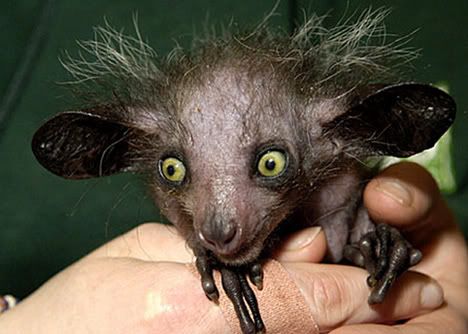
The Aye-aye is the only extant member of the genus Daubentonia and Daubentonia is the only genus in the family Daubentoniidae. So its oddly unique.
and
The Aye-aye is an endangered species not only because its habitat is being destroyed, but also due to native superstition. Besides being a general nuisance in villages, ancient Malagasy legend said that the Aye-aye was a symbol of death. It is viewed as a good omen in some areas, however, but these areas are a minority.
Researchers in Madagascar report remarkable fearlessness in the Aye-aye; some accounts tell of individual animals strolling nonchalantly in village streets or even walking right up to naturalists in the rainforest and sniffing their shoes. Therefore, it is no wonder that displaced animals often raid coconut plantations or steal food in villages. It is not unlike the Common Raccoon in this regard.
However, public contempt goes beyond this. The Aye-aye is often viewed as a harbinger of evil and killed on sight. Others believe that should one point its long middle finger at you, you were condemned to death. Some say the appearance of an Aye-aye in a village predicts the death of a villager, and the only way to prevent this is to kill the Aye-aye. The Sakalava people go so far as to claim Aye-ayes sneak into houses through the thatched roofs and murder the sleeping occupants by using their middle finger to puncture the victim's aorta.[4]
Incidents of Aye-aye killings increase every year as its forest habitats are destroyed and it is forced to raid plantations and villages. Because of the superstition surrounding it, this often ends in death. On the other hand, the superstition can prevent people from hunting them for food.
The Aye-aye is the only extant member of the genus Daubentonia and Daubentonia is the only genus in the family Daubentoniidae. So its oddly unique.
and
The Aye-aye is an endangered species not only because its habitat is being destroyed, but also due to native superstition. Besides being a general nuisance in villages, ancient Malagasy legend said that the Aye-aye was a symbol of death. It is viewed as a good omen in some areas, however, but these areas are a minority.
Researchers in Madagascar report remarkable fearlessness in the Aye-aye; some accounts tell of individual animals strolling nonchalantly in village streets or even walking right up to naturalists in the rainforest and sniffing their shoes. Therefore, it is no wonder that displaced animals often raid coconut plantations or steal food in villages. It is not unlike the Common Raccoon in this regard.
However, public contempt goes beyond this. The Aye-aye is often viewed as a harbinger of evil and killed on sight. Others believe that should one point its long middle finger at you, you were condemned to death. Some say the appearance of an Aye-aye in a village predicts the death of a villager, and the only way to prevent this is to kill the Aye-aye. The Sakalava people go so far as to claim Aye-ayes sneak into houses through the thatched roofs and murder the sleeping occupants by using their middle finger to puncture the victim's aorta.[4]
Incidents of Aye-aye killings increase every year as its forest habitats are destroyed and it is forced to raid plantations and villages. Because of the superstition surrounding it, this often ends in death. On the other hand, the superstition can prevent people from hunting them for food.
Nice one Wal, I was going to post that it was an Aye-Aye, but that was as far as I was going to go. Nice Work