10-11/4/09
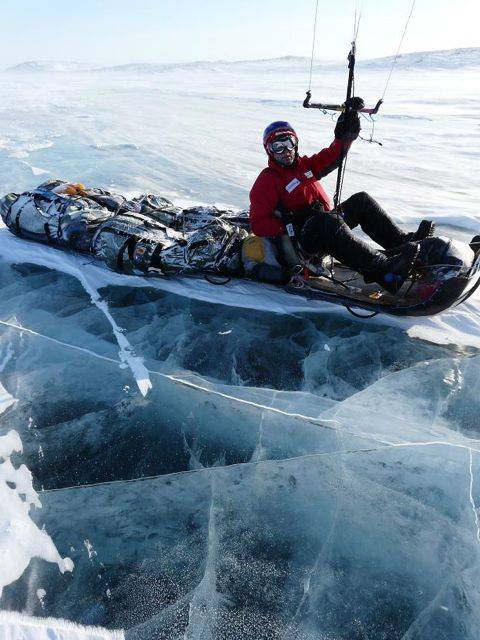
So last time we wrote Dave mentioned we were 140 kilometres out from Rankin Inlet with busted steering on our sled. Not a great situation, but we had a plan B - we’d built the sled to break down into two towable sleds in case something broke, then we could ski with kites and tow the sleds back to civilisation. Manesy and his friends drove back to Rankin the next day and we set about converting the sleds.
But to return to Rankin we needed the wind to turn. It was still blowing lightly from the South East, and there was now way we could sail straight into the wind. We’d been told by a number of locals that the wind nearly always blew from the North, so we decided to wait for a Northerly wind to blow us back to town. (The cabin by the way was little more than a tiny unheated plywood box that smelled of Caribou).
Two days later, the wind was still blowing as steadily from the southeast as the day we had arrived. Dave finished reading “Into the Land of White Death” and moved onto “The Great Escape”. With temperatures inside the cabin around -25 during the day, Dave also impressed with his ability to remain in his sleeping bag for up to 20 out of 24 hours in a day. The wait was a reminder of how at the mercy of the winds we were. We’d chosen Northwest Hudson Bay as it’s one of the windiest places in North America, and our route up to Baker lake had the escape plan of a returning prevailing wind. But for now the prevailing wind decided not to prevail.
After we got a forecast via Sat Phone predicting up to a week of Southerly winds, we packed up and headed north along our original route. We needed three solid days of Southerly winds to reach Baker Lake, otherwise we’d only be getting ourselves further away from civilisation.
Our hunting cabin sat on a tiny island in the middle of a frozen lake some forty kilometres across. We sailed north across the ice, then entered a narrow river valley with granite cliffs on each side.
Long journeys by kite are strange, hypnotic experiences. Unlike a sail on a yacht, a kite never stops moving, and on downwind runs you constantly trace figure-eight patterns in the sky with your kite. Somehow by making small adjustments in the way you trace these patterns you can optimise your speed, so you’re constantly adjusting your squiggles in the sky. It is a bit like staring at a giant hypnotist’s metronome for 12 hours a day and the effect I imagine is similar.
Around your feet are swirling rivers of wind-blown snow, travelling downwind with you. But as you’re travelling at the same speed as the wind, it feels eerily still.
It’s a delightful way to travel.
The wind got lighter and lighter, our progress slower and slower until finally we stopped, and our kites gently fell out of the sky and settled on the snow. We were fifty kilometres closer to Baker Lake, and fifty kilometres further away from Rankin Inlet.
Dave has been becalmed on yachts before, and said it’s not such a problem as you carry your home with you, and there’s always something that needs doing on a yacht.
On a kite-powered journey, being becalmed is like running out of petrol and having to camp by the side of the road. In the arctic though, there is no passing traffic, no hitchiking, and all you can do is sit and wait for the wind gods to fill up your tank.
As we made camp in a light fog, Wolves howled a few hundred metres away. We saw nothing, but in the morning found paw prints the size of my hand. Big doggy!….
Dave continues the story from where Ben left off….
So, we were becalmed 150km into the middle of arctic tundra, surrounded by wolves, and, as it turned out, running out of food. We’d left Rankin Inlet on a 2-3 day run to Baker Lake with food for roughly 12 days, but that was 7 days ago and we where currently going nowhere, very slowly, under a clear blue sky, with no signs of any wind at all. This presented us with 3 options:
1. Wait (eating as little as possible) for northerly wind, and head back to Rankin, staying put during southerly winds (N winds being allegedly predominant here).
2. Vice versa heading for Baker Lake (Noting that S winds had dominated the last week).
3. Attempt to man haul 150km either N or S (Depending on our best guess of which wind might assist us most), and burn about 3 times the calories of options 1 and 2.
We put off the decision till morning and shared a de-hydrated meal between us.
We awoke to clear still skies again, yet I was reminded of a moment in Captain Cook’s journals, when his ship was being inexorably drawn onto reefs in a dead calm, and he writes something like,
“…then a wind arose, that was so faint that we would not have noticed it at any other time.”
We hastily struck camp, and added double length lines on our kites, hoping to catch a few more knots of breeze higher up. It took ages to get both kites up, where even on the long lines, they pulled very weakly. We made a miserable 200m for our efforts. Oh well, exploring on foot, and sunbaking for the afternoon.
A satphone call to Pat informed us that NW wind was due overnight, so we resolved to get an early night, and rise with the wind, travelling in the dark if necessary.
In the morning we where under way, slowly at first, reversing our path through the labyrinth of frozen rivers and lakes. It was good to be moving again.
About lunchtime we came across a tiny cabin with 3 snowmobiles outside, and 3 Inuit watching (and videoing) our approach. We were warmly invited inside, where clear chunks of ice, freshly cut from the lake, melted in a teapot. John and his two nephews were out hunting for the weekend, and had spotted us earlier that morning, fascinated, they told us, by what they thought where huge birds or aircraft behaving strangely in the distance.
As we sipped our tea, and after the standard questions: Have you seen wolves, caribou, musk ox? tracks? going where? we got onto John’s childhood. He had been born in an igloo in the 50s, on a remote piece of coastline near Cambridge Bay. His mother gave birth to 8 children, in igloos, with only her husband helping. They continued living a semi-nomadic life until John was 12, following the Caribou, building fresh igloos each time they moved on. John proudly remembers his first kill, aged 10, when he shot a Caribou for his family while his father was away in hospital.
A topic that always seems to come up when we meet hunters, other than where the game is, is clothing. These guys all sport an impressive range of fur, with seal, beaver, wolf, and polar bear being popular for mitts, and wolf, wolverine, and dog being the usual choice for ruff. Caribou sleeping bags (fur side in) are apparently still in use. Modern light weight gear like ours is viewed with some wariness, and there is considerable interest in how we stay warm in an unheated tent without fur. Many people like our down jackets, but would all want a zipperless pullover version. Front zippers are very out of fashion up here (are you reading this Mountain Hardware?) because they leak cold air when your doing 80 kmh on your snowmobile.
Oversize gumboots seem to be the footwear of choice, preferably white, worn with thick knee-length felt liners. This thoroughly cool look is accessorised by a motley collection of old rifles. One I saw looked WW1 vintage, fitted with modern telescopic sights.
Ben and I are planning to be the talk of the Sydney fashion scene this winter with “Eskimo Chic”.
After our tea, the old Coleman stove was packed away onto a Komatik (sled towed by snowmobile) and the hunters sped off. We caught up to them a few miles further on, as they stopped to investigate a wolverine den, and a few miles after that after John had shot a wolverine. He said the fur was worth up to $800.
At 9pm we were still making good ground. As the sunset had almost completely faded in the south, we started to notice, like slow motion underwater effects, iridescent green cascades in the northern sky . The northern lights entertained us for a full hour with their mysterious pulsating. We stopped to pitch the tent at 10pm, having totalled about 11 hours of skiing that day, covering 110km, and felt sufficiently confident to go back onto full rations for the night, expecting to make the remaining 40 km into Rankin the following day.
To our immense frustration, we awoke to a blizzard from the south, re-instated half rations, and spent the day in a tent slowly being buried by snow and trying not to feel hungry. The blizzard had weakened somewhat to 20 knots the following morning, so we decided to try to make the remaining 40 km by tacking upwind through quite rough terrain.
An exhausting 8 hrs later, we’d made 10 km. Sharing our second last de-hy meal that night, we hoped against hope for a Northerly.
In the end, we arrived back in Rankin the following day on a moderate NW breeze, almost 2 weeks after we’d left, with one de-hy meal, one chocolate bar and some tea bags. As we trudged through the streets of Rankin towards food, we got the sense that word had got around about the two crazy Australians and their kites. Several people said they had seen us leave town and wondered where we had been. Manisee, Steve and John all stopped their pickups to greet us, and all said they had been watching the winds, and looking out for us.
Ben and I had identified early on on this trip that we’re both the type who are little bit glad when things don’t go as planned. We prefer having to deal with new challenges as they come up, rather than simply executing a plan, so, as we sipped our first bad filter coffee, we laughed at how much fun we’d just had, despite how far from the script the trip had gone, and resolved to take on the sea ice in the time we’ve got left…
Since Dave wrote this much more has happened, be sure to keep checking kitesled.com.