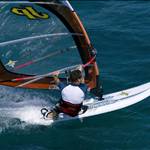
Since existing designs seems to reach their limitation allowing water based vehicles (boats, boards or kites) reach that magic 50 knots I propose completely different approach that allow to double or triple that. At this moment maximum speed which will be result of the drag and propelling forces and strictly limited by gravitational forces required to keep the system in balance. If you want to sail or ride kite faster by applying bigger propelling surface you will simply fly away.
Lets do such experiment ( maybe was made already - i don 't know)
Lets take that fastest known wind powered vehicle - I think that will be land yacht but we can relate to water based vehicle later - vehicle will speed up to the point when any further increase in sails size ( or airfoil) or wind speed will cause vehicle to tumble. I we now took this same land yacht and run bearings on the rails that allow to compensate all forces - up , sideways and down - the maximum speed will be limited only by aerodynamic properties of that specific design - we could apply as big sail - foil surface as we want- -we could use any wind speed -to the strongest cyclone category v included
Resultant speed will be limited only by design and material strength.
This way we could test limits of any designed sail or airfoils and measure forces in all directions.
Obviously we don't want to run our wind powered vehicles on the rails all the time but on the water or land. That is why we did measure forces in all 4 directions on out rail base system and replicate on designed land or water vehicle in such way that allow to compensate opposing forces. Then we need design and perfect devices that will create additional forces that glue this vehicle to the surface at any speed. That could be achieved by : -fins with winglets - that force vehicle down instead of lifting it up -aerodynamic designed board creating downward force -such configuration to the sail that create substantial vertical forces -combination or fins-winglets that compensate for lateral tumbling force
Resultant forces will be then combination of opposing vectors fin+board+ sail (foil or kite too Yes for kites same principia apply and fin with winglets or aerodynamic board should allow to compensate for hugely increased kite size and forces without a risk or loosing contact with surface. As usual in science I am open for critics and additional improvements proposals. Obviously it could also happens already (but so far didn't saw windsurfer or kites running in excess of 100 knots.)
We surely must eventually reach the point where the apparent wind is near as damn it directly on the nose (bow - not smelly). So you pull away, speed up, same problem. Methinks there must be some sort of quantum leap in wind power technology which is independent of apparent wind.

 ). So you pull away, speed up, same problem. Methinks there must be some sort of quantum leap in wind power technology which is independent of apparent wind.