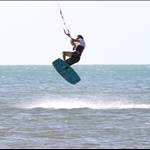
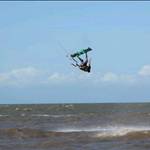
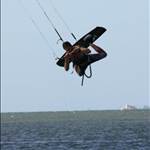
Dropping like a bomb

> 10 years ago
Reply
Register to post, see what you've read, and subscribe to topics.
dafish
dafish
NSW
1654 posts
NSW, 1654 posts
27 Sep 2012 8:03am
I generally like to ride waves, so I don't ride the tt too much. But having come back recently from a flatwater island island spot and having fun on the tt I want to explore this a bit more. I have had no trouble with bigger kites getting air and landing, nothing too exceptional, 4 meter +, nothing fancy etc. Yesterday I went out in my local conditions back home which is usually choppy, seldom have waves...its my go too after work for a quick session. Wind was 20 to 25 knots. I took out my 9 meter kite, I am about 82 kilos. I rode the tt first wanting to boost some airs. No problem getting the height, problem is I drop like a stone. How do I stop that? I revisited the progression series, but I am unclear about a couple of things. One, when you guys say that the kite needs to catch up to you, does that mean be in front of you as you are dropping? How does it catch you to slow the decent? Please don't ask me to loop the kite, not ready to pull the trigger on my 51 year old knees just yet. I have been studying it, but I think flatwater conditions will dictate whether I do or whether I chicken out on the looping.
Any advice will be greatly appreciated.
dafunk
dafunk
QLD
561 posts
QLD, 561 posts
27 Sep 2012 9:49am
what model kite were you using ?
Chris_M
Chris_M
2132 posts
2132 posts
27 Sep 2012 8:36am
As you reach the peak of your jump, direct the kite to 12, and keep the bar pulled in! If you let the bar out at the top of the jump, you will drop quickly.

The kite at 12 with bar pulled in will give you a soft landing, but to land with enough speed to keep planing, try redirecting the kite downwards as you are about to hit the water.

Have fun :)
eppo
eppo
WA
9793 posts
WA, 9793 posts
27 Sep 2012 9:49am
Mate you gotta tell us you kite type. Some kites need to the kept at 12, bar pulled in especially just as you land. Some like mine ask to be downlooped or cranked across the window at the last minute.

You are probably not pulling in the bar and also leaving the kite at 1 or flying it too soon past 12 to 10...

numbers based on a south wester heading out to sea in WA. rework for your situation.
dafish
dafish
NSW
1654 posts
NSW, 1654 posts
27 Sep 2012 12:53pm
Sorry, early morning brain freeze..my small kites, 7 and 9 are Slingshot Rev2's. Love em for the surf, but they kinda scare me in the air. I just need to figure this out so I can pull the trigger a little harder.
Also, I keep the bar sheeted in the whole time, I never seem to sheet it out even to adjust to anything. From the moment I send the kite to 11 ocklock its pulled in hard.
Also use standard lines, 25 meters give or take.
Thanks
Plummet
Plummet
4862 posts
4862 posts
27 Sep 2012 11:04am
Yep the boys advice above is correct. type of kite makes a huge difference to how you apply/time the technique.

To be fair the technique is the same.

blast in one direction.
send kit in opposite direction past zenith.
pull bar in and jump
reach apex of jump
redirect kite back in the direction you are going
dive kite down into powerzone land and ride away.

Without know your kite all i can do is guess and draw a parallel with my kites. In the smaller faster sizes . you hold the kite for longer at the sent position then redirect and dive it down fast as you come in to land. its pretty important to have the slam the bar in just before landing if you have let it out.
Plummet
Plummet
4862 posts
4862 posts
27 Sep 2012 11:15am
oops just seen you reply. I haven't flow revs. but sounds like your not re-directing. Redirect that kite hard.

Some more things to try.

Try different bar positions. you can end up stalling if the bar is allways in. Sometimes i find myself pump the bar like a poorn star to get the desired result.

Go faster. If you stall mid air you can drop hard. faster board speed into the jump will mean more forward speed in the air.

loop it! on the way down just pull hard on the front hand and hold on. ps you need to commit 100% to the loop or it hurts if you bail out mid loop.
suface2air
suface2air
QLD
701 posts
QLD, 701 posts
27 Sep 2012 1:21pm
I think you just aswered it in your reply dont pull bar till you are about to pop otherwise you kite is stalling on the way too zenith and when you are coming down shot that kite foward to pull you along istead of falling .
eppo
eppo
WA
9793 posts
WA, 9793 posts
27 Sep 2012 11:43am
Not familiar with revs but assume they are a more dedicated surf kite say like a REO right?

I try and gain board speed by tracking slightly downwind. So firstly I pull in before a jump to gain speed then almost slightly let off track down wind slightly dig in at last moment for pop. Tend to pull bar in after I have left water and as I ascend. I let off a bit near the apex to get that extra lift redirect to 12 as I drop generally pulling the bar in again but then I move it back to 1 then as I land shoot it fast across the window again. But that suites my kite.

Also mostly I would put it back to 12 then as i drop pull hard on right/left hand to downloop. With a fast kite and from the sounds of it the rev is learn to downloop it. Gotta have that skill on a sb anyhow to really crank in the surf or ya just mowing the lawn on a wave.
Chris6791
Chris6791
WA
3271 posts
WA, 3271 posts
27 Sep 2012 1:27pm
My Core GT's drop me like a rock. I'm almost ready to pull the trigger on a kite loop on the descent (but not yet), but apart from that the timing when I redirect/send it on landing is important if I want to keep moving.

Because I'm not yet game enough to pull the trigger on a loop on the descent between the apex and when I redirect it I sometimes 'wiggle' the kite back and forward across 12 o'clock, not much movement say 11:30 to 12:30 and only a couple of times, but it does seem to help slow the descent before I re-direct the kite proper.
gesper
gesper
NSW
518 posts
NSW, 518 posts
27 Sep 2012 5:14pm
At that windstrength and your weight an 11m would have given you more float when at the apex of your jump and less likely to drop you like a stone if you use the technique that Chris_M pointed out.
Had the same problems with a 2006 11m Fuel .It would rip you up and then at the apex of your jump it would drop you unless you kept the kite moving.
When smaller kites are used sometimes they can generate pull from how fast they can turn and get you up as high as if you used a bigger kite but you wont have the float that you will get with a bigger kite unless you keep the kite moving from 11.30 to 12.30 and dive the kite hard when your about to land
If you used that 9m in 25 to 30 knots i think you will find that you will have more float than what you had.
BTW noreaster was very gusty yesterday even up here.
dafish
dafish
NSW
1654 posts
NSW, 1654 posts
27 Sep 2012 6:32pm
Thanks guys, all good stuff to work on. I have no problem looping the kite with a surfboard to keep myself powered up, and I like downlooping carved turns. But when I am up in the air, its that marriage commitment thing. No backing out.
Hey Gerry, you are right about the bigger kite, with my 11.5 I don't seem to have the same issues. Hoping I can catch up with you this season for a few lessons on some serious hang time...I came back from Thailand early as I didn't like living there. Great place for a holiday, but few things beats Jervis Bay. Pretty spoiled really.
Okay, so its all about the speed, bar out when redirecting, pull in on pop, fly to zenith, redirect as I reach the summit. Down loop if I am feeling heroic, if not fly it across the window near zenith, then just before landing send it hard into the power zone.
You guys are great, thanks for the response.
Cheers
Andrash
Andrash
WA
637 posts
WA, 637 posts
27 Sep 2012 6:32pm
dafish said...

Sorry, early morning brain freeze..my small kites, 7 and 9 are Slingshot Rev2's. Love em for the surf, but they kinda scare me in the air. I just need to figure this out so I can pull the trigger a little harder.
Also, I keep the bar sheeted in the whole time, I never seem to sheet it out even to adjust to anything. From the moment I send the kite to 11 ocklock its pulled in hard.
Also use standard lines, 25 meters give or take.
Thanks


I had Rev's , 9m and 13. On each of them I had to extend the front line about 10cm to get the full power, low end and appropriate lift. Rev's are great jumping kites but not without that extension. Try it and let us know.
dafunk
dafunk
QLD
561 posts
QLD, 561 posts
27 Sep 2012 11:51pm
Ive not flown revs , my c4 does it too . so at a guess redirect earlier and while up there fly side to side vigorously .
SUPSurferQLD
SUPSurferQLD
QLD
339 posts
QLD, 339 posts
28 Sep 2012 8:01am
I know what you mean, you have to fly the revs more I found with my 9 rev 2. If it isnt square above your head, it will tend to just suck you back down into the water. I always had to keep mine up above me, almost at zenith, whenever I went big, otherwise I'd get spanked.
Andrash
Andrash
WA
637 posts
WA, 637 posts
28 Sep 2012 10:38am
breakzmaker said...

I know what you mean, you have to fly the revs more I found with my 9 rev 2. If it isnt square above your head, it will tend to just suck you back down into the water. I always had to keep mine up above me, almost at zenith, whenever I went big, otherwise I'd get spanked.


...it happens because the kite is not full sheeted in even with the bar pulled in, so you have to use the movement of the kite to generate power. This setting suits beginner intermediate kiters as they can't stall the kite even when fully sheeted. With extended front lines, the kite will fully sheet in and gives the float to the jump. However, with this setting the kite can stall and fly backwards when it is further in the power zone, e.g. after a crash, loosing control, wave riding.... Advanced riders who combine waves with jumps have to be aware of this to get the best of both worlds on a rev. I didn't find this problem on other kites, like Cats, RPM, Cult... what I flown last few years.
robbyb
robbyb
QLD
20 posts
QLD, 20 posts
28 Sep 2012 1:20pm
I have experienced being dropped like a rock with my 6m bws but with the bigger sizes have not had any problem. I have put it down to the obvious lack of surface area above your head but also because the thing is so fast you have to re-direct it at just the right moment to get a soft landing.

Exploring the down looping idea a bit more, is the idea to do a very tight down loop above your head just after the apex of the jump then once it has finished teh loop re-direct it for landing OR do a very late down loop completing the loop at you touch down. I have found the second method works well but can also imagine the first working but never tried it.
dafish
dafish
NSW
1654 posts
NSW, 1654 posts
28 Sep 2012 7:22pm
This is all very interesting...thanks for the continued input. Don't think I would add extensions to the front lines, maybe bring the back lines down two knots. I hate when the kite flys backwards, not a fan. I would be more inclined just to keep the kite moving above my head from 11 to 1, or slightly less. It does mean looking up at the kite to see where it is while practicing this.
I really like the idea of the downloop, its going to have to be a perfect day for me to commit the first time.
cheers
bjw
bjw
QLD
3691 posts
bjw bjw
QLD, 3691 posts
28 Sep 2012 7:49pm
So much red on Eppos post. I thought I better add to it, even though what you said made sense. Group think really!

eppo said...

Not familiar with revs but assume they are a more dedicated surf kite say like a REO right?

I try and gain board speed by tracking slightly downwind. So firstly I pull in before a jump to gain speed then almost slightly let off track down wind slightly dig in at last moment for pop. Tend to pull bar in after I have left water and as I ascend. I let off a bit near the apex to get that extra lift redirect to 12 as I drop generally pulling the bar in again but then I move it back to 1 then as I land shoot it fast across the window again. But that suites my kite.

Also mostly I would put it back to 12 then as i drop pull hard on right/left hand to downloop. With a fast kite and from the sounds of it the rev is learn to downloop it. Gotta have that skill on a sb anyhow to really crank in the surf or ya just mowing the lawn on a wave.


kiter zac
kiter zac
QLD
295 posts
QLD, 295 posts
29 Sep 2012 3:41pm
My advice would be to tune your kite properly. It's probably stalling while your in the air do your having trouble redirecting it for a smoot landing. Have your back lines equal length with your front when the bar is pulled in and your powered up fully.
mitch88
mitch88
NSW
271 posts
NSW, 271 posts
29 Sep 2012 4:19pm
good tip for big boosts. practice your landing and kite control on just small jumps than when you have that done gradually build your height up and confidence. it s a progressive thing and every session you will feel more confident and have more control. practice practice practice
Saffer
Saffer
VIC
4501 posts
VIC, 4501 posts
29 Sep 2012 4:31pm
Only flew the rev2 13m but the thing I can say about smaller kites is you need to fly them a little more than big kites because they don't have the same amount of float. I tend to send the kite, do the jump, redirect at the peak of the jump as i would normally but send it back again and the redirect forward hard before landing. It tends to be more of a problem on my 7m than the bigger kites.
Andrash
Andrash
WA
637 posts
WA, 637 posts
29 Sep 2012 3:47pm
kiter zac said...

........ Have your back lines equal length with your front when the bar is pulled in and your powered up fully.


It depends on the design of the kite. Even different models of the same brand may show differences, like the Slingy RPM and the Rev.
DM posted a very good explanation, now some years back, about tuning a kite... I don't have it but it is worth a search.
When a kite is just about back stalling (but not yet) it has the most exposure to the wind, and gives the best float for a jump (less response to bar movements, though). That point, in terms of bar position, is dependent on where the kite is in the wind window. Deeper in the window, and the more you need to keep the bar out (depower) to avoid the kite flying back. So the bar position which gives the most float during a jump will cause back stalling /( flying back) when you whack the kite across the wind window (bottom turn on waves).
It usually takes a bit of experience to get the most out of a kite, and it may need some tweaking, especially on older models. My Revs, for example, were quite frustrating at first, but the best all-rounders after some mods.
Landing a jump softly will also dependent on speed, that's why to send the kite forward before landing. But that wont happen easily if the kite is just about back stalling. So after a good float fully sheeted, you may need to depower somewhat to get the kite moving.
....in reality it's really simple common sence... in verbal explanation... it's not common, and it may not make sense ..
dafish
dafish
NSW
1654 posts
NSW, 1654 posts
29 Sep 2012 6:41pm
As I mentioned before, I have no problem jumping with bigger kites, its just that with the 9 and 7 I fall out of the sky. There are some great enlightening tips here for me, so again, thanks. With my 11.5 and other 12 meter kites I have flown I get plenty of hang time and easy smooth redirect. These Revs however are really whippy, the move fast, and the best explanation that has been given is that I am stalling the kite by sheeting too soon when I send it. Also, a few months ago during the peak of winter I went out to a flatwater spot on howling westerly, rode my 7 meter kite, it was over 30 knots, gusting in the low 40s. I hardly had to send it to get launched, and I do remember flying it from 11 to 1 to stay in the air. That is the only time I have flown that kite with a tt', and in those kind of winds. I prefer it as a surf kite. But I want to get the jumping aspect with a small kite down, hence coming here to learn. Perhaps a different kite will help with that, maybe a small kite that isn't so quick, who knows. But I am lacking in the technique as far as how I sheet and understanding the dynamics of where the kite should sit while I am on the way back down.
Again, that was another reason why I posed the question earlier, what does it mean when people say, " to have the kite catch up to you." Does that mean the kite is in front of you where you can see it, or behind you? I still don't have a clear idea what that means.
And finally, yes, it does take loads of practice, some heartache, hopefully not too much body ache, to get to the level of big air on small kites. I have the time, the patience, and hopefully a strong enough body to withstand the punishment to break through.....
cheers
kevinwd1
kevinwd1
QLD
125 posts
QLD, 125 posts
29 Sep 2012 9:11pm
I always had trouble landing jumps when just redirecting the kite especially in stronger winds. I solved this problem by learning how to down loop the kite just before landing. This gives me a much softer and more controllable landing especially when using smaller kites.
dafish
dafish
NSW
1654 posts
NSW, 1654 posts
29 Sep 2012 9:59pm
hmmm, by all reports, downlooping is the way to go...
So, when do you actually pull the trigger for the loop? Half way down, or just after apex? Or a meter or so before impact? I am gearing myself up for for the first trigger to pull.....(my insurance is up to date!)
eppo
eppo
WA
9793 posts
WA, 9793 posts
29 Sep 2012 8:12pm
Try it as the dude above just said first. Is it a fast kite? Give yourself enough room to bring the kite around at least. Couple of metres above the water. Really commit though, ya want that kite to really get back around and through the window past the 12 o'clock mark.

Also another little tip, as you start looping the kite with all ya might, look the opposite direction to the loop, or where you are going to go when you land. This can stop you following the kite with ya head. As your body follows ya head. Report back man.
giBiLatoR
giBiLatoR
QLD
147 posts
QLD, 147 posts
1 Oct 2012 8:08am
Thought id add something... Some kites do not respond well when sheeted in. Having never flown your kites can't comment on how they respond but its worth trying sheeting out fora really brief micro second whilst redirecting there kite, this will initiatea much quicker movement in the kite which will help generate lift for your landing.

I normally do this on smaller jumps but just depends on how far back the kite is in the window at the layer stages of the descent!

Also try looking up at your kite occasionally whilst your learning the motions (back and fourth) helped me back in the day!

Josh
kitecrazy
kitecrazy
QLD
70 posts
QLD, 70 posts
2 Oct 2012 11:30pm
check that your front lines are not stretched making the kite choke when the bar is pulled all the way in
Please Register, or first...
Topics Subscribe Reply