Kitehard said...Hey scrotus,
Best way to reduce your chances of gettin' bit is to tie a string of dead chickens to the reel leashes on all your kite buddies, then hose them all down in tuna blood before they launch .... you should be pretty right.

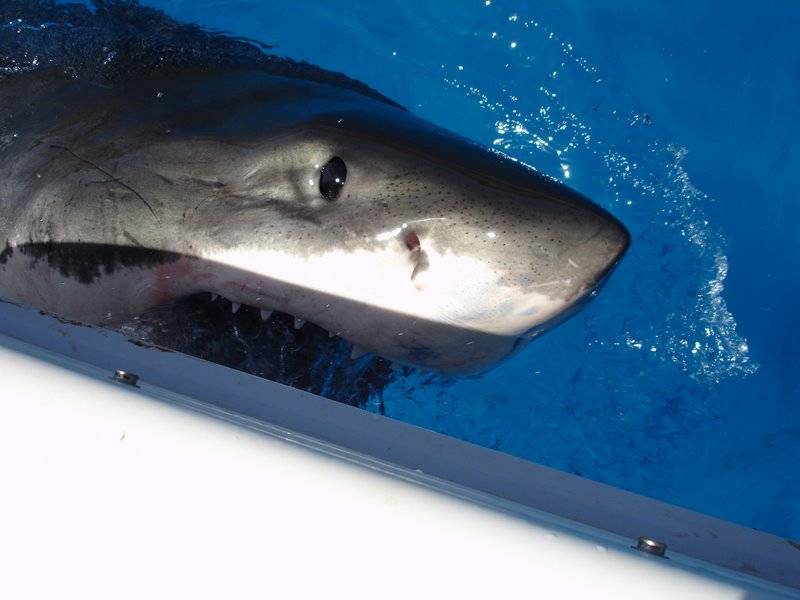
Shark shields don't work. Whilst testing a surfboard mounted SS pod, a Great White attacked and ate it. LOL
EPIC FAIL!Good winds,

I think you're a bit off the mark here mate, I expect the one that got bitten would have been a developmental unit ?
Read the following coroners report....
Findings in the matter of Paul BucklandCORONERS ACT, 1975 AS AMENDED
SOUTH
AUSTRALIA
FINDING OF INQUEST
An Inquest taken on behalf of our Sovereign Lady the Queen at Port Lincoln in
the State of South Australia, on the 17th day of March and the 11th day of April
2003, before Wayne Cromwell Chivell, a Coroner for the said State, concerning
the death of Paul William Buckland.
I, the said Coroner, find that, Paul William Buckland aged 23 years, late of 3/6
Bishop Street, Port Lincoln, South Australia died at sea off Smoky Bay, South
Australia on the 30th day of April 2002 as a result of exsanguination from
amputation of his right leg.
1. Introduction
1.1. On 30 April 2002 Paul William Buckland, then aged 23 years, was a
professional scallop fisherman. He operated a 6½ metre aluminium boat and
leased a scallop fishing licence from his brother.
1.2. On that day, Mr Buckland was fishing with Shannon Luke Jenzen in the
Great Australian Bight, off Smoky Bay, about 40 kilometres south of Ceduna.
1.3. The two men left Smoky Bay at about 7:30am and tried about four
locations without much success.
1.4. When they arrived at the fifth location, at about 11:30am, Mr Jenzen
began diving and found good quality fish in about 32 feet of water with good
visibility. Mr Jenzen dived for about an hour and came up at about 12:30pm,
at which time Mr Buckland replaced him in the water.
1.5. Mr Buckland had been diving for between five and ten minutes when
tragedy struck. Mr Jenzen described what happened as follows:
'I was sorting a catch and I was about three-quarters of the way down the
hose when I heard Bucky calling out to me, he was yelling my name. I
didn’t see him come up but I knew something was wrong. I think he was
saying "Shannon come quick". He was between 50 and 100 metres away. I
kicked the motors over and put it in gear and started to motor over to
him. The shark attacked virtually straight away and I saw it happening in
front of me. I saw that it was a white pointer and it had Bucky in its
jaws. It lunged out of the water and shaking its head and thrashing
around. It didn’t take Bucky under. I steamed up to the shark and it was
still attacking him it wouldn’t let him go. The shark was enormous it was
the size of the boat. The girth of it was huge. It was just thrashing him
on the top of the water. Bucky wasn’t screaming at all it was just so
violent. I reached him and hit the shark with the side of the boat. I went
around to the steps at the side got on the steps and pulled Bucky in. The
shark let go as I pulled Bucky in. As I pulled Bucky from the water I felt
the Shark Pod zapping me. If the pod is on it will give out little
electric shocks when it comes out of the water.
Bucky was still alive when I was pulling him in but I saw that his
injuries were so extensive. As I pulled him in he just said "get me in the
boat". He died pretty well straight after I had got him in.'
(Exhibit C1c, p2)
1.6. Unfortunately, the VHF radio on the boat was defective, and the mobile
telephone on the boat had a flat battery, so Mr Jenzen was unable to contact
the shore. He steered the boat back towards Smoky Bay, stopping on the way
to ask some fishermen to radio for an ambulance, which they did. He warned
other fishermen in the area to get their divers out of the water. He then
headed to the boat ramp and awaited the ambulance but it was clearly too
late for Mr Buckland.
2. Cause of death
2.1. A post-mortem examination of the body of the deceased was performed by
Professor R W Byard at the Forensic Science Centre on 2 May 2002. Professor
Byard noted that Mr Buckland’s right leg had been completely amputated
through the hip joint. There were also multiple irregular incised bite marks
of the buttocks and upper left leg.
2.2. Professor Byard commented:
'Death was due to exsanguination from amputation of the right leg through
the hip joint. This was associated with multiple incised wounds typical of
those found with shark attack. Further assessment of the bite marks will
be available in a separate odontology report (see attached). No underlying
organic diseases were present which could have caused or contributed to
death. There were no other significant traumatic injuries. Toxicology was
negative.'
(Exhibit C3a, p1)
2.3. Dr Helen James, Forensic Odontologist, examined Mr Buckland’s injuries,
and his wetsuit, bathers and diving vest. She concluded that the pattern of
wounds was consistent with the dentition of a great white shark. She was
unable to accurately determine its size (Exhibit C5a).
3. The shark repellent device
3.1. I have already mentioned Mr Jenzen’s evidence that Mr Buckland was
wearing a ‘Shark Pod’ at the time of the attack, and that it was functioning
as he pulled Mr Buckland out of the water.
3.2. I heard evidence from Ms Helena Wescombe-Down, the Commercial Manager
of Sea Change Technology Pty Ltd. Ms Wescombe-Down was previously a Managing
Director of Shark Protection Pty Ltd, the company which imported the ‘Shark
Pod’ device from South Africa. The device works as follows:
'The deterrent technology, which surrounds the user with an electrical
field, was developed by the Natal Sharks Board in Kwa Zulu Natal, South
Africa, approximately 10 years ago. It works by surrounding the user with
an electrical field, which impacts on special receptors in the snout of
the shark. These receptors, called the Ampullae of Lorenzini, appear as
many tiny black dots on the snout of the shark. The receptors are filled
with an electrically conductive gel that connects external electrical
fields to an array of nerves.
The shark repelling technology produces electrical field strengths that
impact on a shark’s central nervous system. As a shark approaches, the
impact of the field first creates discomfort, and then produces muscle
spasms causing the shark to flee the immediate area. A distinct advantage
of the unique electronic wave-form is that it only repels sharks.'
(Exhibit C10)
3.3. The ‘Shark Pod’ consists of three main components which are described
as the ‘main body’, in which the electronic componentry and the battery are
located, and which is attached to the air cylinder or the buoyancy vest of
the diver, the ‘fin electrode’ which attaches to the diving fin of the
diver, and the ‘hand switch’ which is a cable device which comes over the
divers shoulder and is attached to the front of the buoyancy vest.
3.4. The User Manual for the equipment states:
'Note: For maximum protection the diver unit should be left on for the
full duration of the dive. It may also be switched on, or off, at any
time under water.'
(Part of Exhibit C10, p7)
3.5. Ms Wescombe-Down said that in order to be fully effective, the
electrodes in the main body and the fin electrode need to be at least 1.5
metres apart (see the User Manual, page 6).
3.6. Mr Jenzen told me that when he and Mr Buckland used the device, the fin
electrode was actually attached to the airhose with a float, so that it was
above the diver’s head, rather than below him. He said that divers found
this more convenient, enabled them to get the electrodes further apart, and
avoid electric shocks to the legs (T15).
3.7. Mr Jenzen also told me that he and Mr Buckland were in the habit of
turning the unit off once they reached the sea bed, again to avoid shocks,
because they felt safest on the sea bed, and that they were most at risk
when ‘mid-water’ (T16). He also explained that this method reduced battery
consumption, although this was a less important factor (T17).
3.8. Ms Wescombe-Down explained that the problem with having the electrode
on the air hose is that because the hose is flexible, and is inclined to
bend, the electrodes become too close together and are less effective. This
is particularly the case when the diver is on or near the surface.
3.9. I also heard evidence from Senior Sergeant R B McDonald, the Officer in
Charge of the Water Operations Unit, part of the STAR Group, South Australia
Police. Senior Sergeant McDonald is a highly experienced diver and has been
in charge of the Water Operations Unit for about five years.
3.10. Senior Sergeant McDonald arranged for the ‘Shark Pod’ unit worn by Mr
Buckland to be tested at Sea Change Technology Pty Ltd on 22 May 2002. He
said the unit was tested alongside two others, including one owned by SA
Police. All three units performed satisfactorily and the battery, even three
weeks after the attack, was still carrying an effective charge (Exhibit C9,
p5).
3.11. Senior Sergeant McDonald explained shark behaviour when confronted
with a repellent device as follows:
'It is my belief and understanding that Great White sharks are generally
instinctive and unpredictable in their behavioural patterns. They are
known to have highly developed senses of smell, hearing and sight and
possess an ability to detect a presence through vibration from quite some
distance. Once the presence of something of interest is detected (a food
source) a shark will often commence to circle to further investigate.
During this stage if it passes through the electronic pulsating field
produced by the Shark Pod it is more than likely going to move away. As
the creature becomes more interested or excited during circling it may
begin to commence making passes of the object of interest thus using all
of its senses of smell, sound and sight. During this stage also it is more
than likely that it may be deterred by the presence of the electronic
pulsating field emitted by the Shark Pod. Eventually all of the various
stimuli associated with a food source will lock into place and the shark
reaches a point or level of excitement where it will attack. Attacks can
be in the form of a "mouthing" or "feeling" with its mouth or in the case
of Paul Buckland straight out attack. It is more than likely at this stage
that the wearing of any form of shark repellent device would have little
or no effect in discouraging a shark from attacking.'
(Exhibit C9, p2)
3.12. Senior Sergeant McDonald gave his opinion as to what happened to Mr
Buckland as follows:
'It is quite possible that this shark was in the vicinity or and aware of
the presence of Shannon Jenzen whilst he was underwater and could have
been circling and passing him without his knowledge. Because the Shark Pod
was turned off, the shark was not deterred. During the change over of
divers I feel that this partially interested or excited shark became more
excited and interested by the movement of Jenzen to the surface, movement
on the surface by both divers and then the descent of Buckland to the sea
floor. Scallop divers spend the greater majority of their time on the sea
bed looking down to identify and pick up scallops by hand. It is highly
likely that this shark continued to circle and pass Buckland undeterred by
his non activated Shark Pod. It would appear that after 5-10 minutes into
this dive which would ordinarily have lasted for at least an hour on the
bottom, Paul Buckland has spotted the shark, probably as it was making a
pass. By this stage the shark must have been quite excited or preparing to
attack. Instead of staying on the sea bed and making his way along the
bottom to a point directly below the vessel with his Shark Pod turned on,
he appears to have immediately left the bottom and commenced an ascent
switching his Shark Pod on as he went. In doing so he was surfaced 50-100
metres (a considerable distance) from the boat and called for assistance.
Once on the surface his Shark Pod is more than likely ineffective because
the second electrode designed to be fitted to his flipper or foot had been
fitted to his airline above his head. On the surface, this electrode would
have been out of the water thus preventing it from performing as designed
to produce the pulsating electronic field output.
Due to the distance that he has surfaced from the boat and the time that
it has taken for him to raise the alarm and for his partner to start up
and move to his location he was unable to get out of the water and away
from this shark. He was subsequently attacked by a single bite from this
shark as he waited on the surface and died a short time later aboard his
boat.'
(Exhibit C9, p3-4)
Senior Sergeant McDonald is very experienced in these matters, and I accept
this evidence.
3.13. Senior Sergeant McDonald also explained that once Mr Buckland reached
the surface, the electrode attached to the airhose would have been
ineffective since it was no longer fully submerged. Ms Wescombe-Down agreed,
although she stated that it might still have been partially effective since
the underside of the electrode would still have been in the water and so
might have sent out a smaller electronic pulse (T49).
3.14. This, combined with the fact that the airhose may have bent while on
the surface, thereby reducing the gap between the two electrodes and
rendering the device even less effective, may have combined to rob Mr
Buckland of the protection it might have otherwise provided.
4. Conclusions
4.1. Taking the above evidence into account, I form the following
conclusions:
· That Mr Buckland was wearing his ‘Shark Pod’ device incorrectly at the
time of the attack on 30 April 2002 in that the fin electrode, instead of
being attached to his fin, was attached to his airline supported by a
float which had the potential, particularly when he reached the surface,
to make the shark repellent device less effective;
· The practice, adopted by Mr Buckland and Mr Jenzen, of turning the
‘Shark Pod’ device off when they reached the sea bed and commenced
working, also reduced the potential effectiveness of the device in that it
failed to repel the shark during its initial investigation of their
presence.
5. Recommendations
5.1. The ‘Shark Pod’ device has now been superseded by a device called the
‘Shark Shield’. This is a device which was developed by Sea Change
Technology Pty Ltd using the same core technology under licence from the
Natal Sharks Board. Both Ms Wescombe-Down and Senior Sergeant McDonald told
me that this device is much more ‘user friendly’ than the ‘Shark Pod’, in
that it is lighter, easier to put on, and has better batteries. Senior
Sergeant McDonald told me that it is SAPOL policy for these units to be worn
by members of the Water Operations Unit when underwater in areas where the
presence of sharks may pose a risk. He said that when worn, the units are
switched on for the entire duration of the time spent underwater.
5.2. Taking into accounts Senior Sergeant McDonald’s comments, together with
the ‘testimonials’ from divers who use the equipment (including one from Mr
David Buckland, a brother of the deceased), it seems clear that this
equipment can be effective in repelling sharks in a significant proportion
of circumstances. Of course, having regard to the unpredictability of these
creatures, it cannot be said with certainty that the device will always be
effective in any circumstances. It seems to me, however, that both
commercial and recreational divers who dive in areas where they may
encounter sharks should be encouraged to wear this equipment. Ms
Wescombe-Down used an analogy with seatbelts and airbags in motor vehicles,
saying that although they will not guarantee that the passenger will survive
every crash, the chances of survival are enhanced. I agree that the same
applies to these devices.
5.3. I therefore recommend, pursuant to Section 25(2) of the Coroners Act,
that commercial and recreational divers, when operating in waters where
there is a risk of the presence of sharks, should wear a shark repellent
device of the ‘Shark Pod’ or ‘Shark Shield’ type, provided that the
equipment should be used in accordance with the manufacturers instructions,
and should be turned on for the entire duration of time in the water.
Key Words: Shark Attack; Diving - Underwater; Shark Repellent Technology
In witness whereof the said Coroner has hereunto set and subscribed his hand and
Seal the 11th day of April, 2003.
Coroner
Inquest Number 6/2003 (1099/2002)

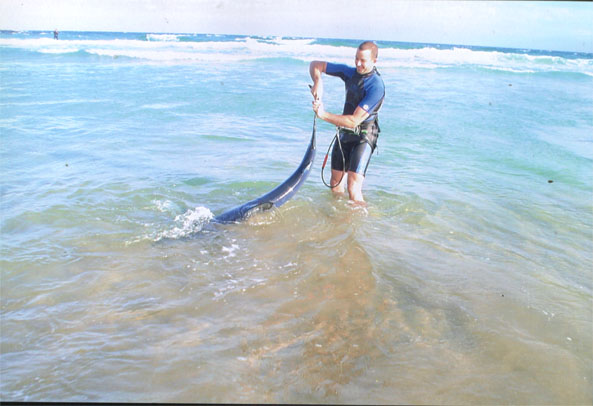

 as they are curious to what all the fuss is about !