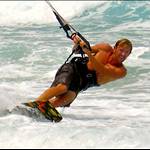
I've just finished building my second board. I'm using divinycel foam, unidirectional carbon, fibreglass and epoxy, and vacuum bagging it. It's a whole lot easier to do than I thought it would be.
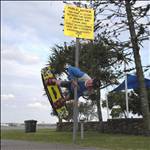
My first board was finished about 3 weeks ago. See picure at
www.seabreeze.com.au/gallery/gallery.asp?imageid=559 When I first made it, it was ultra-flexible, so much so that I put a whole lot more carbon onto the base. This gave it a really good amount of flex, and would load up really well for the jumps. I've never done such big jumps. Unfortunately I didn't test the flex in both directions, and it was still too bendy in the opposite direction to what you would normally see in a board - ie the tips could flex downwards. Given that the board was fairly short (122cm), this had two effects.
1 - when a gust hit, the board would flex that way, and start to turn me downwind, accelerating me even further.
2 - my board exploded last week. On landing a very big jump rather hard, the middle of the board stopped when it hit the water, but my feet kept going.
www.seabreeze.com.au/gallery/gallery.asp?imageid=560 My second board has come out really well. It looks for all the world like a bought one - really good smooth finish, concave base, nicely curved rails. I think it's probably too stiff this time, and I should have made the board thinner towards the tips. I've yet to get out on the water wth it, but this week is looking promising.
See the piccies here
www.seabreeze.com.au/gallery/gallery.asp?imageid=558 and here
www.seabreeze.com.au/gallery/gallery.asp?imageid=557 This second board took a week to make.
Having found how easy it is to do this, I won't bother messing around with ply wood. Only requirement is the vacuum bagging equipment, which you may be able to borrow somewhere.
Bring on the wind!
Brady

 I'm planning a 125 x 38 board - I will let you know how I go along the way
  - I always wish I had done industrial tech in High School now, but at least doing Graphics will pay off here
 lol - Pretty straight forward, but I'll keep my progress updated once I start (provided it's not windy)- Hope everyone got out on the weekend

 Honeslty i won't blow in your mouth.