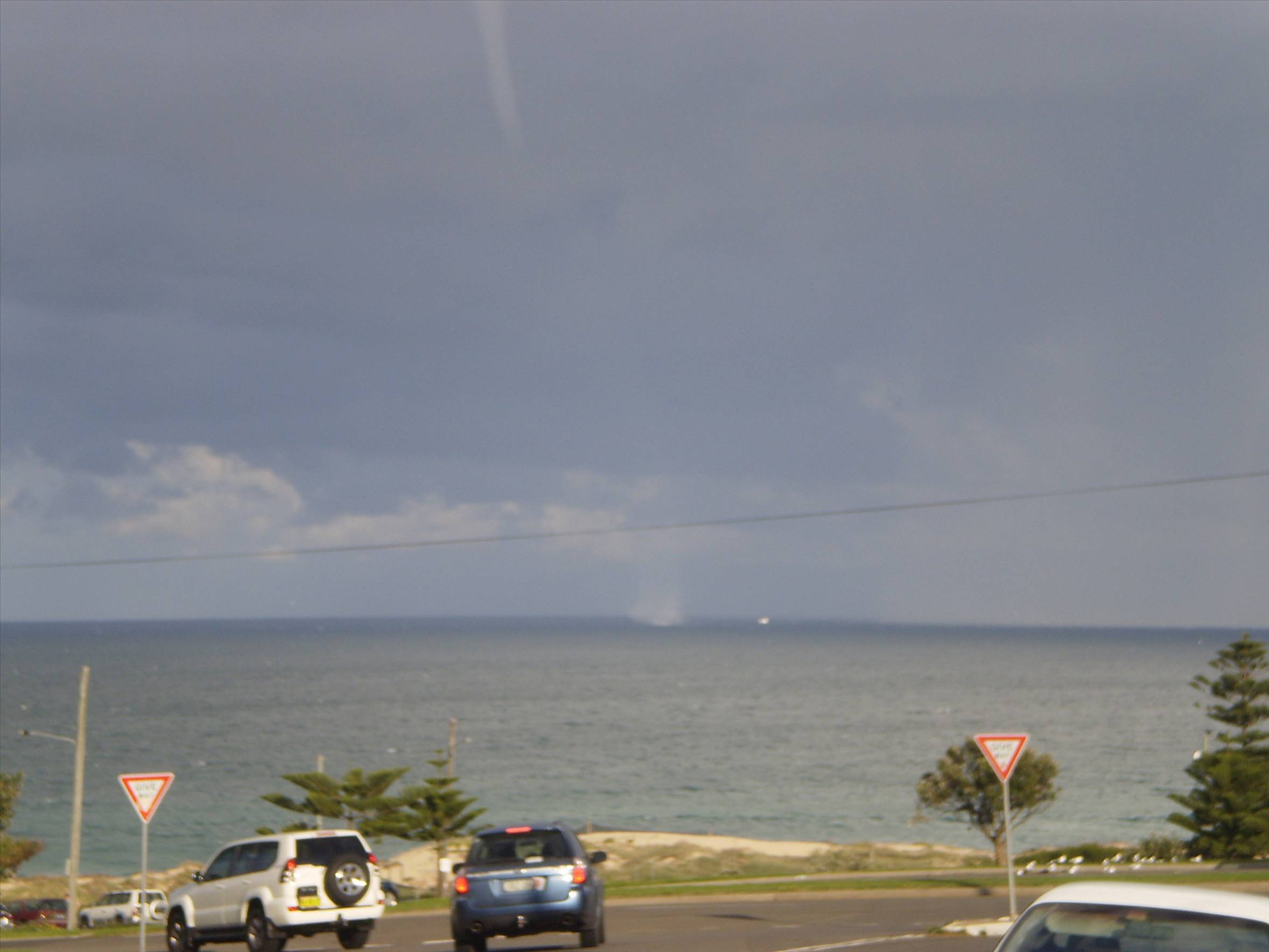
A tornado or lesser whirlwind occurring over water and resulting in a funnel-shaped whirling column of air and spray.
An intense columnar vortex (not necessarily containing a funnel-shaped cloud) of small horizontal extent, over water. Typical visible vortex diameters are of the order of 33 ft (10 m), but a few large waterspouts may exceed 330 ft (100 m) across. In the case of Florida waterspouts, only rarely does the visible funnel extend from parent cloudbase to sea surface. Like the tornado, most of the visible funnel is condensate. Therefore, the extension of the funnel cloud downward depends upon the distribution of ambient water vapor, ambient temperature, and pressure drop due to the vortex circulation strength. These vortices are most frequently observed during the warm season in the oceanic tropics and subtropics.

Waterspouts and tornadoes are qualitatively similar, differing only in certain quantitative aspects: tornadoes are usually more intense, move faster, and have longer lifetimes-especially maxi-tornadoes. Tornadoes are associated with intense, baroclinic (frontal), synoptic-scale disturbances with attendant strong vertical wind shear, while waterspouts are associated with weak, quasibarotropic disturbances (weak thermal gradients) and consequent weak vertical wind shear.

ref:
www.answers.com/search?q=waterspout









 ?
?