Auto or not?.

9 years ago
Reply
Register to post, see what you've read, and subscribe to topics.
samsturdy
samsturdy
NSW
1659 posts
NSW, 1659 posts
4 Jun 2017 1:20pm
When you're out on the big blue water in a 30+ knt breeze dead astern and a big swell, do you trust
your auto pilot not to broach or do you manually steer so you can micro change direction going down
the wave.
shaggybaxter
shaggybaxter
QLD
2679 posts
QLD, 2679 posts
4 Jun 2017 2:55pm
Hi Sam,
Absolutely do I trust it! Steers better than I do :)
samsturdy
samsturdy
NSW
1659 posts
NSW, 1659 posts
4 Jun 2017 3:19pm
OK Shaggy. I had this impression that going down the face of a wave was potentially dangerous
because if you started to go side on, the result would be a broach. And I didn't know if an auto
pilot would be able to react quickly enough to keep you on track.
shaggybaxter
shaggybaxter
QLD
2679 posts
QLD, 2679 posts
4 Jun 2017 3:39pm
You are right to be concerned, it does depend on the quality of autopilot, and also to the geometry of the boat, ie: if it is hard to helm in these conditions it will be hard for an autopilot. Helps if your rudder has a good bite when heeled .
To give you an idea, at 30 kn my Raymarine ST struggled a bit with big following seas, the NKE in comparison is just a dream.
Edit: slight correction, the Raymarine had an EVO gyro to a ST ram.
samsturdy
samsturdy
NSW
1659 posts
NSW, 1659 posts
4 Jun 2017 4:06pm
OK. So my boat has a spade rudder and the boat will turn very quickly which would
make you think it has a good grip...but if you're travelling at little more than the speed
of the water, doesn't that reduce the grip ?. I have an ST2000 tiller pilot which works
brilliantly in Pittwater but would it do the job offshore. I feel that I would rather
disengage it and manually steer, but as I have never been in the situation.....I'm
just asking.
lydia
lydia
1936 posts
1936 posts
4 Jun 2017 2:18pm
Balance the boat first.
It will be fine.
On most boats drop the main all together and use enough headsail.
samsturdy
samsturdy
NSW
1659 posts
NSW, 1659 posts
4 Jun 2017 4:36pm
Right....I seem to recall a statement a long time ago "keep all the pressure forward of the mast" ( I think ), would
that have been made in relation to a similar question ?.
.
Ramona
Ramona
NSW
7756 posts
NSW, 7756 posts
4 Jun 2017 5:37pm
If your sailing down wind with the wind 30 knots over the stern you would most likely be down to just a small headsail so not so likely to broach.

There is an enormous difference between a NKE autopilot and a ST2000 tiller pilot!
shaggybaxter
shaggybaxter
QLD
2679 posts
QLD, 2679 posts
4 Jun 2017 5:56pm
Ramona is right, even with the Evo being a gyro the performance was worlds apart.
I must admit the Evo was on a transom hung rudder which makes it more difficult, but it was deep with a big bite.
Mind you, a run with seas on your beam in high winds in my experience is the hardest ask of an autohelm!
Ramona
Ramona
NSW
7756 posts
NSW, 7756 posts
4 Jun 2017 6:06pm
I was actually referring to the cost of the two units.
Jolene
Jolene
WA
1624 posts
WA, 1624 posts
4 Jun 2017 4:53pm
Downwind using my st4000 tiller pilot is hard work. I usually manual steer or use my windvane. I really need to spend some time adjusting the gain setting to improve its downwind helming abilities. It tends to snake which leads to large inputs for correction,, then over corrections and tiller is fairly heavy down wind. Up wind is fine.
spiggie
spiggie
VIC
79 posts
VIC, 79 posts
4 Jun 2017 7:09pm
Guess it depends on how competant the helmsman is, how long he has been steering, how tired he is ,how long has the sea been running , Kite up or down , goose swinge or not , is the yacht a planning hull or non planning , night or day sailing , cat or monohull, are you steering to a compass course /rumb line , ? to many variables in your question but personally i would be helming if it is blowing 30kts what are the gusts ?extra 10kts we all know when it gust the breeze swings , most likely a 4 - 6 mtr swell and breaking seas.
Not to mention the type of auto helm does it steer by apparent or true wind ?
Sailing square is really not an option not in 30 kts you would have to be a bloody good helm .
I would recommend sailing at 140 apparent and putting a couple of gybes in
Ramona
Ramona
NSW
7756 posts
NSW, 7756 posts
4 Jun 2017 7:19pm
Plenty of photos on Sam's page of his yacht.
cisco
cisco
QLD
12365 posts
QLD, 12365 posts
4 Jun 2017 7:51pm
If I was running and the boat is being driven at hull speed or more, I will be steering, not George.
sirgallivant
sirgallivant
NSW
1531 posts
NSW, 1531 posts
4 Jun 2017 8:37pm
Sam, as another '28-er' with an ST 2000 tiller pilot l wonder what would you do out there in that weather?
As l know the answer to this question, it is only theorethical, l would say one could, however, l am sure, in that weather there are much better options especially if the weather is building.
Half of the recommendations given by members disregard one's knowledge and abilities, so disregard them as pure theory. Like gybing in a 30 knot wind.

One's boat's abilities must be a well known fact to an experienced sailor as all boats are behaving differently in different conditions under different sails or like under tiller pilot.
Some boats would sail happily and others would founder.

The ST 2000 is 'only' a very simple tiller pilot not a sophisticated auto pilot!
Few weeks ago in 18-22 knot winds and 7-9 foot swell but smooth seas, l was sailing mine with a big reacher and full main outside the heads on tiller pilot in steady winds, no worries, while l was cooking lunch at the same time. The sails were balanced, the pilot worked easily doing 6-7 knots. I'm not sure how it would have worked if the wind was 30 knots +, definitely NOT with the same sail configuration!

One could recommend Steve and Linda Dashew's excellent and freely downloadable book:
'Practical Seamanship'.

It is splendid reading for a cold winter night with a glass of nice red in the hand.


spiggie
spiggie
VIC
79 posts
VIC, 79 posts
4 Jun 2017 9:01pm
sirgallivant said..
Sam, as another '28-er' with an ST 2000 tiller pilot l wonder what would you do out there in that weather?
As l know the answer to this question, it is only theorethical, l would say one could, however, l am sure, in that weather there are much better options especially if the weather is building.
Half of the recommendations given by members disregard one's knowledge and abilities, so disregard them as pure theory. Like gybing in a 30 knot wind.

One's boat's abilities must be a well known fact to an experienced sailor as all boats are behaving differently in different conditions under different sails or like under tiller pilot.
Some boats would sail happily and others would founder.

The ST 2000 is 'only' a very simple tiller pilot not a sophisticated auto pilot!
Few weeks ago in 18-22 knot winds and 7-9 foot swell but smooth seas, l was sailing mine with a big reacher and full main outside the heads on tiller pilot in steady winds, no worries, while l was cooking lunch at the same time. The sails were balanced, the pilot worked easily doing 6-7 knots. I'm not sure how it would have worked if the wind was 30 knots +, definitely NOT with the same sail configuration!

One could recommend Steve and Linda Dashew's excellent and freely downloadable book:
'Practical Seamanship'.

It is splendid reading for a cold winter night with a glass of nice red in the hand.
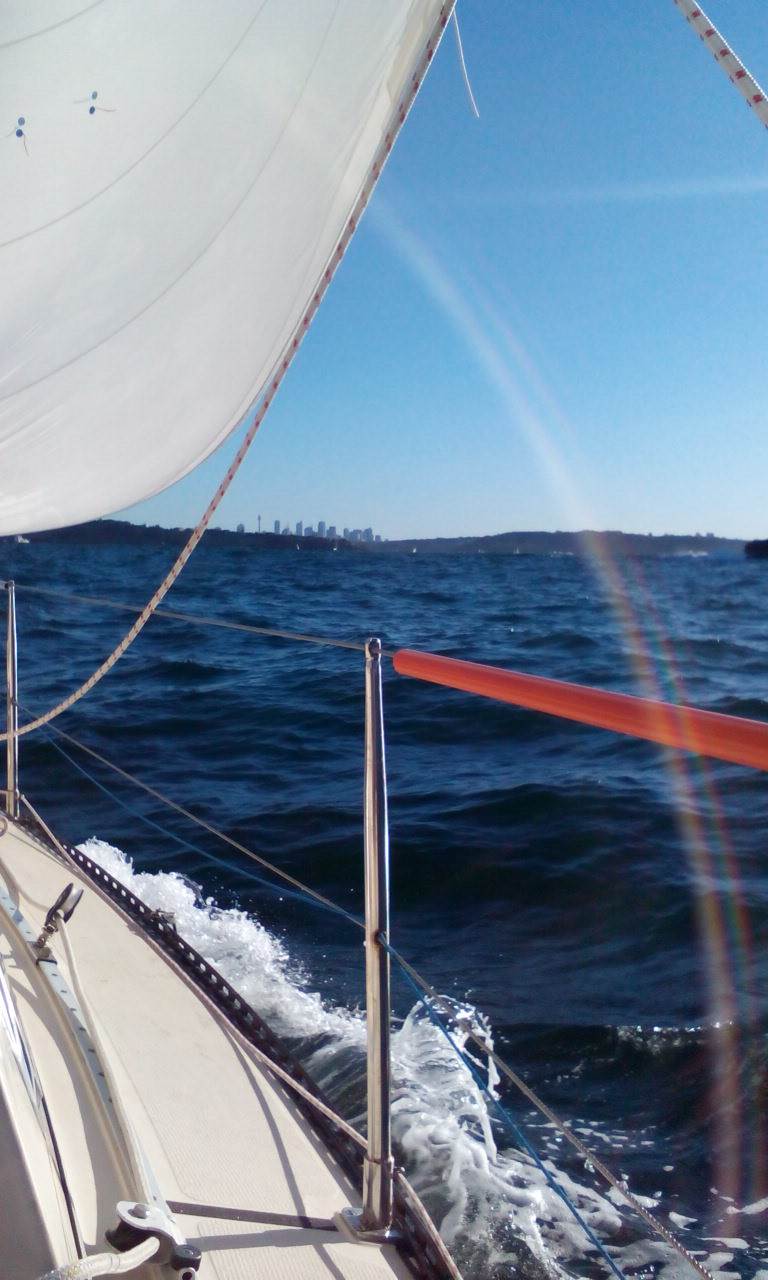


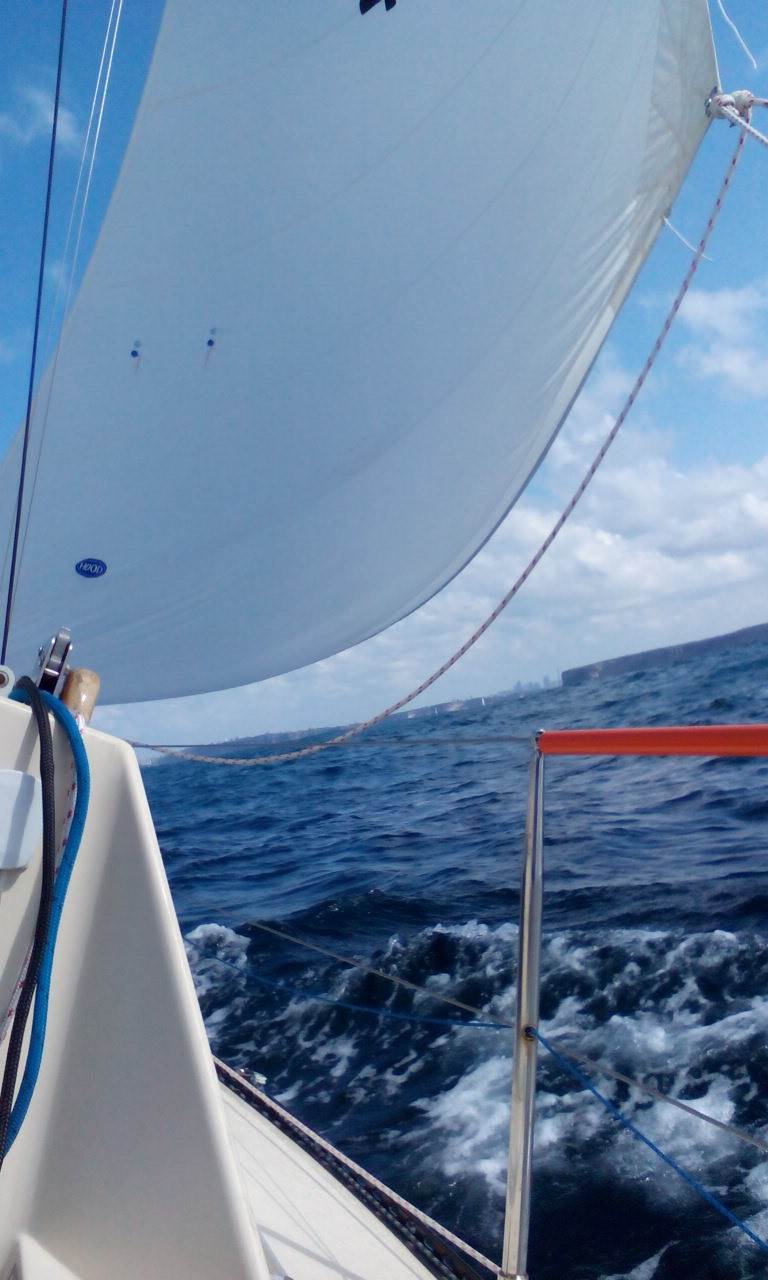
Looking at the way your sails are trimmed you are broad reaching,in flat seas although looking at the telltales perhaps the sheets arent trimmed correctly ,Gybing is fine if you know what you are doing with competent crew and good knowledge of your yacht
You always sail to the conditions, your ability and the marine traffic
3 rules when sailing offshore
Boat safety ,Crew comfort, compass course
MorningBird
MorningBird
NSW
2711 posts
NSW, 2711 posts
4 Jun 2017 9:52pm
The SIMRAD TP32 steers the S&S34 downwind in stiff breezes and big seas. I run at about 140-160 degrees, I don't have the wind instrument integrated with the SIMRAD yet so you can't do dead downwind for long periods while cruising short handed.
The Fleming will steer almost dead downwind in strong breezes but again, shorthanded you just can't do it with safety.
nswsailor
nswsailor
NSW
1458 posts
NSW, 1458 posts
4 Jun 2017 11:02pm
Sam, it will eventually overheat and you will burn the motor out, apart from flattening your batteries.

Keep a hand on the body and when it gets hot [you will know when] it's time for you to steer for a bit until it cools down.

Done and tested and I have seen one that was driven to destruction by over use in the situation you set.
Sectorsteve
Sectorsteve
QLD
2195 posts
QLD, 2195 posts
5 Jun 2017 1:06am
Downwind is hard yakka on the human arm in a big sea and 30 knots.
Id say its a Strain on an ap as well.
Pick up the tp22 tomorrow. My life is about to change.
boty
boty
QLD
685 posts
QLD, 685 posts
5 Jun 2017 8:00am
i use an st 2000 auto it is capable of steering our boat in all conditions ( 37 foot long keel never any weight on helm always steer with 2 fingers ) though once boat speed hits 10 knots and you are regularly surfing you have to steer by hand mainly caused by corkscrewing from the long over hangs and waves overtaking
i think it mainly depends on the type of boat the average light displacement modern boat will be easier on the helm down breeze ior style boats would be very challenging
there is no overall correct answer each boat is its own case study
Bruski068
Bruski068
VIC
457 posts
VIC, 457 posts
5 Jun 2017 11:55am
O.T.B. Can I suggest that in these conditions it's time to throw the drogue out the back to prevent you from broaching whilst sailing down waves.
Datawiz
Datawiz
VIC
605 posts
VIC, 605 posts
5 Jun 2017 5:45pm
Bruski068 said..
O.T.B. Can I suggest that in these conditions it's time to throw the drogue out the back to prevent you from broaching whilst sailing down waves.


+1 Bruski
Sectorsteve
Sectorsteve
QLD
2195 posts
QLD, 2195 posts
6 Jun 2017 9:33am
A few of the comments suggest here in 30knots and swell to be running just a small jib.
In my tophat returning north from Jervis Bay recently my sail plan started as a reefed main and my full hanked on reefable jib.
Seas = 2-3 m, wind 25- 30knots. Sailed due east form hole in the wall mooring and once near point perpendicular i stowed the main and decided to run with the jib only.
This was mostly fine, but around Crocodile head(outer JB) was a washing machine and around Gerringong was also large swell.
I think i would have had more stability with reefed main and a number 3 and sailing across the waves slightly. The boat was a bit hard to manage dead downwind in these conditions and for an auto pilot it would have been also because after this 6 hours of pretty fast sailing my arm was rooted.
I regretted this Sail plan later and it was really out of fear that i did it this way as i have the downhaul on the jib and can manage it from the cockpit.
I since heard somewhere that Tophats arent ideal dead downwind and im still yet to try this in a moderate/large seastate.
Reading Steve Dashews books confirms this, but he also says all boats are different.
I know this topic is about autohelm or not, and ive lately been a shocker for deviating off topic - im sorry, but im curious to hear what others think of sailing dead downwind in a large-ish sea with a certain sailplan. How do you do it to minimise stress on the rudder. Im looking forward to trying both sails next time in similar conditions because i have a feeling ill have more control and that therell be less pressure on the tiller/rudder.
samsturdy
samsturdy
NSW
1659 posts
NSW, 1659 posts
6 Jun 2017 10:18am
OK, I'm back on deck. Had a day on the boat getting a topping lift fitted at the local riggers. The reason for
the question was a result of daydreaming sailing to the Whitsundays now Winter has set in here in Sydney.
My auto pilot has limitations in the flukey winds of Pittwater. Often I have to disengage the pilot when it's
challenged by a sudden change in wind direction, it operates much better in a steady blow. So I'm thinking
if Pittwater can challenge it how about something a lot more aggressive like surfing down the face of a wave.
Now I've only read about sailing these conditions in books, but I know some of you blokes actually do it so
I wondered just how much you rely on your auto pilot.
LittleBoris
LittleBoris
NSW
27 posts
NSW, 27 posts
6 Jun 2017 12:41pm
Also reading this with interest, what are peoples thoughts on the Simrad Tiller Pliots vs the Raymarine Tiler pilots?

Any thoughts on upsides or downsides to either brand would be appreciated.
EC31
EC31
NSW
490 posts
NSW, 490 posts
6 Jun 2017 12:59pm
I am in the process of fitting a Coursemaster i85, but that is a below deck hydraulic system. Luckily, I have space on my rudder shaft below the quadrant, but with the key visible, to attach the ram. Will find out how it handles down wind in a few weeks and get the bugs ironed out before heading north in July.
As old IOR's are not the most stable downwind, I suspect the unit will be working pretty hard to keep up. LittleBoris, I suspect you will have similar issues.
boty
boty
QLD
685 posts
QLD, 685 posts
6 Jun 2017 1:49pm
Sectorsteve said..
A few of the comments suggest here in 30knots and swell to be running just a small jib.
In my tophat returning north from Jervis Bay recently my sail plan started as a reefed main and my full hanked on reefable jib.
Seas = 2-3 m, wind 25- 30knots. Sailed due east form hole in the wall mooring and once near point perpendicular i stowed the main and decided to run with the jib only.
This was mostly fine, but around Crocodile head(outer JB) was a washing machine and around Gerringong was also large swell.
I think i would have had more stability with reefed main and a number 3 and sailing across the waves slightly. The boat was a bit hard to manage dead downwind in these conditions and for an auto pilot it would have been also because after this 6 hours of pretty fast sailing my arm was rooted.
I regretted this Sail plan later and it was really out of fear that i did it this way as i have the downhaul on the jib and can manage it from the cockpit.
I since heard somewhere that Tophats arent ideal dead downwind and im still yet to try this in a moderate/large seastate.
Reading Steve Dashews books confirms this, but he also says all boats are different.
I know this topic is about autohelm or not, and ive lately been a shocker for deviating off topic - im sorry, but im curious to hear what others think of sailing dead downwind in a large-ish sea with a certain sailplan. How do you do it to minimise stress on the rudder. Im looking forward to trying both sails next time in similar conditions because i have a feeling ill have more control and that therell be less pressure on the tiller/rudder.


when running square always balance the sail plan ie full main spinnaker full main poled out no 1 reefed main poled out no 2 and so forth this will mitigate major roll and also make the boat much lighter on the helm then you can just enjoy sailing
even the most expensive of autopilots wont correct for a badly balanced boat or poor hull design
MorningBird
MorningBird
NSW
2711 posts
NSW, 2711 posts
6 Jun 2017 1:56pm
samsturdy said..
OK, I'm back on deck. Had a day on the boat getting a topping lift fitted at the local riggers. The reason for
the question was a result of daydreaming sailing to the Whitsundays now Winter has set in here in Sydney.
My auto pilot has limitations in the flukey winds of Pittwater. Often I have to disengage the pilot when it's
challenged by a sudden change in wind direction, it operates much better in a steady blow. So I'm thinking
if Pittwater can challenge it how about something a lot more aggressive like surfing down the face of a wave.
Now I've only read about sailing these conditions in books, but I know some of you blokes actually do it so
I wondered just how much you rely on your auto pilot.


Does your pilot steer to the wind from an instrument or maintain a set compass course? If the former it will obviously do better in the situations we are talking about.

I also know Pittwater well and the winds there are fluky at the best of times. Especially off Careel Bay where it can do a 360 even when it is quite fresh. The problem there is that the wind change direction too fast for the pilot.

The problem at sea is the seas coming up from the stern. The wind doesn't matter too much if the boat is balanced, Boty comments above are spot on in my view.

If you run 30 degrees off dead downwind the tiller pilot should handle it up to a reasonable sea. You will just have to experiment as to what is reasonable.

In the S&S34, 3/4 keel but smallish rudder on a skeg, the SimradTP32 (for boats up to about 40ft LOA, max load on the drive is 84kg, it has a strong and fast action) is ok in 25 or more knots and 2 metres. Above that it handles it but would flatten the batteries quickly. The S&S is light on the helm but doesn't like quartering seas so the pilot does have to work.

The Fleming is great between 10 knots and in my experience 50+ knots relative. In strong winds you can set a course maybe 10 degrees off dead downwind and she will hold it without fear of gybing. In big seas it is better than a helmsman who would be knackered after 30 minutes.

On Berrimilla's 2005 circumnavigation Alex Whitworth was awed by how after a knockdown the boat would right itself, the Fleming would give a bit of a shake like a wet dog and start the boat powering downwind again. And he was bare poles in 70+ knots and 10 metre seas.
samsturdy
samsturdy
NSW
1659 posts
NSW, 1659 posts
6 Jun 2017 2:04pm
So, if you're sailing single handed in reasonable conditions and your pilot is missing/broken would
you consider lashing the tiller to the centreline to give yourself a break ??.
MorningBird
MorningBird
NSW
2711 posts
NSW, 2711 posts
6 Jun 2017 2:06pm
LittleBoris said..
Also reading this with interest, what are peoples thoughts on the Simrad Tiller Pliots vs the Raymarine Tiler pilots?

Any thoughts on upsides or downsides to either brand would be appreciated.


My Simrad TP32 is now 10 years old, been drowned, dropped, sat on, kicked, used in seas it shouldn't have been used in and had everything bad done to it you could imagine and it still works ok.
I bought the Simrad because it is self contained so I didn't have to drill more holes in the boat. It had a more robust drive mechanism, stronger max pull and faster reaction than the Raymarine.
However, the Raymarine had more features and has a better reputation for reliability. Based on my experience the Simrad reliability reputation isn't well founded.
The Simrad is much much cheaper.
MorningBird
MorningBird
NSW
2711 posts
NSW, 2711 posts
6 Jun 2017 2:07pm
samsturdy said..
So, if you're sailing single handed in reasonable conditions and your pilot is missing/broken would
you consider lashing the tiller to the centreline to give yourself a break ??.


No. Absolutely not. I'd heave to.
Please Register, or first...
Topics Subscribe Reply