Cast Iron keel rust

> 10 years ago
Reply
Register to post, see what you've read, and subscribe to topics.
FreeRadical
FreeRadical
WA
855 posts
WA, 855 posts
11 Nov 2015 9:57am
Noticed a few little rust spots on the keel when snorkelling around the boat. The boat comes out this week for antifouling. Anyone have ideas on treating rust spots?

I'm thinking sand/grind back to bare metal, immediately apply International Interprotect building to min 3 coats, then Primocon, then Antifoul (Altex No.5)
CoolRunnings
CoolRunnings
NSW
159 posts
NSW, 159 posts
11 Nov 2015 4:00pm
If you are going to all the trouble,I would(did) grit blast back to bare.

My waterblaster has a grit blasting attachment and when using say Garnet minimises air pollution.If you say keep some plastic under the immediate work area,this will catch most of the old material.Garnet being a natural crushed rock does not present environmental problems either.
From there we used a compatible rust converter as the cast iron will rust almost immediately when raw again.

As you mentioned,then apply your system of choice.
We used a Jotun mastic which lasted 8 years before any small signs of 'bleeding occurred again.

Good Luck!-C.R.
ChrisJ1978
ChrisJ1978
NSW
57 posts
NSW, 57 posts
11 Nov 2015 4:01pm
Sounds spot on to me!
Sunseeker39
Sunseeker39
WA
71 posts
WA, 71 posts
11 Nov 2015 9:06pm
Hi Cool Runnings,

I paid for someone to grind back my keel rust on my Hanse 400 then applied 3 layers of epoxy and got 6 months out of the repair .
I have been delaying my antifoul replacement because I am yet to find a viable alternative.

I'm very very keen to see photo's of what your talking about - applicator and products including your coatings if possible.
Sadly I dont recognise the names of the items your talking about.

If by any chance you have the gear lying around I'd love to see some photos so I can replicate.

I'd kill for 8 years of no rust - bloody rust is destroying my antifoul and I therefore need to dive on it 2-3 weekly.

Regards Craig
CoolRunnings
CoolRunnings
NSW
159 posts
NSW, 159 posts
12 Nov 2015 12:29pm

As mentioned previous for cast iron keel and to do the job properly, I feel you have to get back to bare material.
Grinding will only make the situation worse as it will simply bury the antifoul further into the substrate. Wet sanding is okay but you will still have problems in the short term, as you are still going over leftover product which does not offer a good 'key' for the new paint system. Again paint strippers will only remove so much of the old material.

The first pic is the Sodablast rig which is a wet set-up that will run through a waterblaster. This requires a minimum flow rate of about 20l per min of water to be effective. It is simply graded Bicarb soda and with any wet blasting you must not let water backflow into the hopper or bucket.(goes hard/lumpy)
This stuff is good for the general underwater hull areas and will not ruin the gelcoat which is important. You do not want to be ripping into any fibreglass layers!
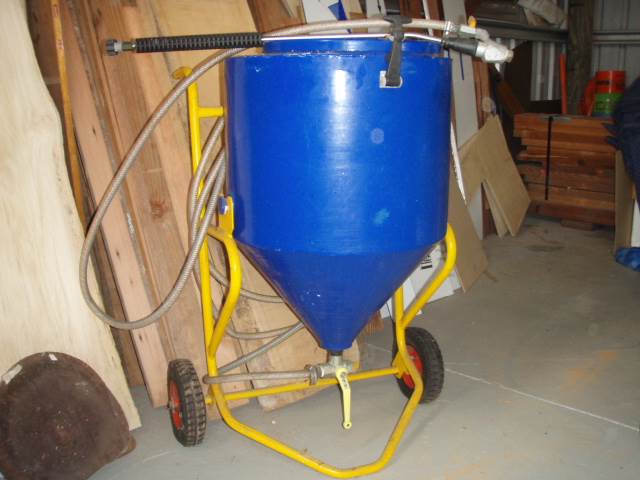

The second pic is the waterblaster setup with the grit nozzle which again simply sucks the media out of a bucket or hopper by venturi effect.

You do not have to spend big money these days like this set-up below. Mine is all Aussie Spitwater gear.
What with the cut price imported stuff and a trip to say a Gasweld or whatever, you can be off and running quite cheaply.
Kennards may even hire this equipment out, depending on your location.

To stop water running back into your product, the lance must be held with the tip facing downwards and have the inlet elbow on top(not like the picture).
This used with say a Garnet should clear off the iron keel of any coatings quite well and ready for a new paint system. Get hold of a piece of scrap metal plate as a test piece and try out before howing into your keel to gain a 'feel' for what's required. Try also to be accurate especially near the hull/keel join and some minor filleting may be required as fairing to make good again. Don't use the Garnet on the fibreglass hull!

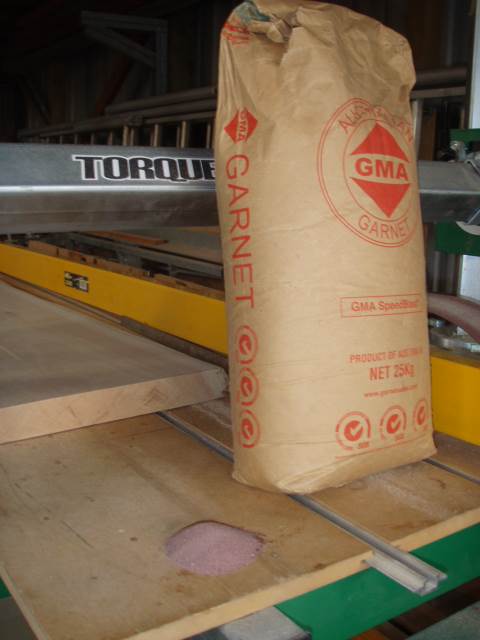
Lastly here is a sample of the Garnet that I have used on iron keels. The benefit of wet blasting, is most of the waste can be reasonably contained.
With dry blasting, a full enclosure may be warranted,otherwise crap will go everywhere, including all through your's/neighbour's boat. This set-up usually requires big compressors and large equipment also.
By all means consult with a marine paint supplier and get hold of a reputable paint system, including your barrier coats, primers and so on.
Craig, speak also to Windcraft on your Hanse, as you would hope they should be able to offer decent advice on this as well.

If still not overly confident,there would be specialist blasters(probably Soda) around, that do this type of marine work and do your research on their reputation.
Be there at all times to supervise and pull them up if you are not happy. You do not want a Cowboy or an untrained bunny indiscriminately ripping into your pride and joy! C.R.

samsturdy
samsturdy
NSW
1659 posts
NSW, 1659 posts
12 Nov 2015 1:22pm

Very good information CR. Well done.
Sunseeker39
Sunseeker39
WA
71 posts
WA, 71 posts
12 Nov 2015 2:28pm
Thank you so much, I can now hold a conversation about wet and dry blasting with some shipwrights.
Also make a few inquiries regarding those nozzles. I'll take copies of the photos. Thank you.

Sadly it right along the keel hull join so it sounds like Garnet may be a bit aggressive.
It sounds like a dry powder blast would be the best option given I don't want to destroy the glass at the join.

If that doesnt work -I'll have to drop the keel and garnet.

A friend on mine just dry blasted his rusted steel engine framework on his Farr 40, I think he used the bicarb.
One thing he suggested was after rust converter a top coat of a old fashioned tar paint.
His concern for my boat was the join will always move and no matter how many layers of epoxy I put on,
the epoxy hull join will simply crack which will then alloy water in.
Realistically it may be that complete access may require dropping the keel.
Sadly that is more $$ than I have right now.

The tar paint he mentioned is waterproof and flexible - Do you have any thoughts on the tar option.
Obviously primer and antifoul on top.
Neither he no I am away of anyone in recent years using the tar under the water lione which I believe is a very old waterproofing coating.

Thoughts /

Many thanks again Craig
Jode5
Jode5
QLD
853 posts
QLD, 853 posts
12 Nov 2015 6:46pm
Hi Sunseeker,
The way they do the keel is to V out the keel joint to about 10mm wide and deep and fill with Siker. First you must make sure the keel is tight and well bonded to the hull. If it was me I would drop the keel and start from scratch. The idea of the wide Siker joint is to take out the very slight movement which you will never stop. The wide joint will move but not allow water into the joint. You will still see a line that looks like a crack in the antifouling after a while as the antifouling is not flexible. This will not cause a problem, the main thing is to keep the water out of the joint. unfortunately there is no cheap way out of it and if you don't do it properly with cast iron keels it will keep giving you trouble and costing you money until you do. As for treatment of the keel there is a lot of good advise above. PS cast iron keels are a pain in the ######, it is the one thing I don't like about my boat and most European boats.
John
samsturdy
samsturdy
NSW
1659 posts
NSW, 1659 posts
13 Nov 2015 9:16am

Yes Jodes right, it's no use using a non-flexible compound on the keel joint. Fortunately my
keel is lead so no rust problems, but I still get a little gap where keel joins hull. I use Fixtech
and antifoul over it when it has gone off. Works for me.
Please Register, or first...
Topics Subscribe Reply