Faster than the wind

> 10 years ago
Reply
Register to post, see what you've read, and subscribe to topics.
samsturdy
samsturdy
NSW
1659 posts
NSW, 1659 posts
20 Oct 2015 9:21am

I awoke this morning dreaming of Shaggybaxters boat, when my mind rumbled.....a thought......
I seem to recall a statement that boats such as Shaggys can sail faster than the breeze that's
blowing them along.......is this true????.
Crusoe
Crusoe
QLD
1197 posts
QLD, 1197 posts
20 Oct 2015 8:44am
YES.

Imagine squeezing a greasy steel ball between 2 lengths of steel (say about 2 meter long) that are hinged at one end. The pieces of steel may only need to close 100mm but the ball needs to move 1000mm to escape the squezeeing force being applied near the hinge.

Now the sails on these boats are very efficient at converting wind into movement, so that the when on a reach, the sail may need to move twice as fast as the wind to release the pressure being applied by the wind. This is not normally possible on a displacement hull due to the drag losses but when a boat is on the plane or up on foils, it all becomes possible. Instead of healing over they are able to move at speed to release the force instead of healing over like a displacement boat.

Hope this simple way of looking at the concept helps you on the road to enlightenment.

And as always, I could be wrong again :)
Jode5
Jode5
QLD
853 posts
QLD, 853 posts
20 Oct 2015 9:14am
Ice yachts travel many times the wind speed as they have next to no resistance on the ice. What Crusco said is correct.
samsturdy
samsturdy
NSW
1659 posts
NSW, 1659 posts
20 Oct 2015 10:45am

Well said Crusoe. I'm sort of equating the concept to an electric motor charging a battery with an alternator that
produces more amps than the system uses, thereby creating perpetual motion. But then I am insane!!!!.
nebbian
nebbian
WA
6277 posts
WA, 6277 posts
20 Oct 2015 10:38am
Windsurfers do it all the time. I regularly hit 25 knots in 15-18 knots of wind.

Think of it this way:
You're harnessing the difference in speed of the wind and the water, and turning that energy into forward movement. So you need something to bite into the wind (a sail) and something to bite into the water (a keel). Take either of them away and you stop extracting the energy.

The bigger your sail, the more energy you can extract, so the faster you can go. Of course there are limits


Now to take this idea further, there are other ways of extracting energy from the water/wind interface... a wind impeller can be used to good effect. This was done by a new zealand fellow who put an impellor on a boat, connected to a gearbox and a prop. He could sail directly upwind and was banned from racing due to winning all the time.

Here's another one:
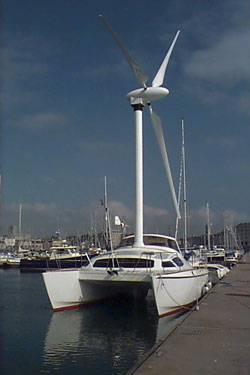

Recently another idea came to light, this one uses a propellor connected via gears to a set of wheels. With the right gearing you can get some speed up.

Open your mind, and watch this:

jev7337
jev7337
QLD
460 posts
QLD, 460 posts
20 Oct 2015 12:47pm
Yes, well, given the yacht doesn’t need to carry tonnes of lead in the keel to keep it upright then it is possible. Most foiling cats, racing cats and even some cruising cats do go faster than the wind – easily. Check this video between 0:30 and 0:40, 20knots speed in 18 knots wind. That will put a smile on your face.


frant
frant
VIC
1230 posts
VIC, 1230 posts
20 Oct 2015 3:34pm
nebbian said..
Windsurfers do it all the time. I regularly hit 25 knots in 15-18 knots of wind.

Think of it this way:
You're harnessing the difference in speed of the wind and the water, and turning that energy into forward movement. So you need something to bite into the wind (a sail) and something to bite into the water (a keel). Take either of them away and you stop extracting the energy.

The bigger your sail, the more energy you can extract, so the faster you can go. Of course there are limits


Now to take this idea further, there are other ways of extracting energy from the water/wind interface... a wind impeller can be used to good effect. This was done by a new zealand fellow who put an impellor on a boat, connected to a gearbox and a prop. He could sail directly upwind and was banned from racing due to winning all the time.

Here's another one:


Recently another idea came to light, this one uses a propellor connected via gears to a set of wheels. With the right gearing you can get some speed up.

Open your mind, and watch this:

//

We've been through this one before Nebs and IT IS possible for a vehicle with a propellor driven by gears to the wheels can travel directly downwind at faster than the wind speed. It is simply a question of how energy is extracted from a mass of air moving relative to the surface interface. It is also possible for a sail craft to arrive dead downwind at faster than the wind speed. Ie vmg is greater than wind speed. It's all down to physics.
Yara
Yara
NSW
1322 posts
NSW, 1322 posts
21 Oct 2015 6:28am
samsturdy said..

Well said Crusoe. I'm sort of equating the concept to an electric motor charging a battery with an alternator that
produces more amps than the system uses, thereby creating perpetual motion. But then I am insane!!!!.


Sticking with the electrical analogy you could say it is like a transformer- lower voltage in, higher voltage out.
samsturdy
samsturdy
NSW
1659 posts
NSW, 1659 posts
21 Oct 2015 9:51am

Yes Yarra. However getting back to the original thought, I still find it difficult to understand
how a vessel propelled purely by the wind can go faster than the wind itself. It's like, if the
vessel speed is the same as the wind speed then that's a 100% but how can a vessel achieve
say, 120% from a 100% wind speed.
As Frant said, it's all down to physics.
Crusoe gave an explanation but it's a little too 'mechanical' although I understand the physics
of what he said. But, I dunno!!!!!.
shaggybaxter
shaggybaxter
QLD
2680 posts
QLD, 2680 posts
21 Oct 2015 10:59am
Hi Sam,
The way I understand it is, reverting back to physics, is a function of lift (power) vs drag, with the real focus being on decreasing drag, rather than increasing power. Drag is a much bigger value than lift in most traditional hull designs. Typical ways to reduce drag is by reducing weight and the wetted surface area.

The wide beamy concept enables you to not only harness more power (can handle a bigger sail area) but it spreads the weight of the boat over a larger surface area, and the by product of a flatter hull shape both combine to reduce drag by decreasing the wetted surface area. This is usually only when reaching or running, lots of poorly designed flat beamy shapes are terrible at going to windward.

It is worth noting that this comes at another cost, the flatter hull is a lot more uncomfortable in short sharp seas when beating to windward, ie: it lands on a flat surface where a displacement hull will ride more comfortably.

In our trials last week, we were reaching at 7.8 kn in 8 knots of breeze without planing, this I can only put down to a sufficient reduction in drag (wetted surface area)whilst maximising the available power (efficient/larger ?? sail plan) .

The Americas Cup 72' cats when they were foiling were easily doing 2x wind speed!! How? Mostly by decreasing drag (wetted surface are)
Hope this helps!
SB
samsturdy
samsturdy
NSW
1659 posts
NSW, 1659 posts
21 Oct 2015 1:59pm

Hi Shaggy, thank you. If we take away drag altogether, say a feather floating on the breeze.
would the feather only travel at wind speed??.
The feather of course would be subject to a direction of any which way. So does the fact that
a boat can be held in a specific direction have any bearing on the physics that makes it go faster
than the wind that's blowing it. Does the fact that it's 'grounded' increase the forces that are
acting on it?. Although I'm still at a loss at how the output can be more than the input.


shaggybaxter
shaggybaxter
QLD
2680 posts
QLD, 2680 posts
21 Oct 2015 1:32pm
HI Sam,
I'm with you.I think the answer is efficiency of design, if your feather was shaped like a wing , like the example earlier with Ice yachts, the wing aerodynamics can provide more than enough power, it is getting rid of the drag that is the key.
Your feather is a good example, you are not gaining any efficiency, so it cannot go faster than wind speed. But the way your sails works, by creating a low pressure and high pressure side hence creating lift, is your golden ticket, it is increasing the power of the wind. This is why when you are badly trimmed, you cant achieve wind speed or greater, there is no multiplier on your available energy,
So, does that mean the old chestnut of needing more input energy than output is not a rule of physics, it is a engineering challenge??
samsturdy
samsturdy
NSW
1659 posts
NSW, 1659 posts
21 Oct 2015 3:45pm


Ah Shaggy, a little light has gone on. Could it be that this 'faster than the wind' concept can only happen
using something as efficient as a sail because of the capacity to create high and low pressures.
If a sail can be kept at a correct angle to the wind and the drag kept to a minimum then it is not
the wind that pushes the sail but the low pressure that pulls it. So if the low pressure can be increased
by efficiency beyond the speed of the wind then the sail (plus the low drag boat) must go faster.
Am I anywhere near the theory???.
Windjana
Windjana
WA
405 posts
WA, 405 posts
21 Oct 2015 1:23pm
Sam,

As you say a feather is never going to blow faster than the wind.

But with regards to sailing another thing to consider is the apparent wind speed.
More apparent wind over the sails such as on a close reach, will create greater differences in pressure either side of the sails. High pressure on the windward side and lower pressure on the leeward side - this is converted into forward momentum.

It is this difference in pressure along with the aforementioned principles that can allow a fast, low drag, planing type yacht to sail faster than the wind.

My cruiser will probably never sail faster than the wind!


Windjana
Windjana
WA
405 posts
WA, 405 posts
21 Oct 2015 1:29pm
NowandZen said..
Sam,

As you say a feather is never going to blow faster than the wind.

But with regards to sailing another thing to consider is the apparent wind speed.
More apparent wind over the sails such as on a close reach, will create greater differences in pressure either side of the sails. High pressure on the windward side and lower pressure on the leeward side - this is converted into forward momentum.

It is this difference in pressure along with the aforementioned principles that can allow a fast, low drag, planing type yacht to sail faster than the wind.

My cruiser will probably never sail faster than the wind!


Disclaimer on my previous post.
A feather can blow faster than the wind - if it is still attached to the bird.
samsturdy
samsturdy
NSW
1659 posts
NSW, 1659 posts
21 Oct 2015 4:42pm

Right N&Z. The more I think about the theory the more it makes sense. two things seem to be of most importance,
.....very low drag (low weight and ability to plane)
.....optimum low pressure.
So all the talk about rig tension- luff, leach, stays. slot effect, boom angle and sail shape is all to do with creating
optimum low pressure. There's more to sailing than meets the eye......isn't there!!!!.
samsturdy
samsturdy
NSW
1659 posts
NSW, 1659 posts
21 Oct 2015 4:44pm

Yes N&Z, especially on a Peregrine falcon.
Windjana
Windjana
WA
405 posts
WA, 405 posts
21 Oct 2015 1:52pm
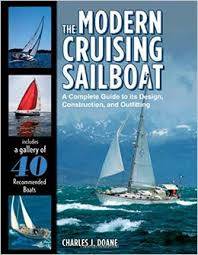
I found this book one of the best reference books I have ever read.
It might have something to do with being super keen on the subject!

I would recommend this book to anyone.


The Modern Cruising Sailboat: A Complete Guide to its Design, Construction, and Outfitting.
Author: Charles J Doane.


nebbian
nebbian
WA
6277 posts
WA, 6277 posts
21 Oct 2015 4:10pm
frant said..

We've been through this one before Nebs and IT IS possible for a vehicle with a propellor driven by gears to the wheels can travel directly downwind at faster than the wind speed. It is simply a question of how energy is extracted from a mass of air moving relative to the surface interface. It is also possible for a sail craft to arrive dead downwind at faster than the wind speed. Ie vmg is greater than wind speed. It's all down to physics.


Errr... Frant...

I did say that didn't I? And provide videos that support the theory?


I think we're in violent agreement
Yara
Yara
NSW
1322 posts
NSW, 1322 posts
22 Oct 2015 6:06am
Sailing works by changing the direction of the wind towards the back of the boat. You need force to do that, and that force drives the boat forward. All the rest is detail, but that is the principle. As long as you can create that change in direction, it does not matter what speed the boat is travelling at.
samsturdy
samsturdy
NSW
1659 posts
NSW, 1659 posts
22 Oct 2015 9:32am


That's absolutely true Yara but I don't see how that will make the boat go faster than the
breeze pushing it. Surely with the wind PUSHING, the boats maximum speed is the same
as the wind speed. However, if a force is PULLING the boat ( low pressure in front of the sail)
then the maximum speed is related to strength of the pressure rather than the strength
of the wind.


SandS
SandS
VIC
5904 posts
VIC, 5904 posts
22 Oct 2015 11:36am
Anyone mentioned waterline length yet ?
samsturdy
samsturdy
NSW
1659 posts
NSW, 1659 posts
22 Oct 2015 1:54pm


Well, you've mentioned it SandS so put your two bobs worth in.
CanAussie14
CanAussie14
48 posts
48 posts
22 Oct 2015 11:51am
samsturdy said..
...if a force is PULLING the boat ( low pressure in front of the sail)
then the maximum speed is related to strength of the pressure rather than the strength
of the wind.


Bingo! :)
Chris6791
Chris6791
WA
3271 posts
WA, 3271 posts
23 Oct 2015 10:32am
CanAussie14 said...
samsturdy said..
...if a force is PULLING the boat ( low pressure in front of the sail)
then the maximum speed is related to strength of the pressure rather than the strength
of the wind.


Bingo! :)


Well bugger me, I think you boys have just inadvertently explained how I go upwind on my kites. I never could figure that bit out.
samsturdy
samsturdy
NSW
1659 posts
NSW, 1659 posts
24 Oct 2015 10:12am


Good onya Chris. Frankly, I've really enjoyed this little mind excercise. Thanks for your input
everybody.
Please Register, or first...
Topics Subscribe Reply