JonE said..
Thanks lads.
Interesting you raise the B&G. I was racing on a boat with B&G with built in ais (tx and rx) last weekend. It appeared to be somewhat unreliable - my pet theory being that when there were too many unacknowledged targets the AIS shat the bed until the unit was power-cycled.
I wonder if the right thing to do is to have one more go at getting GPS into my iCom and get one of those $500 standalone ais units.
I've a preference for the vhf radio to stick to just rx and a separate Class B transponder for rx and tx.
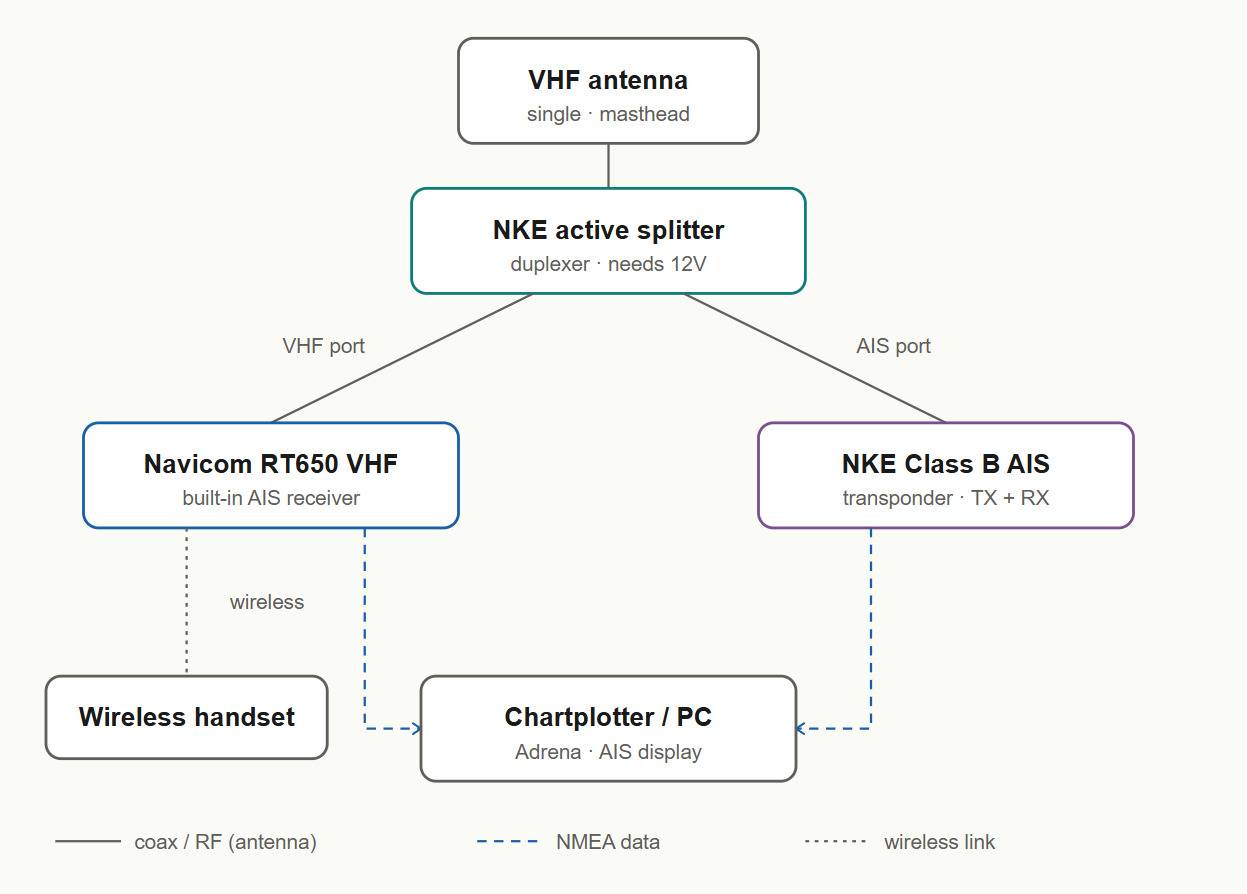
You just need an active splitter (no big deal) as now you have two transmitters, vhf on the radio and ais on the transponder.
Having dual AIS receivers is really handy, especially for troubleshooting. Both Receivers' had RS232 to the PC (as well as the NMEA port) for Adrena, so I could swap between them if I needed to.
There was a little app on the PC called ProAIS2 that was cool, indsutry standard app that gave you all the usual stuff (diagnostics, signal levels, MMSI etc) but you could also read the NMEA strings going out on the nmea port.
Below is a simple line digram of my old setup, The only thing I'd change from this is upgrading the Class B transponder from the older CSTDMA to SOTDMA.
SOTDMA uses scheduled time slots or windows for transmission, a much better solution than the old 'wait for a free slot' used by my CSTDMA unit.