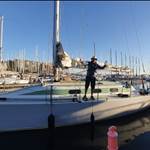
Extract from Alex's article in Offshore about 1999 Hobart.
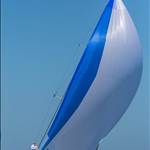
The first two days were just like last year, chasing the big kite downwind at close to Morning Glory's record pace of 1996 Routine, except that we found the only hole on the entire east coast just off Eden and almost parked for a couple of hours.Several sail changes later we opened our celebratory Cascades at half way, almost exactly two days out.
Nokia had finished and we were waiting for the forecast 40 knots from the south.
A final meal of chilli prawns and we watched the change move in.
It came at first at 35 knots, , directly up the rhumbline, then 40, then 50 by nightfall!
At this point, with three reefs and the #4, the boat was going very fast and pounding into a short steep break- ing sea.
We decided to go for the storm gear.
The tri-sail slowed the boat from about 8 to 7 knots and the storm jib should have completed the job, but Alex got his face wrapped around the inner forestay while setting it and we decided to stick to the tri-sail andreassess the situation.
Alex's face looked a mess and wesent him below to his bunk, but he seemed OK. "Absolutely no heli- copters please and bloody well keep racing" came the order, so we set the storm jib on the inner forestay and took a long tack westwards into the lee of Flinders and Cape Barren Islands where the seas were a bit easier and we could make a little better progress.
A night and a day and a night later, about 45 short tacks through the shoals around Cape Barren and North Eastern Tasmania down to Eddystone Point and we were abeam of St Helens.
We had lost our ability to charge the batteries a day or so earlier because water had got in through a partially open mushroom vent left open to accommodate the aerial lead for the Comsat 2, as a last minute compromise to avoid drilling the deck.From St Helens we tried a long tack out to sea and came back in at Scamander with minimal gain.
At midday on New Years Eve we used the handheld VHF to get a forecast from Scamander Coastal Patrol - 36 hours more of 35 to 50 knots from the south.
A short discussion and we agreed that the mathematics did not add up. We had three people with more or less serious injuries, no charging ability, intermittent prob- lems with the engine starter and the prospect of another two days bashing into the gale. We needed to stop and fix things and get some rest.
The alternatives were Bicheno, about a day upwind, or Skeleton Bay, about 14 miles astern.
No choice really and we surfed back to Skeleton Bay with 50 knots apparent at times in 8 metre seas and dropped anchor.With everything hung out to dry, we fixed the electrics, which was simple in calm water with no green ones breaking over the boat.New Year's eve in Skeleton Bay.
Appropriate for a millenium sleepover. We had some lamb curry given to us byJack Kristofferson after his brave attempt to get away in time to make Cape Horn before the window closed, and just a little OP rum to round it off.
Several replays of Monty Python, a passable imitation of Pete and Dud doing Jayne Mansfield's lobster and everyone was asleep by 10. Bugger the millenium!
At 0700 on New Year's Day we were off again, into a 20 - 30 knot southerly which at least allowed us to move south down the coast. We reached the point at which we had turned back the day before exactly 21 hours after turning back and the last three boats had sailed past us while we were anchored.
This was when the Iron Sturt called us up and asked us how we were going. Happy New Year all round.The rest was routine. Calm, blow, furious sewing of a huge tear in the #1 while the kite was up at Tasman Island and the usual busters at the Island.And the opportunity for the definitive photo of the race: as we rounded TI. Mari-Cha m was at Cape Raoul on her way back to Sydney a week or so after she had finished and we crossed south of Port Arthur. They were estimating Sydney in one day and 19 hours. Isn't technology wonderful?
So up the Derwent in the dark in a dying breeze, the first time we have finished at night and into a very quiet Constitution Dock.
About eight other boats and some backpackers who shared their fish and chips with us.
We had sailed 920 miles to get there, 600 odd since passing halfway, into a constant southerly from Bass Strait to the Hippolytes. The Brolga was undamaged but the crew were exhausted, battered, thirsty and exultant-we were in Hobart, later than usual but with honour intact.
In relative terms this race was harder than 1998, but maybe not as hard as 1977. In 1998 we had 60-70 knots full on for 12 hours and the rest was easy. In 1977 we had six days of southerly winds reaching 60 knots, with an 80 knot gust at Tasman Island.