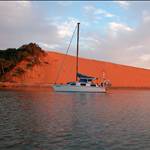
What would you do if ?

> 10 years ago
Reply
Register to post, see what you've read, and subscribe to topics.
SandS
SandS
VIC
5904 posts
VIC, 5904 posts
15 Jun 2010 11:52pm
What would you do if,......you were 4 miles west of a shore line the wind drops out, it,s oily calm ,engine wont start,your in 200 ft of water,its nearly sunset and theres a 30knt sthwesterly change forcast for 6am the following morning. your boat is 28ft long and weighs 3.5 ton all sails and rigg is ok .You are 30 mile from a safe habour?
planesailing
planesailing
WA
380 posts
WA, 380 posts
15 Jun 2010 11:02pm
Connect my dinghy with a long rope and start rowing at least when
the front arrives you may only have 15 miles to sail in it. probably
make 2knots in calm oily conditions.
Or wait for the front and sail home on reduced sail area.
frant
frant
VIC
1230 posts
VIC, 1230 posts
16 Jun 2010 10:08am
SandS said...

What would you do if,......you were 4 miles west of a shore line the wind drops out, it,s oily calm ,engine wont start,your in 200 ft of water,its nearly sunset and theres a 30knt sthwesterly change forcast for 6am the following morning. your boat is 28ft long and weighs 3.5 ton all sails and rigg is ok .You are 30 mile from a safe habour?


put the kettle on and have a cuppa.

you were obviously intending for an overnighter anyway so just prepare for reduced sail and to stand offshore when the breeze kicks in. Is it prudent to enter this harbour at midnight which would be the case if your engine was started. (30 mile @ 5 knots). If so then set about starting the engine, presumably an inboard diesel so change the spark plugs!!!! if all else fails
smash78
smash78
VIC
27 posts
VIC, 27 posts
16 Jun 2010 10:53am
SandS said...

What would you do if,......you were 4 miles west of a shore line the wind drops out, it,s oily calm ,engine wont start,your in 200 ft of water,its nearly sunset and theres a 30knt sthwesterly change forcast for 6am the following morning. your boat is 28ft long and weighs 3.5 ton all sails and rigg is ok .You are 30 mile from a safe habour?


Nothing, take shifts and each person have a sleep and wait untill the 30 knt winds to arrive and have a heap of fun sailing when it does arrive
nick0
nick0
NSW
510 posts
NSW, 510 posts
16 Jun 2010 6:10pm
frant said...

SandS said...

What would you do if,......you were 4 miles west of a shore line the wind drops out, it,s oily calm ,engine wont start,your in 200 ft of water,its nearly sunset and theres a 30knt sthwesterly change forcast for 6am the following morning. your boat is 28ft long and weighs 3.5 ton all sails and rigg is ok .You are 30 mile from a safe habour?


put the kettle on and have a cuppa.

you were obviously intending for an overnighter anyway so just prepare for reduced sail and to stand offshore when the breeze kicks in. Is it prudent to enter this harbour at midnight which would be the case if your engine was started. (30 mile @ 5 knots). If so then set about starting the engine, presumably an inboard diesel so change the spark plugs!!!! if all else fails


incase your not jokeing frant diesels dont have spark plugs
Rattlehead
Rattlehead
QLD
555 posts
QLD, 555 posts
16 Jun 2010 6:42pm
what,,,,It's 30 knots not 50 ,couple of reefs the main , # 3 heady cruise home in the morning ,If your that worried get on the blower call up the Coast Guard and get em to tow your sorry ass home!
SandS
SandS
VIC
5904 posts
VIC, 5904 posts
16 Jun 2010 7:42pm
Some interesting ideas there. I like PlaneSailing,s Rowing Idea , from the point of veiw of being able to put more distance between you and the lee shore . Thats the biggest risk here I recon, the potental for the 4 mile buffer to rapidly disappear
The Idea of doing nothing , not keeping an eye on current and or tide drift could put you in a nasty position , while your waiting for your 30 knts [ or 50 knts as is someones want] to sail home with . Also to use the time to change sails etc would make sence .
And Cisco,s "let someone know the situation and position" would hopefully be the first thing we would all do. And thankfully I havent had to deal with that situation myself Cisco, but now Ive got some Idea,s If it ever happens. And yes, spark plugs may come into play on the tenders outboard, while towing out to sea!!
badinfluence
badinfluence
QLD
538 posts
QLD, 538 posts
16 Jun 2010 8:09pm
Is this a trick question??

Can't see the problem myself?? Hopefully basic seamanship would get one out of the problem you describe??

Just a valid lesson that on a sailing boat the main power comes from sail and the AUXILIARY is the engine.

Thank goodness on real boats, we have two sources of getting where we need to go...LOL.

trace
SandS
SandS
VIC
5904 posts
VIC, 5904 posts
16 Jun 2010 9:25pm
badinfluence said...

Is this a trick question??

Can't see the problem myself?? Hopefully basic seamanship would get one out of the problem you describe??

Just a valid lesson that on a sailing boat the main power comes from sail and the AUXILIARY is the engine.

Thank goodness on real boats, we have two sources of getting where we need to go...LOL.

trace


Its not a trick question,just a question. The problem is theres no wind for 12 or so hrs and no " aux" engine . And yes hopefully basic seamanship would get one or two of us out of this problem.
frant
frant
VIC
1230 posts
VIC, 1230 posts
17 Jun 2010 8:00am
SandS said...

Some interesting ideas there. I like PlaneSailing,s Rowing Idea , from the point of veiw of being able to put more distance between you and the lee shore . Thats the biggest risk here I recon, the potental for the 4 mile buffer to rapidly disappear
The Idea of doing nothing , not keeping an eye on current and or tide drift could put you in a nasty position , while your waiting for your 30 knts [ or 50 knts as is someones want] to sail home with . Also to use the time to change sails etc would make sence .
And Cisco,s "let someone know the situation and position" would hopefully be the first thing we would all do. And thankfully I havent had to deal with that situation myself Cisco, but now Ive got some Idea,s If it ever happens. And yes, spark plugs may come into play on the tenders outboard, while towing out to sea!!


I first misread your situation as having the shore 4 miles to the West, ie a typical East coast situation with the change coming offshore. Reading it as you being 4 miles off the West coast puts you more like somewhere off Tasmanias West coast. A slightly more serious position. Now with a SW change forecast for approx 12 hours away you shouldn't be out there in a poorly prepared boat, surely the forecast change was first issued at least 48 hours earlier. Preparation is the key, don't head off in a boat that is not 100% reliable. Why won't the engine start? Poor maintenance or doesn't the hypothetical operator even know the basics of his boats systems. If the motor won't start whats to say that the rig is in good condition and that the operator can be trusted in his knowledge of how the whole boat works. As indicated in my earlier post if the operator doesn't know how to change the spark plugs in a diesel then he probably doesn't know how to get himself out of the predicament he is in. Best not to be out there in the first place.
frant
frant
VIC
1230 posts
VIC, 1230 posts
17 Jun 2010 8:23am
By the way I think plainsailing is being tongue in cheek when he suggests getting into the dinghy and rowing. You havent gone offshore in a 28 footer while actually towing a hard dinghy have you? Did you stow the hard dinghy on the foredeck or hang it from the davits on your 28 footer!!! So you have pulled out the inflatable, pumped it up and are now going to climb out of your boat into a dinghy at night!! Have you ever tried to row an inflatable or even motor an inflatable with its 2 hp seagull!! Now having rowed for 12 hours I would be knackered and probably in tip top shape to handle anything the weather could throw at me if only I could get back into the boat.
SandS
SandS
VIC
5904 posts
VIC, 5904 posts
17 Jun 2010 5:41pm
frant said...

SandS said...

Some interesting ideas there. I like PlaneSailing,s Rowing Idea , from the point of veiw of being able to put more distance between you and the lee shore . Thats the biggest risk here I recon, the potental for the 4 mile buffer to rapidly disappear
The Idea of doing nothing , not keeping an eye on current and or tide drift could put you in a nasty position , while your waiting for your 30 knts [ or 50 knts as is someones want] to sail home with . Also to use the time to change sails etc would make sence .
And Cisco,s "let someone know the situation and position" would hopefully be the first thing we would all do. And thankfully I havent had to deal with that situation myself Cisco, but now Ive got some Idea,s If it ever happens. And yes, spark plugs may come into play on the tenders outboard, while towing out to sea!!


I first misread your situation as having the shore 4 miles to the West, ie a typical East coast situation with the change coming offshore. Reading it as you being 4 miles off the West coast puts you more like somewhere off Tasmanias West coast. A slightly more serious position. Now with a SW change forecast for approx 12 hours away you shouldn't be out there in a poorly prepared boat, surely the forecast change was first issued at least 48 hours earlier. Preparation is the key, don't head off in a boat that is not 100% reliable. Why won't the engine start? Poor maintenance or doesn't the hypothetical operator even know the basics of his boats systems. If the motor won't start whats to say that the rig is in good condition and that the operator can be trusted in his knowledge of how the whole boat works. As indicated in my earlier post if the operator doesn't know how to change the spark plugs in a diesel then he probably doesn't know how to get himself out of the predicament he is in. Best not to be out there in the first place.


Best of luck trying to find the spark plugs in the diesel Frant!

cRAZY Canuk
cRAZY Canuk
NSW
2528 posts
NSW, 2528 posts
17 Jun 2010 5:42pm
Break out the tool box and fix the old noise box?

Use your sailing skills to sail the boat in what little wind comes by to stay off the lee shore and wait for the front to get you home?

SandS
SandS
VIC
5904 posts
VIC, 5904 posts
17 Jun 2010 5:57pm
cRAZY Canuk said...

Break out the tool box and fix the old noise box?

Use your sailing skills to sail the boat in what little wind comes by to stay off the lee shore and wait for the front to get you home?


yep, try to fix the old iron headsail ,and any breeze that comes well take it.

Sounds good to me ! Gota have that breeze though!
frant
frant
VIC
1230 posts
VIC, 1230 posts
17 Jun 2010 7:23pm
n
SandS said...

frant said...

SandS said...

Some interesting ideas there. I like PlaneSailing,s Rowing Idea , from the point of veiw of being able to put more distance between you and the lee shore . Thats the biggest risk here I recon, the potental for the 4 mile buffer to rapidly disappear
The Idea of doing nothing , not keeping an eye on current and or tide drift could put you in a nasty position , while your waiting for your 30 knts [ or 50 knts as is someones want] to sail home with . Also to use the time to change sails etc would make sence .
And Cisco,s "let someone know the situation and position" would hopefully be the first thing we would all do. And thankfully I havent had to deal with that situation myself Cisco, but now Ive got some Idea,s If it ever happens. And yes, spark plugs may come into play on the tenders outboard, while towing out to sea!!


I first misread your situation as having the shore 4 miles to the West, ie a typical East coast situation with the change coming offshore. Reading it as you being 4 miles off the West coast puts you more like somewhere off Tasmanias West coast. A slightly more serious position. Now with a SW change forecast for approx 12 hours away you shouldn't be out there in a poorly prepared boat, surely the forecast change was first issued at least 48 hours earlier. Preparation is the key, don't head off in a boat that is not 100% reliable. Why won't the engine start? Poor maintenance or doesn't the hypothetical operator even know the basics of his boats systems. If the motor won't start whats to say that the rig is in good condition and that the operator can be trusted in his knowledge of how the whole boat works. As indicated in my earlier post if the operator doesn't know how to change the spark plugs in a diesel then he probably doesn't know how to get himself out of the predicament he is in. Best not to be out there in the first place.


Best of luck trying to find the spark plugs in the diesel Frant!


trust me an old diesel mechanic taught me about finding and changing the spark plugs. Gave me a check list of all the things to do if it wont start including bleeding and unblocking the injectors, cleaning filters, polishing the fuel etc etc. at the end of the list and if you work through it systematically and it still wont start then you have to change the sparkplugs.....never got to that stage as they always fire up before then but this bloke knew what he was talking about, so don't jump to conclusions about sparkplugs and diesels. It always pays to have a systematic approach to a problem and then sometimes even the implausible or impossible can be achieved.
Please Register, or first...
Topics Subscribe Reply