madmission said..lydia said..
discipline from the trimmer.
Thanks Lydia , was afraid that was the answer .
I know Sailing is not an exact science but why on boats so dependent on mainsail trim and in demanding racing conditions do you use such a mainsheet system ?
Think i found the reasons from a discussion on SA
""Yes, the mainsheet purchase in the first post is 16/1 minus friction and stretch. Good for boats up to 6,000-10,000 pounds (and others). Setting up using the Harken catalogue is the bible. Not that you have to buy Harken blocks, but the math is sound.
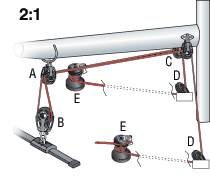
Only thing is every increase in purchase using multiple blocks results in a *lot* of loose line running at high speeds during jibes etc., piled in the cockpit upwind, etc. If the boat is big enough, dual dedicated mainsheet winches aft above a double ended 2/1 cockpit mounted traveller allows more sanitary control and higher sheet loads when cranked with much less slack line. Simply put, the 4/1 coarse tune with 4/1 fine tune is good to maybe 75lbs pull x 16 = 1,200lbs.OTOH, A 2/1 traveller setup going to winches with a serious grinder (50lb on a 12" winch handle on a single speed 5" diameter drum = 300lbs and a two speed winch may offer 24:1 in low gear = 7,400lbs tension, with much lower sheet travel when adjusting at high loads. Make sure you boat gear can handle such loads. It's all about sail sizes and shapes, and expected wind conditions, (and strength of mast, standing rigging and boom). I've known boats that have switched back and forth, delegating the aft winches to spinnaker sheets in light air venues using a 16/1 mainsheet purchase system, and on longer offshore races switching to direct winch mainsheet control and relegating halyard cabin top winches to the spinnaker sheets. I'll reiterate; putting really high loads on mainsheet, backstay, shrouds and sails may be fast, but make sure your gear can handle it. A 16:1 mainsheet coarse-fine tune is not a high load setup, probably not going to break anything but also not going to win; sorry.""