Converting a thruster SUP to a Twin fin

1 month ago
Reply
Register to post, see what you've read, and subscribe to topics.
colas
colas
5428 posts
5428 posts
14 Sep 2026 9:37pm
My only regret about having to switch from surfing to SUP was no longer having a twin-fin in my quiver, even though I’d loved twin-fins when I was younger.

There are quite a few different styles of twin-fin surfboards:
- the short, “competitive” ones with wide tails, popularized by Mark Richards
- the retro “fish” boards focused on speed
- and now the “mid-length” round-pin-tail boards, often with channels (e.g Gong’s Fury)

Since I already have a SUP thruster that’s very much geared toward smooth glide (my custom 8'1" hybrid shape between a Curve SP and an Alley) with a fast rocker, which I’d been riding with small fins to maximize its glide, I decided to have two fin boxes installed to convert it into a twin. This will serve as a test to see if I need to (even more) pester the Gong shaper for a future genuine Twin Fin SUP.

It cost me €140 at my local shaper (Spoutnik Surfboards, 200 meters from my house). Great work (FCS II boxes in Airex PVC foam cassettes), 220 g of weight added total. What I asked was for maximizing glide, speed and hold:
- the rear of fin base set 28 cm (11") from the tail, aft enough for drive and grip, as I planned to use Quobba L fins, smaller than usual Twin Fin fins for the less drag. I thought that the thin rails would provide enough bite to not require big fins.
- very little toe-in—about 1°— speed at the expense of looseness
- not too close to the rail, to mitigate the risk of spin-outs due to ventilation

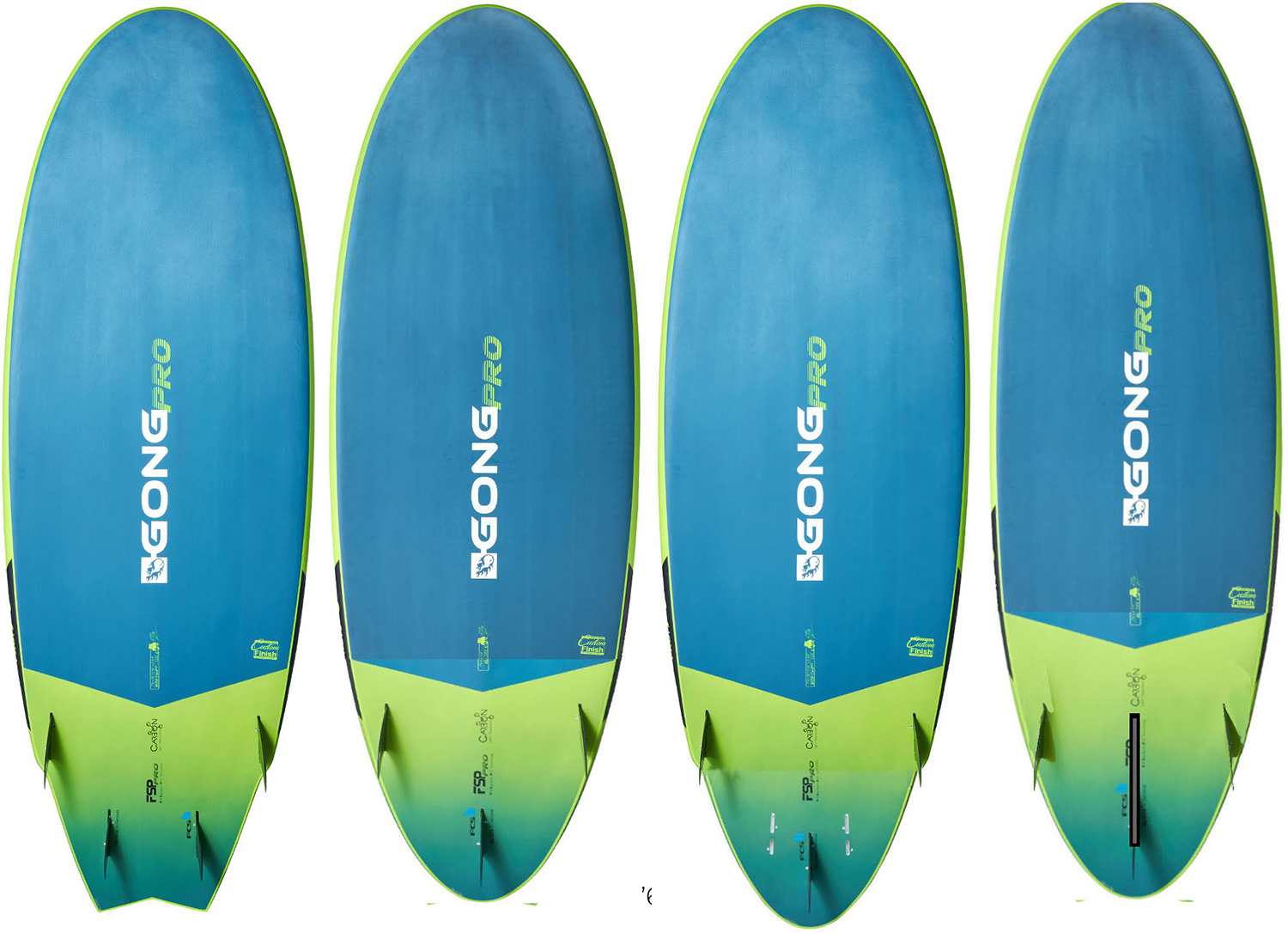
Before, a thruster 3-boxes setup:


After:


As you can see, the twin fin boxes are just between the side and central thruster boxes. 1" more to the rear than most 8'-ish twin fins.


First session, I rode some tiny but fairly hollow waves: not enough to attempt turns, but the speed was definitely there. Getting into the wave was noticeably easier than with its thruster setup.


Second day, the waves were a bit bigger but pretty mushy. I was really surprised by the grip: the fins set further back provide insane drive (and also less toe-in/fin pinch), and excellent stability in turns—despite their small size for twins: L —. That said, since the Quobba fins have both less drag and more stability than normal fins, it makes sense.
This board, already fast thanks to its rocker, is going to become a speed monster. Can’t wait to test it tomorrow in bigger waves (head high).

Third day: I’m blown away by this transformation:

- The board has perfect grip; the tail is anchored in the water like a single fin, with no wobble, no sloppiness, and no skidding that twin fins can get. I think this is due to the fin placement and their slight toe-in, combined with the thin rear rails.
- The board is still easy to turn by its pulled-in tail, but you must use the rear rails in turns (roll the board into turns).
- The natural speed gain is noticeable compared to its previous thruster setup—even with small fins—and especially the acceleration at the bottom turn, the “drive,” is on par with the best thrusters, plus it has the low drag of a twin fin.
- No issues on the backside—that’s always my concern with twin fins.
- The ride feels more like a mid-length Simmons than a Mark Richards-style twin.
- No need for big “twin” fins with all their drag. Good, standard yet effective fins are enough, and they’re significantly faster (less drag).

The board setup is more technical and less playful than a "pro" model like the Gong Alley; you have to set up your turns more carefully, push into them, and follow through—a bit like riding a single fin... but with the acceleration out of turns of a multi-fin setup..
It combines the teachable and reliable nature of a single fin with the drive and speed of a twin fin.

So, converting a board to a twin fin works.

I'd recommend however to put the fins 1" from the tail, with standard (similar to a thruster sides) toe-in, if you want a more balanced compromise speed/looseness, and use real (bigger) Twin Fin fins however. Also plan a box to add a central trailer if your rear rails are not very thin.

obijohn
obijohn
WA
171 posts
WA, 171 posts
16 Sep 2026 2:28am
Great detailed post. A fun and thought provoking read. Thanks for posting this.
colas
colas
5428 posts
5428 posts
5 Oct 2026 11:09pm
I love the frontside drive of this setup at the bottom turn, but to loosen it for the roller, I tried an asymetrical fin setup:

- keep the single "twin" on the toe side, where I have more control and can handle the drive

- but loosen the heel side but moving the fin forward, and complement it by a small symmetrical trailer to make it more tolerant to the clumsiness of pushing on my heels
I used a front fin with the head cut into a "spitfire" tip for less drag, the control being provided by the rear fin.

I am very satisfied with the result: the board keeps the speed and glide of a twin, with still lots of drive on my frontside turns, but with a noticeable looseness on the backside, without any squirelling.


obijohn
obijohn
WA
171 posts
WA, 171 posts
6 Oct 2026 2:01am
I love reading about all your experiments. I have a question for you to consider. If I remember correctly, you also have a windsurfing background. If so, do you remember the old assymetricals from the late 1980's? They had the same goal of creating bite and drive on the bottom turns but sharper turns on the cutbacks. We did this through three design features; a shorter rail line on the cutback side, the wide point pulled back on the cutback side so there was more curve in the rear part of the rail outline, and sometimes there was a side fin placed just on the cutback side to provide a further forward fin position. With your new setup, I am wondering what would happen if you kept the twin fin position on the bottom turn side, and used a fin in the old thruster box on the cutback side without the trailing fin you have behind that now. That might give you the results you are liking on the bottom turn, and even more looseness on the cutbacks. I can see the advantage of having the cutback side fin further forward, but I am not sure about the advantage of having the trailing fin behind that one which would seem to just make it harder to turn tight off that heel rail.
Just a thought from a fellow 'fin experimentor'.
colas
colas
5428 posts
5428 posts
6 Oct 2026 2:46am
Yes,, of course, I remember the "can opener" windsurfing boards of the last century.
Never tried them, I did not had good reliable cross/off shore spots.

I surfed a lot twin fins before the thruster era, and loved how the thruster fixed the problems I had backside with the twin fins.
I am afraid that using only the front box on the heel side will make the board oversteer and kill the speed mid-turn.

Having two fins on the heel side make the fin pivot zone wider, so the board is less sensitive to the precise position of the foot.

This said, you are right, this needs to be tested :-)

I had the idea to experiment this after seeing a reputed local shaper, Chienville, explain his asymetrical design in this interesting video (In French, but with English subtitles).
As you can see, in his asymmetrical designs with only two fins, the heel fin is only moved forward a tiny bit (such as the yellow board on the right of the title video pic). My setup is closer to the purple one in the middle.


thegreatsup
thegreatsup
605 posts
605 posts
6 Oct 2026 6:26pm
That is crazy colas!! Good on you for. Trialling and documenting new things 🙂
flowmaster
flowmaster
375 posts
375 posts
6 Oct 2026 11:56pm
Next post he reshaped the tail 😎,

colas
colas
5428 posts
5428 posts
7 Oct 2026 2:57am
flowmaster said..
Next post he reshaped the tail 😎,


Nah, I love round tails.

... Which means that, yes, I toyed with the idea of reshaping the fish tail of my Mob to a round tail :-)
colas
colas
5428 posts
5428 posts
7 Oct 2026 6:02pm
Discussion with the answers of the Gong shaper:
www.gong-galaxy.com/en/blogs/magazine/matos-et-si-le-tail-de-la-mob-etait-rond?

flowmaster
flowmaster
375 posts
375 posts
10 Oct 2026 2:10am
The tail off one and three is a bit like the Hipster swallow and pin but the nose and rails look different, also the rocker line could be different but interesting this
drivethebus
drivethebus
NSW
239 posts
NSW, 239 posts
10 Oct 2026 6:52am
Hi Colas, a great experiment I have a Hipster Twin which I love and recently added an Infinity Escape Pod. The E.P is so fast and has that friction free feel on a wave, the thing that surprised me the most was how solid it feels on my backhand. Not a true twin and a little challenging for me with my height and weight at 6'3 and 100 kg riding the 7'10 E.P.

Where you inspired by the Harley Ingleby HIBT 3+3?

thunderboltsurf.com.au/collections/tolhurst-x-hi/products/tolhurst-hibt?variant=46680117149931

I have toyed with asking Sunova or SMIK for a custom SUP with the same fin set up. So reading that yours works is great.

Cheers.

Steve.
colas
colas
5428 posts
5428 posts
10 Oct 2026 4:54am
drivethebus said..
Where you inspired by the Harley Ingleby HIBT 3+3?


No, I wasn't aware of it! Thanks a lot for the info, yes it seems the same basic idea.
colas
colas
5428 posts
5428 posts
16 Oct 2026 1:15pm
Interesting: HI explains that after experimenting with asymmetrical board design he found out that it was the asymmetry in fins that was the key, the board shape was not as important.
Summary of his video:

Harley Ingleby Reveals HIBT 3+3 Design Secrets: Board Explained

- **Channel :** Hawaiian South Shore Surf Boutique
- **Date :** 2026-05-06
- **Duration :** 32:08
- **Source :**


## Summary

Harley Ingleby walks through the HIBT ("H A B T" — his first full board collaboration with Billy Tolhurst, ~2.5 years in development), a flat-fish-tail performance board that sits between the Moe and Mid Six in dimensions but is, in his words, "very much a shortboard" — just a big surfboard at the longer sizes, not a mid-length. Its headline feature is a 3+3 fin system: dedicated twin-fin and quad plug sets that turn one board into "two surfboards in one" — or three, since you can ride a broken-up twin/quad set as an asymmetric setup, recapturing the feel of Harley's 2016 ASM without buying an actual asym.

## Origins of the 3+3 fin system

- The idea traces back to Harley's 2016 ASM (asymmetric board): riding it, he sensed a "stickiness" in transition from having a long toe-side rail and short heel-side rail — cutting the swallow tail to match the round tail's length removed it.
- That made him wonder how much of the asym feel came from the fins rather than the uneven plan shape. He retrofitted twin-fin plugs into symmetrical swallow-tail quads and found that **just breaking up the fin sets reproduced the whole asym sensation**.
- Market lessons also fed in: Moe and Mid Six owners loved adding twin fins, but putting twins in the front plug position doesn't work well (longer base puts fins too close to the rail, board rides too loose and forces a forward stance). A true rear twin-fin position is essential — hence two dedicated plug sets.
- Asyms also failed commercially in 2016: they required bespoke broken-up fin sets in every size, natural and goofy skew. The 3+3 lets anyone "dabble with asym without risk."

## Design details

- **Rocker:** Billy Tolhurst's BT twin-fin rocker — super fast — with a little tail flip added. Flatter between the feet than the Moe/Mid Six, so even faster trim speed; nose keeps a performance entry rocker with kick for knitting into steep waves ("not a flat groveller twin fin").
- **Flyer:** after testing drop flyers and low-foiled flyers, they settled on a "sting-style flyer" — a square-cut tail rail after the flyer, in a traditional flyer position. Makes the board extremely free and loose off the top, even as a quad, with almost no stuck re-entries.
- **Rails/hold:** thin, small performance rails do the holding so the releasing flyer doesn't cost drive; bury the rail and it holds, de-weight and it releases instantly. Harley notes a sting-style flyer with thick blocky tail rails would lose carry.
- **Tail:** baby swallow — "almost having two pin tails": width of a pod for planing speed plus two corners to stall, steady the ship and control speed in juicy waves; swallows also transition rail-to-rail cleanly.
- **Bottom:** deliberately simple — flat up front with slight rail relief (keeps the nose neutral, no stick/buck risk from excess concave in dead or hollow sections), light double concave between the feet, blending to near-dead-flat out the back. Flat front + rail relief also allows smaller, quicker-engaging rails without unforgivingness.
- **Construction:** Red construction with a slightly de-tuned internal structure so a 5'10" doesn't ride too rigid; Harley (≈88 kg, heavy-footed) reports little to no denting.
- **Sizing:** R&D started on an oversized 6'6" "magic stick" then scaled both ways — you can't cheat on an oversized board the way you can overpower a low-volume shortboard. Biggest size is a 7'2" / 50 L with noticeably more nose volume for paddle but tail thickness nearly identical to the 5'10"; Harley keeps the ~40 L 6'6" as his favorite.
- **Fins:** FCS — Power Twin (designed by Harley for the 2016 Twinny) on the toe side, Reactor larges / Performer mediums in new PG construction as the matching quad set, released at launch. Twin plugs are white inside, quad plugs black; boards ship with a peel sticker explaining fin placement.

## How it surfs

- **Quad** is its strong suit in Harley's point-break waves; **twin fin** suits peaky/weak surf — he's ridden it overhead on twins no problem, and experienced twin-finners effectively have "no limit" on size.
- **Asym setup** (twins toe, quads heel): frictionless speed and far-out bottom turns from the twin, hard drive off the backhand quad with easy release off the top — "best of both worlds," and it genuinely feels like a true asym.
- Range: knee-high to comfortably double overhead as a quad; Harley has surfed it double-overhead back beach and believes it would handle country double overhead (the Mid Six probably a touch better there, but this would do).
- Forward wide point plus the neutral flat-bottom front means you can stay on the tail and surf it like a performance board, or creep forward to trim in low-power sections — no forced mid-length stance.
- Versus the Moe: more speed, dramatically easier out of the lip, more shortboardy lip interaction; the Moe keeps its own flowy fishy feel and remains a number-one seller seven-plus years on. The smaller sizes finally give the range an entry point for surfers who wanted something shorter than a Moe or Mid Six.
Please Register, or first...
Topics Subscribe Reply