Shaft stiffness and flex character

> 10 years ago
Reply
Register to post, see what you've read, and subscribe to topics.
Paddlezz
Paddlezz
101 posts
101 posts
26 Jan 2014 10:41pm
Need a new paddle for a 14 allwater board soon,
so I read and read a lot about paddle-shafts, like round, round tapered, oval, oval tapered, stiff, flex,
a little more flex and got more and more confused.
How I can compare shafts from different manufactures?

Is it time too think about a with home&kitchen-tools measurable standart what describes stiffness and flex-characteristic of the paddle-shafts ? that everybody can understand and able too reproduce?
Just to judge the application area and personal suitability .

What is your opinion??

grtz
Laz


DavidJohn
DavidJohn
VIC
17570 posts
VIC, 17570 posts
27 Jan 2014 6:57am
What was the question?

I think it's more a 'feel' thing rather than a maths or science thing.
petedorries
petedorries
QLD
700 posts
QLD, 700 posts
27 Jan 2014 7:12am
DavidJohn said..

What was the question?

I think it's more a 'feel' thing rather than a # or science thing.


What DJ said....
LordRumpunc
LordRumpunc
NSW
60 posts
NSW, 60 posts
27 Jan 2014 8:32am
Bigger the bloke... stiffer the paddle!
surfershaneA
surfershaneA
869 posts
869 posts
27 Jan 2014 6:34am
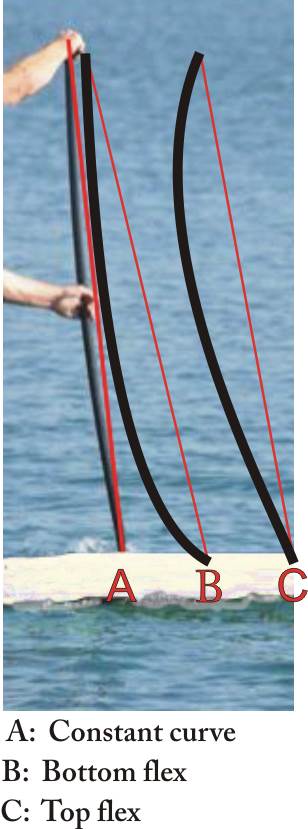
Personally , I preffer a much stiffer shaft like type A surfing, a Kialo Methane This has a lot to do with my past experience paddling Canadian canoes. I can really bury the paddle without the flex throwing me off. Regardless, on shorter faster boards, for a bit more responsiveness, I would consider type B bottom flex in a stiffer shaft.

From my limited flat water paddling experience, I find a more flexible shaft is definitely the go. Especially distance paddling, too stiff a shaft is hard work For a nice balance of flex and power, type B like the tampered Ke Nalu, would be the go?

Cheap soggy constant flex paddles are just bloody horrible as are most of the extenables.

Hope this helps?
E T
E T
QLD
2286 posts
E T E T
QLD, 2286 posts
27 Jan 2014 8:39am
What DJ and Pete said I reckon.

ET.
KennyK
KennyK
QLD
395 posts
QLD, 395 posts
27 Jan 2014 9:20am
For me, I find a really stiff shaft like the QB Kahana too hard on my dodgy shoulders.
I prefer a bit of flex to reduce the initial impact on the shoulders. I currently and for a long time have used a Kialoha Methane which had a nice oval shaft, (feels good in the hands), and has a bit of flex.
I just tried a naish adjustable Makani which I thought had probably too much flex, although having said that I would like to use it for a bit longer to really know, but that was my initial thought.
But overall I would say that more than anything it will come down to personal preference. What suits your physiology the best.
And after trying enough different paddles you will know.
RJK
RJK
NSW
622 posts
RJK RJK
NSW, 622 posts
27 Jan 2014 1:25pm
petedorries said...
DavidJohn said..

What was the question?

I think it's more a 'feel' thing rather than a # or science thing.


What DJ said....


I disagree, flex is for pansies
laceys lane
laceys lane
QLD
19804 posts
QLD, 19804 posts
27 Jan 2014 12:38pm
RJK said..

petedorries said...
DavidJohn said..

What was the question?

I think it's more a 'feel' thing rather than a # or science thing.


What DJ said....


I disagree, flex is for pansies


i disagree -flexless is for those that don't know an better

i reckon too many paddle companies put it in the too hard basket to develop strong rebounding flexing shafts.

easier just give them stiff shafts and tell them that's what racers use- it's old hat
Mahanumah
Mahanumah
VIC
336 posts
VIC, 336 posts
27 Jan 2014 1:43pm
Oh are we talking about paddles?
RJK
RJK
NSW
622 posts
RJK RJK
NSW, 622 posts
27 Jan 2014 2:32pm
laceys lane said...
RJK said..

petedorries said...
DavidJohn said..

What was the question?

I think it's more a 'feel' thing rather than a # or science thing.


What DJ said....


I disagree, flex is for pansies


i disagree -flexless is for those that don't know an better

i reckon too many paddle companies put it in the too hard basket to develop strong rebounding flexing shafts.

easier just give them stiff shafts and tell them that's what racers use- it's old hat


Haha, yeah, I just don't understand how flex can be a benefit apart from being softer of your shoulders. In which case surely a smalle blade would achieve the same thing

husq2100
husq2100
QLD
2031 posts
QLD, 2031 posts
27 Jan 2014 1:51pm
RJK said..

laceys lane said...
RJK said..

petedorries said...
DavidJohn said..

What was the question?

I think it's more a 'feel' thing rather than a # or science thing.


What DJ said....


I disagree, flex is for pansies


i disagree -flexless is for those that don't know an better

i reckon too many paddle companies put it in the too hard basket to develop strong rebounding flexing shafts.

easier just give them stiff shafts and tell them that's what racers use- it's old hat


Haha, yeah, I just don't understand how flex can be a benefit apart from being softer of your shoulders. In which case surely a smalle blade would achieve the same thing


depends, the energy going into flexing the shaft has to be released. It can not be stored in it (hmmm maybe KERS for paddling......anyway) so depending on the shaft design, how that energy is released is key.

Note, the shaft will not "make" energy and a good design should return most of it some how. Just dont want it releasing the energy on exiting the water.

RJK
RJK
NSW
622 posts
RJK RJK
NSW, 622 posts
27 Jan 2014 3:11pm
husq2100 said...
RJK said..

laceys lane said...
RJK said..

petedorries said...
DavidJohn said..

What was the question?

I think it's more a 'feel' thing rather than a # or science thing.


What DJ said....


I disagree, flex is for pansies


i disagree -flexless is for those that don't know an better

i reckon too many paddle companies put it in the too hard basket to develop strong rebounding flexing shafts.

easier just give them stiff shafts and tell them that's what racers use- it's old hat


Haha, yeah, I just don't understand how flex can be a benefit apart from being softer of your shoulders. In which case surely a smalle blade would achieve the same thing


depends, the energy going into flexing the shaft has to be released. It can not be stored in it (hmmm maybe KERS for paddling......anyway) so depending on the shaft design, how that energy is released is key.

Note, the shaft will not "make" energy and a good design should return most of it some how. Just dont want it releasing the energy on exiting the water.


Yeah but the way I see it is rebound only returns the energy when the force you put in the shaft is backed off (at the back end of the stroke). And instead of the blade rebounding though the water giving you "extra power", this force is absorbed through the decellaration of the shaft as your stroke slows at the back end.

Anyway, I still think flex is for pansies, anything else is marketing hype
KennyK
KennyK
QLD
395 posts
QLD, 395 posts
27 Jan 2014 2:57pm
If your shaft is consistently too flexible try Viagra.
laceys lane
laceys lane
QLD
19804 posts
QLD, 19804 posts
27 Jan 2014 3:12pm
all i know is the 7.25 innegra fanatic paddle is by far the best paddle i've owned, they have sold bucket loads of them and a paddler like jake jenson, a well known pansy, switches between the carbon and innegra versions- both being flexy


its the future- small blades and good flexy shafts
supallday
supallday
84 posts
84 posts
27 Jan 2014 2:43pm
laceys lane said...
all i know is the 7.25 innegra fanatic paddle is by far the best paddle i've owned, they have sold bucket loads of them and a paddler like jake jenson, a well known pansy, switches between the carbon and innegra versions- both being flexy


its the future- small blades and good flexy shafts


I agree but on the flip side to the trend of small flexy blades.. Is kai Lenny his Le blade is big in today's terms and bloody stiff !! And he's one of the smallest lightest blokes at the pointy end of the sport
Deano72
Deano72
NSW
540 posts
NSW, 540 posts
27 Jan 2014 6:34pm
It's great that there are plenty of paddle options available.
There's no one blade size or shape or shaft stiffness that suits everyone......even though some of the hype would have you believe otherwise.
Demo some different stuff and go with what feels comfortable.....but keep in mind that what's comfortable for you now may not be in the future as your skills grow, fitness changes and technique evolves.
laceys lane
laceys lane
QLD
19804 posts
QLD, 19804 posts
27 Jan 2014 6:23pm
supallday said..

laceys lane said...
all i know is the 7.25 innegra fanatic paddle is by far the best paddle i've owned, they have sold bucket loads of them and a paddler like jake jenson, a well known pansy, switches between the carbon and innegra versions- both being flexy


its the future- small blades and good flexy shafts


I agree but on the flip side to the trend of small flexy blades.. Is kai Lenny his Le blade is big in today's terms and bloody stiff !! And he's one of the smallest lightest blokes at the pointy end of the sport


thats interesting because from what i was told the year before at the bop he was leading the charge with using smaller blades. maybe he needed a bigger blade to steer around his board with that small fin of his
husq2100
husq2100
QLD
2031 posts
QLD, 2031 posts
27 Jan 2014 8:51pm
RJK said..

husq2100 said...


depends, the energy going into flexing the shaft has to be released. It can not be stored in it (hmmm maybe KERS for paddling......anyway) so depending on the shaft design, how that energy is released is key.

Note, the shaft will not "make" energy and a good design should return most of it some how. Just dont want it releasing the energy on exiting the water.


Yeah but the way I see it is rebound only returns the energy when the force you put in the shaft is backed off (at the back end of the stroke). And instead of the blade rebounding though the water giving you "extra power", this force is absorbed through the decellaration of the shaft as your stroke slows at the back end.

Anyway, I still think flex is for pansies, anything else is marketing hype


Agreed to a point, just like the flex should be limited to a point. IMO, the shaft will flex somewhat with the intial loading but max out and transmit that force during the stoke

A few things to consider, we are not pushing water backwards, but propelling ourselves forward, levering off the water in front (think of the paddle staying at the point of entry and us and boards moving forward to meet/pass it)

If you are paddling really technically, your paddle is still near vertical when removing to start next storke, so any relaxing will now release what energy is left over through the blade at that point.

If you are a crap paddler like me, then you dont release early enough and that paddle is now pushing up (bogging down the board) and energy is wasted.

Most paddle rates are fairly continuous though out the stroke, ie no real accerlation or decellaration in one stroke.

supallday
supallday
84 posts
84 posts
27 Jan 2014 6:52pm
You might be right LL I'm just going on a few pictures I've noticed and his paddle seems just like the mass produced Le race paddle sold in the shops which is 95 odd sq and the one I demoed seemed so stiff very little flex that could of been my poor technique and with the very small amount of rake on the Blade it really let's you know if you have left the blade in to far past the feet. Clearly it works for Lenny though as in sure he gets what he wants from Naish
Kieranr
Kieranr
NSW
526 posts
NSW, 526 posts
27 Jan 2014 10:24pm
I think a bit of flex with a medium size blade is great. That said my paddle requirements are very different to most others; I cut my paddles about 1500 - 1600mm. That's from tip of blade to top of handle.
As a result of this I've got some seriously stiff paddles. For example: a 100sq inch quick blade elite racer. Now that's stiff!! With that size blade it gasses me out over any great distance(5k+). It's great for sprinting though.
I've got 5 different paddles in all different sizes/shaft compositions that I've tried and I keep going back to a mid size(95sq") blade and reasonable flex shaft for most of my distance paddling. (After it's cut down it's probably got flex similiar to a longer "stiff" shaft).That's what works for me.
I think it is different for everybody and that there is no single correct answer. Best advice of all is to speak to your local shop and demo as many as possible.
latman
latman
QLD
177 posts
QLD, 177 posts
28 Jan 2014 9:17pm
the smaller diameter at the top of the shaft will always flex more than the rest of it , I'm sure it could be worked out mathematically if you were so inclined
husq2100
husq2100
QLD
2031 posts
QLD, 2031 posts
28 Jan 2014 9:22pm
latman said..

the smaller diameter at the top of the shaft will always flex more than the rest of it , I'm sure it could be worked out mathematically if you were so inclined


assuming the same wall thickness through out, and constant shape...
laceys lane
laceys lane
QLD
19804 posts
QLD, 19804 posts
28 Jan 2014 9:53pm
assuming the shaft tapers
Paddlezz
Paddlezz
101 posts
101 posts
28 Jan 2014 11:25pm
Hi SUP friends,

thank you for the mostly serious and some less serious reactions to this complex topic.
I have actually 4 OC1 paddles and use only one, so I would not like that I have to buy again four SUP paddles , until I found a suitable.
How many " bad buy" paddles have you folks in your garage?

Generally, one can deduce that a paddle is very much judged subjectively, so I try to divide the most important factors of selection into three categories.

1.) Human factor:body size, body weight, fitness level, paddle technique, experience, application area (race- short/long distance/ touring / downwind / surf)

2.) Blade: blade area, width in x axis, length in y axis, shape of the blade, dihedral, flat, concave, deepest spot of the concave respect to the y axis, the shaft/blade angle of attack in degrees.
(the flex characteristics of the blade should neglecting here, although the course also contributes to total flexibility)

3.) Shaft: (The most important Joint IMO btw. the human body and water )
physical properties of the paddle shaft; like geometry (round / oval)
shaft diameter, length, parallel or tapered and the laminate construction

to 3.)

For bending behavior and stiffness of the shafts can be said in general: (see the illustration above)

A.) Constant curve-flex is a one piece shaft with: ( the most offered shaft's I guess)

- constant diameter over the full length, NOT tapered
- round is softer
- oval is stiffer (compared with the same wall thickness)
Diameter size:
- small diameter (1 inch or less) is softer
- bigger diameter is stiffer (compared with the same wall thickness)

B.) Bottom flex
-unknown
(In the case you'll mix a stiff constant flex shaft with a supersoft blade)

C.) Top flex is a one piece shaft with:

Tapered shaft, round or oval ( round is softer, compared with the same wall thickness)
The more tapering the more Topflex
Constant diameter round/oval over the full length,Topflex is build in with gradually extending the fibers

Please tell if I'm wrong or forgot something.I know this is common knowledge for most of yours, but somebody must it write down.

Hope these rough considerations make some & my a pre-selection of the right shafts easier.
Concerning the relative stiffness and dimensions of flexibility "Measuring is knowing" but unfortunately I don't have some test objects...yet.


PS.: Sorry my poor english, the google translator sucks again,
just try to read between the letters.
colas
colas
5388 posts
5388 posts
29 Jan 2014 7:44pm
In my experience, you may want some flex in the shaft, to save your joints, but the less possible flex at the shaft/blade junction, where it messes your stroke (cheap brands often have weak shaft/blade connections). Maybe this means that "flex top" could be better to give some flex while keeping control?
Kami
Kami
1566 posts
1566 posts
29 Jan 2014 11:24pm
Paddlezz said..

Hi SUP friends,

thank you for the mostly serious and some less serious reactions to this complex topic.
I have actually 4 OC1 paddles and use only one, so I would not like that I have to buy again four SUP paddles , until I found a suitable.
How many " bad buy" paddles have you folks in your garage?

Generally, one can deduce that a paddle is very much judged subjectively, so I try to divide the most important factors of selection into three categories.

1.) Human factor:body size, body weight, fitness level, paddle technique, experience, application area (race- short/long distance/ touring / downwind / surf)

2.) Blade: blade area, width in x axis, length in y axis, shape of the blade, dihedral, flat, concave, deepest spot of the concave respect to the y axis, the shaft/blade angle of attack in degrees.
(the flex characteristics of the blade should neglecting here, although the course also contributes to total flexibility)

3.) Shaft: (The most important Joint IMO btw. the human body and water )
physical properties of the paddle shaft; like geometry (round / oval)
shaft diameter, length, parallel or tapered and the laminate construction

to 3.)

For bending behavior and stiffness of the shafts can be said in general: (see the illustration above)

A.) Constant curve-flex is a one piece shaft with: ( the most offered shaft's I guess)

- constant diameter over the full length, NOT tapered
- round is softer
- oval is stiffer (compared with the same wall thickness)
Diameter size:
- small diameter (1 inch or less) is softer
- bigger diameter is stiffer (compared with the same wall thickness)

B.) Bottom flex
-unknown
(In the case you'll mix a stiff constant flex shaft with a supersoft blade)

C.) Top flex is a one piece shaft with:

Tapered shaft, round or oval ( round is softer, compared with the same wall thickness)
The more tapering the more Topflex
Constant diameter round/oval over the full length,Topflex is build in with gradually extending the fibers

Please tell if I'm wrong or forgot something.I know this is common knowledge for most of yours, but somebody must it write down.

Hope these rough considerations make some & my a pre-selection of the right shafts easier.
Concerning the relative stiffness and dimensions of flexibility "Measuring is knowing" but unfortunately I don't have some test objects...yet.


PS.: Sorry my poor english, the google translator sucks again,
just try to read between the letters.


You seem to me right about every thing.
Can be forget about relation between the type of shaft section and the length of the shaft.
The mix of these 2 parameters give the effect how you want in the all paddle itself.
I think that dealer of paddle should have different section of carbon pipe in relation of length paddle wanted customer ask for.
IMO, would be custom paddle shop, this way you can have it the way you like, long or short , stiff or flex whatever you like , yep Lacey
bownes
bownes
122 posts
122 posts
30 Jan 2014 12:59am
Kieranr said..

I think a bit of flex with a medium size blade is great. That said my paddle requirements are very different to most others; I cut my paddles about 1500 - 1600mm. That's from tip of blade to top of handle.
As a result of this I've got some seriously stiff paddles. For example: a 100sq inch quick blade elite racer. Now that's stiff!! With that size blade it gasses me out over any great distance(5k+). It's great for sprinting though.
I've got 5 different paddles in all different sizes/shaft compositions that I've tried and I keep going back to a mid size(95sq") blade and reasonable flex shaft for most of my distance paddling. (After it's cut down it's probably got flex similiar to a longer "stiff" shaft).That's what works for me.
I think it is different for everybody and that there is no single correct answer. Best advice of all is to speak to your local shop and demo as many as possible.


This is interesting as it relates to archery believe it or not. The stiffness (spine) of an arrow increases greatly the shorter the arrow is cut.
One arrow may come in many different spines or wall thicknesses and an archer will consider what suits his/her bow best at the length it will be cut.
Generally the wall thickness and taper of the arrow will determine the "spine" and there are detailed charts to assist in this..

I expect SUP paddles shafts may follow this example eventually with more technical information on the flex of a shaft to an industry standard.
As it stands now one man's flexi shaft may be quite different to another... so to speak.
caltrano
caltrano
VIC
87 posts
VIC, 87 posts
30 Jan 2014 4:44pm
I have broken 3 paddles over the last 18 months and have just ordered 4 shafts from exel composites

I ordered 4 No. PCKS 20 @1.65m.

The PCKS 20 is 75% glass / 25% carbon/Kevlar and outer dia 29.5 (approx. 2.5mm wall thickness and weigh 320g at 1.65m.)

Steve @ Exel was helpful and went through the different options and benefits - given my experience with my other 3 paddles (1*trident and 2*QB) I am keen for strength and low flex. One paddle broke 300mm from the top of the shaft and the other 2 in near the middle.

It has been hard to sort out replacements but I am sick of buying new stiffer paddles only to see them fail also.


KennyK
KennyK
QLD
395 posts
QLD, 395 posts
30 Jan 2014 9:07pm
Just demo'd a couple of Naish Vario paddles. The Koholo, 100% carbon, and the Makani 75% carbon.
I need a bit of flex to limit the impact on my injured shoulders.
However I found the Makani to have too much flex for my likings.
The Kaholo had a bit of flex, just a little bit more than my Kialoha Methane.
It also has a larger diameter shaft which felt much better.
So I bought the Koholo.
Interesting to note is that I demo'd the 8.5 Koholo and the 8.o Makani, I noticed that the Koholo didn't feel any bigger than the Makani when paddling.
So when I finished I compared the two by laying one over the top of the other, to my surprise they were the same size.
The Koholo 8.5 is supposed to be .5" wider than the Makani 8.0, go figure? The Makani may be half a bees dick smaller up the top.
Anyhow when compared to my Methane 97 sq", the Kaholo is a bees dick bigger, so I guess the area that the Kaholo is meant to be at 98 sq" would likely be accurate. However I would suspect that the Makani is not 95.3 sq", but more like 97.5 - 98 sq"?
I used to own a 100 sq" Quickblade Kahana which had a very stiff shaft, I found it to be far too taxing on my shoulders.
I put it down to a combination of the large blade as well as the stiff shaft.
Please Register, or first...
Topics Subscribe Reply