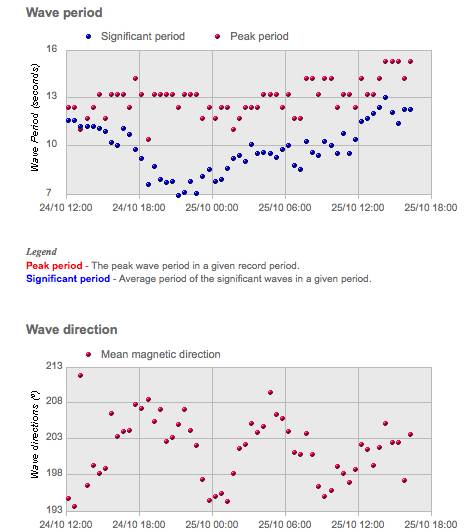
wave period and wave direction graphs

> 10 years ago
Reply
Register to post, see what you've read, and subscribe to topics.
oliver
oliver
3952 posts
3952 posts
25 Oct 2009 3:15pm
Can someone explain these graphs to me. Iv'e been trying to understand what they mean but just go along and pretend to think all the dots are meaningful - which they obviously are. For example, the last dot on the wave direction chart ( the bottom chart, one how does that single dot tell me what direction the swell is - or do I have to join the dots?)


Ted the Kiwi
Ted the Kiwi
NSW
14256 posts
NSW, 14256 posts
25 Oct 2009 6:38pm
I interpret these charts as telling me we have a 12 second swell on average (with a few longer period ones thrown in) and its mainly coming from the SSW direction. 180 is direct south swell and 270 is west so 203 is pretty much south with a little bit of west in it. The single dots are just points in time that the buoys take readings. Think of them as discrete points - a single point in time. No real need to join them up - just take an overview of them and calculate yourself a rough average. A few degree's is not going to make much difference. Where it gets interesting is when the buoys are picking up to distrinctly different swells at once. Eg: a south swell and a new North East on its way. The good tihng about this chart is that its showing you that the period is increasing as we move forward. A very positive thing to see!!!!

oliver
oliver
3952 posts
3952 posts
25 Oct 2009 3:49pm
Ted the Kiwi said...

I interpret these charts as telling me we have a 12 second swell on average (with a few longer period ones thrown in) and its mainly coming from the SSW direction. 180 is direct south swell and 270 is west so 203 is pretty much south with a little bit of west in it. The single dots are just points in time that the buoys take readings. Think of them as discrete points - a single point in time. No real need to join them up - just take an overview of them and calculate yourself a rough average. A few degree's is not going to make much difference. Where it gets interesting is when the buoys are picking up to distrinctly different swells at once. Eg: a south swell and a new North East on its way. The good tihng about this chart is that its showing you that the period is increasing as we move forward. A very positive thing to see!!!!


Yep I understand the direction now, the y column is the direction in degrees and 180 degrees is south, 360 or 0 would be north.

Now with the wave period of 12 seconds does that tell us the spacing of the waves or the sets. Would this mean the lower the peak period the more waves?

OG SUP
OG SUP
VIC
3516 posts
VIC, 3516 posts
25 Oct 2009 6:50pm
Oliver,

All you need to look at is that the swell direction over the time period logged is between 193 and 213 deg.

180 deg is directly south
225 deg is directly south west
270 deg is directly west

So the swell direction vector was SSW and varied in direction by 20 degs.

Phill
Kagey
Kagey
569 posts
569 posts
25 Oct 2009 3:58pm
Period is everything in determining size and power of shoreline surf. Long period swells (like 13 seconds) will pack more size and more punch when compared to a short period wind swell (like 4 seconds). And for your information my local has a wave period of 3 tomorrow...
oliver
oliver
3952 posts
3952 posts
25 Oct 2009 4:05pm
Kagey said...

Period is everything in determining size and power of shoreline surf. Long period swells (like 13 seconds) will pack more size and more punch when compared to a short period wind swell (like 4 seconds). And for your information my local has a wave period of 3 tomorrow...


Could I interpret then that the time period relates to how the bouy is being hammered? ie the bouy is being hammered every 13 seconds with a bigger wave or altenatively every 3 seconds as you are experiencing with a less powerful wave?

Thanks for all your responses. I've been looking at these things for months and was acting all cool but didn't really have any idea of what it all meant.
Kagey
Kagey
569 posts
569 posts
25 Oct 2009 4:33pm
Yup and I got this from a dictionary just to clarify;

wave period: The time required for two successive wave crests to pass a fixed point, or the time for a single wave crest to travel a distance equal to the length of the wave.
daletor
daletor
VIC
301 posts
VIC, 301 posts
25 Oct 2009 8:02pm
The wave period of the graph above indicates a ground swell. Once it starts showing 12 and above you know it is not just a localised wind swell and has come from a long way away (groundswell)


With the swell direction you will notice that it oscillates every 6 hours. As this is from the wavebouy just outside the Rip(Pt Nepean) I suspect it is from tidal influence. Do wave bouys in other locations show this oscillation due to tide?

The swell direction is handy for identifying spots that need a south swell to get in to them. If there is a howling northerly or northwesterly yo can see how it affects this graph from a direction that cannot be groundswell.

Takes a while to understand what this data means but once you get the hang of it is priceless. It is my first point of call for planning my session for the next day and checking it out first thing in the morning.
Bnaccas
Bnaccas
VIC
1722 posts
VIC, 1722 posts
26 Oct 2009 12:37am
Hey Oliver, Wave height is straight forward but swell direction and period tells the story.

The period has been well explained above, the average time between the peak or
trough of 2 swells. The higher the number the better.

Swell direction is very important to know for your protected breaks and reefs.
An example, I surfed Pt Leo at 3ft with just Simon Trigger and 2 other guys out when
the open beaches where only 4ft due to direction. 10degrees can make a big difference.
goatman
goatman
NSW
2151 posts
NSW, 2151 posts
26 Oct 2009 10:39am
Another interesting thing regarding period is that longer period swells bend more effectively into protected bays and points. That is why 2 identical size and direction swells can yield very different results at your favourite protected point.

Ya gotta love the internet for surf forecasting!!
Please Register, or first...
Topics Subscribe Reply