SP said...
Another article on it.
http://surfinglife.com.au/news/asl-news/7177-the-details-of-asp-and-zoseas-future-vision-for-pro-surfing-
Thats a good find SP. I have always enjoyed his writing. Nicely said. This was in The Australian yesterday
Graham Cassidy all but closed one of the sports' biggest broadcast deals in the 1990s
BY: FRED PAWLE
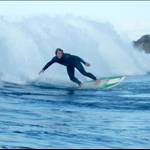
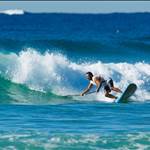
Since the ambitious CSI deal was scuttled in 1996, world-title surf contests have occasionally been held at ordinary surf locations, such as in New York last year. Picture: ASP Source: Supplied
IF he wanted to, Graham "Sid" Cassidy could now be serving his former adversaries a dish of revenge so cold, it's frozen.
But he's not that type of guy. The details of the betrayal he suffered in December 1996 are still fresh in his mind, but he is not bitter.
"It's a vindication," he said this week. "I don't say that in a smug way. I'm not interested in gloating. I've always accepted it. I'm not bitter and twisted. It's just life." Vindication is an understatement.
Over a period of two years during the mid-1990s, Cassidy put together the most spectacular offer the sport of surfing has ever seen, one that makes the offer from Californian media company ZoSea, which was accepted amid subdued optimism from within the sport this month, look amateur by comparison.
ZoSea has persuaded the Association of Surfing Professionals that it can sell the broadcast of the pro surfing tour to a major TV network for more than the $US20 million-plus that the tour costs to produce.
But its bona fides are unknown. It is a new company led by two people - Terry Hardy and Paul Speaker - who have modestly impressive backgrounds in youth and pop culture organisations. In Hardy's case, this deal has been a three-year project, and his energy, vision and Californian contacts may enable his success.
By comparison, Cassidy's proposal was solid. He had persuaded CSI, one of the biggest sports broadcasters in the world at the time, to broadcast and invest in the sport, promising to increase the prizemoney of four events to $US1m by 2000.
There was also a prize pool for the world title, an insurance scheme for athletes, an ambitious specialty event at remote Shipsterns, southern Tasmania, and a five-year commitment to grow the sport, with a focus on taking events to the best locations.
"They'd seen all sorts of sports grow," Cassidy said. "They knew what they had to spend."
But, in a tumultuous meeting in Hawaii in December 1996, the ASP board voted to request amendments to a contract it had signed with CSI earlier that year. CSI, the goose that had spent that year laying golden eggs, declined. At considerable expense, it walked away. Surfing has never recovered from it.
Surfing luminary Wayne "Rabbit" Bartholomew said at the time that the industry was afraid of losing control of its own sport. Specifically, it was worried that surfing's particular style of kooky presentation, which is different to most other sports, would not be adopted by CSI.
"The board accepted the fact that CSI might completely reject our (request to change the contract)," Bartholomew said at the time. "But the trade-off was that if CSI failed to have that magic and portray us as good or better than we had been doing ourselves, then the ASP was going to lose the support of the industry."
Others were not so sanguine. "I'm disgusted, horrified," four-times Australian world champion Mark Richards said at the time. "In the end CSI would have been for the benefit of everyone."
Fellow Australian world champion Damien Hardman agreed, describing the ASP board as a "pack of amateurs trying to run a professional organisation".
Bartholomew didn't return a call from The Weekend Australian yesterday. The two big Australian-based surf sponsors, Billabong and Rip Curl, declined to comment.
The carnage that the surf industry finds itself in today is directly related to that one dramatic decision. Pro surfing has remained a fringe marketing tool for the surf industry ever since, and the companies that financed it are mostly now in trouble.
Their combined future was always going to be limited, Cassidy said this week. "The top three (Billabong, Rip Curl and Quiksilver) are a finite group of companies," he said. "You don't put everything in one basket because what you're doing is pretending that that one basket is going to produce the outcomes that you want in years to come.
"The outcome could have been so different. If you go back and imagine they gave the green light at that meeting in 96. Can you imagine the leaps and bounds the sport would have taken?"