I once owned a board with thrusters many years ago but have always only sailed with one fin. The multi-fin choices have come to the fore for wave boards in the last 5 years. You can find endless debate on multi-fin boards.
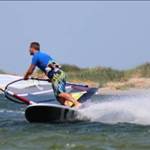
At Pozo, which is onshore and jumping more than riding, the Moreno twins seem to use a twin fin configuration mostly, but here you can see Iballa is using a quad fin configuration for these top grade waves in Fuerteventura. (Iballa weighs 60 kg and is using a Blade 4.7m sail and usually uses a 69 litre quad board, but this is probably the 74 in very light wind)
Lets just say that a single fin board works very well and you can get to a very high level of wavesailing with a single fin. FSW boards are nearly all single fin.
Boards have different fin boxes. The most common in single fin wave boards are the US box - where the fin can be adjusted to a more rearward position for more directional stability, or forward for more manouvreability
- or the Powerbox, which is a more solid fixing of the fin in one position and is mostly used in FSW boards.
Freestyle-wave fins are a bit like wave fins but usually a bit bigger to match the (usually) bigger sails and a bit more of an upright shape to give better upwind performance at the expense of some smoothness in the gybe.
Size for a 85 to 90 litre FSW depends on the sail size and the manufacturers usually give a guide on that. Biggest sail for an 85 might be about 5.8m and for a 90 about 6.2m. Smallest would be maybe 4.0 and 4.2m. FSW fins for the sails would be between a wave fin of 21 cm up to a FSW fin of about 27cm.
Wave fins tend to have more of a curve or sweep to them and that tends to make carving the board smoother than a more upright fin.