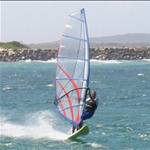
I'm currently working on a 'skiff-like' raceboard design that incorporates a bow with a vertical stem and a planing stern like a formula/slalom board. The links below show the concept:
www.lbwindsurfing.com/raceboard/raceboard-design/http://www.lbwindsurfing.com/raceboard/raceboard-design-2/To help refine the raceboard design, I'd like to understand some aspects of Formula board design:
1. What is the impact of the tail cut-outs on the waterline/bottom surface underneath the rear foot-straps. In other words, how would a formula board handle if these cut-outs were not present?
2. From my understanding, the large width of a formula board has evolved for earlier planing and to enable higher/deeper angles, both upwind and downwind. Is there ever an advantage in having a narrower board for higher wind strengths? How would a narrower formula board (say 70cm) compare to the max width boards?
3. Similarly to the above question, I understand that the large fin size of a formula board enables earlier planing and deeper angles. How does a formula board behave when used with a smaller fin?
Any help would be appreciated.