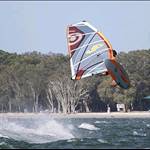
Harness + straps = speed, why?

> 10 years ago
Reply
Register to post, see what you've read, and subscribe to topics.
nebbian
nebbian
WA
6277 posts
WA, 6277 posts
29 Jan 2006 6:38pm
Hi,

I was out at the train today, having a lovely time pottering along, watching everyone blasting past me, occasionally getting onto a plane but mostly happy just to be shlogging. After a couple of hours of this I got up the confidence to go for the straps... and MY GOD don't you move when your feet are locked in!!!

Gotten Himmel!!

My question is: why Why do you seem to go so much faster when the feet are just in a different position? It's not like they're touching the water, my weight is still the same, the board would have to displace the same amount of water (I'd think). The only thing I can think of is that maybe it's related to wetted surface area, when you're in the straps then only the back of the board touches the water and therefore doesn't have as much skin friction... but then again I'd expect a flat board to go quicker than one that's cocked up at a bit of an angle.

'Tis weird this windsurfing physics
oldie
oldie
VIC
356 posts
VIC, 356 posts
30 Jan 2006 7:38am
Without the straps, one cannot happily trust all their weight to the harness, and hence to the mast base, which is the condition around which the fiendishly efficient machine is designed.
Still trying to get a mental picture of the magical moments of inertia and various vectors involved.
How does this sound-
A windsurfer in top gear (true planing, not partial planing condition) has a triangle of forces along the line of the board in balance. The sail has been raked back until it's centre of effort is directly above the fin. The sailor (screaming with joy or terror depending on his level of experience) can be considered to be suspended from this centre of effort until he is deposited amongst the debris resulting from not knowing how to handle this extrordinary situation.
RAL INN
RAL INN
SA
2898 posts
SA, 2898 posts
30 Jan 2006 8:34am
Well said Oldie,

What is even more amazing is the difference moving your straps back and out does. Even more speed.

then start sliding the mast base back towards the end of the track.

Tail walk! bring it on

then it's time to start shortening the harness lines, and start lifting with the front foot.

Then start bearing off, sometimes the walk back is pleasent reflection time.

Best winds
Tony L
nebbian
nebbian
WA
6277 posts
WA, 6277 posts
30 Jan 2006 6:32pm
quote:
Without the straps, one cannot happily trust all their weight to the harness, and hence to the mast base, which is the condition around which the fiendishly efficient machine is designed.


Sounds reasonable. I do know that when in the straps I'm more liable to lean out more instead of just sheeting out when a gust hits, it's like a state of mind that says "Hey I've got my seatbelt on so let's flatten it and see how fast we can go..." But even so I don't think that really explains the burst of speed I seemed to get yesterday afternoon. I also can't see the difference from a physics point of view between standing on the board, and sitting in the harness, if both methods keep the nose down.

Now as for the forces involved, that's a really tricky one that involves a center of effort that moves depending on sail angle, wind speed, apparent wind speed, mast angle, a force downwards for the sailor that also has some horizontal components, force from the sailor's feet into the board, force from the fin which may or may not also involve a vertical component, force upwards on the back of the board which also depends on board angle, force backwards from skin friction from the surface of the water, and that's just the obvious ones!! Yowch. My physics isn't up to it, we didn't do 3D vectors like those in uni!!

I'm still amazed at how people can get planing in wind that I have no chance of planing in, I'll be shlogging along with one foot in front of the mast and I'll hear a machine gun tearing past me... Obviously there's a lot to learn with regard to board attitude
decrepit
decrepit
WA
12885 posts
WA, 12885 posts
30 Jan 2006 6:56pm
certainly with the force of the sail taken by the harness, that leaves the arms to just trim for max speed.
Feet in straps allows much more force to be transmited thru sailor, (more than sailors weight, I know this from experience, wrenched front foot out of strap to gybe, just got mega catapaulted).
Also feet instraps allows for better board trim, you can lift the windward rail, until fin lift takes over and does it for you.
I find it easier to pump in the straps, the feet can get involved as well. That's the other thing of course if the wind is marginal, it might not blow you onto the plane, but if you pump there, there's often enough to stay there.
oldie
oldie
VIC
356 posts
VIC, 356 posts
31 Jan 2006 12:19pm
Them experts are not necessarily good instructors, as they seem to have forgotten the detours in their road to speed.
"Planing ability depends on wether you were planing already"- sounds like a Catch 22... Rather than push water with the full width of the board until it rises, they seem to pull up straight away onto the narrower back area?
Their movements are so subtle compared with my heaving and in/out sail flapping that they look to be doin nothin.
But I am at the stage of exagerating everything just to see what it does.
The dreaded catapult seems to recede as one gets further back on the board, so to never lose the harness tension seems a good goal.
whyner
whyner
NSW
762 posts
NSW, 762 posts
31 Jan 2006 12:54pm
Harness + straps = speed, why?

Because
Katy
Katy
WA
44 posts
WA, 44 posts
31 Jan 2006 1:48pm
Harness + Straps = speed

This is a great formula until your fin hits a stupid piece of rope lying just under the surface.

Feet stay in straps, body catapults with harness...
Makes you taller

I find bearing down wind a little to pick up speed helps me to get on the plane before straightening out and going more upwind. Or maybe adjust your sail settings?

I know how you feel though. Was sailing on the river in Perth in 10-12knots - basically bobbing around, when some guy streaks past and pulls off a flat water forward! Sulk....
nebbian
nebbian
WA
6277 posts
WA, 6277 posts
31 Jan 2006 6:37pm
Out at the train today I got another piece of advice from some dude rocketing past me... "Sheet in!!" I had a chat to him at the beach, and he said that I was way undersheeted, I needed to pull the sail in, then rake it back for max power.

So I tried it, and whaddayaknow? It works!! I can get into the straps sooo much sooner now, then with my weight forwards, the sail raked back and sheeted in, I find myself going the same speed as all the other guys. I even beat a guy with a 7m sail, when I was on a 5.7!!!!
YEEEEEEEHHHHAAAAAAA

That machine gun noise is getting a lot more frequent now, and I can't believe how well you go upwind when planing... doesn't make sense to me but then again I'm just going to have to resign myself to not understanding how the "fiendishly efficient machine" works. Just go with the flow
decrepit
decrepit
WA
12885 posts
WA, 12885 posts
31 Jan 2006 8:39pm
Are you taking the fin in to account??
That's allso a foil, not asymetric like the sail, but it does have an asymetric flow across it, and produces huge lift! Water is lots denser than air, the faster you go the more help the fin is.
drjukka
drjukka
QLD
258 posts
QLD, 258 posts
31 Jan 2006 11:06pm
Nebbian,

perhaps we are forgetting the apparent wind effect and the lift it supplies.

As the wind flows faster over the sail the Bernoulli forces increase - these are the same forces that give an aeroplane lift. The wind flowing over the outside of the sail travels a greater distance than the wind on the inside of the sail - this creates a pressure differential (low force in the sail luff) which manifests itself as lift (desire for pressure to equalize from low to high creates a force that is directed away from the sailor (inside luff pocket to outside luff pocket) and this is transmitted through the mast base (and our body when we are in the straps) Hence when we are in the straps our ability to harness the forced moves from one point to 2 or 3 and we have greater control and usually greater power delivery and ultimately greater speed.

(the faster you travel the more the lift - hence thto get the board moving to provide lift from the Bernoulli forces.

This force is counter balanced by the fin by directing our weight through the fin which needs to be be big enough to overcome the sideways force and convert this to forward motion. Too small a fin = lots of sideways "drift" If the fin is too large then you can harness too much power and the sideways counter balance of the fin can lead to a vertical lift- which leads to "tail walking".


This also means that if you can work the board ont the plane through pumping or running downwind you can maintain the plane as the lift from the sail generates its own apparent wind. This is fine until you decide to gybe, get halfway through the gybe and discover the wind had disappeared.!!!

This is why luff pocket shape is so important in a sail and why cambered sails which induce and hold the surved shape have more power than RAF sails - especially at the top end and when sail >110 degrees off the wind. ALso why balancing fin and sail size is so important.

Of note - I think of the sail twist at the top of the leach relating to the same principles. In normal conditions, the sail has no/minimal twist providing max power, as the power - wind gust hits the leach twists to reduce the power load from a gust - in this manner the twisting leach sails provde good low end power and high wind control.

By my scientific education all this stuff can be derived from 1st year Uni Physics 101 and if you require the high level very fine tuning a higher degree in maths may be required.

Dr J.
nebbian
nebbian
WA
6277 posts
WA, 6277 posts
1 Feb 2006 11:13am
quote:
The wind flowing over the outside of the sail travels a greater distance than the wind on the inside of the sail - this creates a pressure differential (low force in the sail luff) which manifests itself as lift


This is a common misconception, which is widely accepted as false. Here's a good page showing why this explanation is wrong:
www.grc.nasa.gov/WWW/K-12/airplane/wrong1.html

The problem as I see it is that lots of people have a lot of experience with windsurfing fast, they know where to put their bodies to go fast, but have little idea of the physics behind what's happening... Take the guy in the shop where I bought my windsurfer, who tried to tell me that if my arms were bent, they would heat up, and that was because I was absorbing the power in the sail into my arms, therefore I would go slower as the 'power' was being 'absorbed'. "It's simple physics", he said. Right end result, but he had no idea what the actual mechanism was. (btw the heating up is because of the way muscles work, it's nothing to do with whether a solid object is bent or not, no power from the sail is 'absorbed' in your arms)

quote:
Hence when we are in the straps our ability to harness the forced moves from one point to 2 or 3 and we have greater control and usually greater power delivery and ultimately greater speed.

So when I'm standing on the board (not in the straps), my legs don't have any contact with the board? They don't have any friction, don't push on the board, and aren't able to move the board around? *sigh*

quote:
If the fin is too large then you can harness too much power and the sideways counter balance of the fin can lead to a vertical lift- which leads to "tail walking".
I still don't understand this, if the board is level then how can a large fin lift the board at all? Does it have something to do with the board heeling over to leeward, thereby having a vertical component to the lift?

Lots of explanations are around on the web, but every one I've found is inconsistent in one way or another... perhaps the best way is to just try things until something works, instead of getting to a false understanding and then trying things based on that model
grumplestiltskin
grumplestiltskin
WA
2331 posts
WA, 2331 posts
1 Feb 2006 11:25am
Neb, who gives a rats a..e why, just get in the straps, hook up and yell yeeehaaaaaa!
drjukka
drjukka
QLD
258 posts
QLD, 258 posts
1 Feb 2006 1:52pm
Nebbian,

Nice link explanation on the lift aspect and looks like what I learned in physics 101 was wrong!! - or not the complete explanation.

With regard to your feet. If you are just standing on the board you are exerting a downward force. You are using gravity to counter balance the pull of the sail. The only direct connection between the motive force and the board is at the universal joint. If you put your feet in the straps, there are effectively three direct direct connections allowing you to transfer more power, more controllably. .

I will have a more detailed think about this and will try and post something sensible later tonight.
-J

mdjnelson
mdjnelson
WA
33 posts
WA, 33 posts
1 Feb 2006 4:19pm
quote:
Originally posted by nebbian

The problem as I see it is that lots of people have a lot of experience with windsurfing fast, they know where to put their bodies to go fast, but have little idea of the physics behind what's happening... Take the guy in the shop where I bought my windsurfer, who tried to tell me that if my arms were bent, they would heat up, and that was because I was absorbing the power in the sail into my arms, therefore I would go slower as the 'power' was being 'absorbed'. "It's simple physics", he said. Right end result, but he had no idea what the actual mechanism was. (btw the heating up is because of the way muscles work, it's nothing to do with whether a solid object is bent or not, no power from the sail is 'absorbed' in your arms)


Actually he is correct. Nebbian you just started windsurfing and still have your feet infront of the mast. Stop questioning the experienced people who know what they are talking about. If you want to go fast, get a harness, beach or water start head down wind get in the harness then footstraps and stop wondering why the ocean swell is angling at a different angle than the other day and enjoy it!
vando
vando
QLD
3419 posts
QLD, 3419 posts
1 Feb 2006 7:19pm
Use the force Nebbian

nebbian
nebbian
WA
6277 posts
WA, 6277 posts
1 Feb 2006 5:55pm
quote:
Stop questioning the experienced people who know what they are talking about.


Tsk tsk tsk. I see we've another conformist in our midst.


Wise, that Vando is.
ducati
ducati
QLD
474 posts
QLD, 474 posts
1 Feb 2006 9:04pm
Crriikkey if sailing is sooo scientific 4U it must be awesome hearing U theorising while having a r**t sex
decrepit
decrepit
WA
12885 posts
WA, 12885 posts
1 Feb 2006 9:03pm
There are those that blindly enjoy, and those who want to know why, and neither understands the other all that well.
Me, I want to know why!!! then you have a chance of improving the experience!!
Good on ya nebs, keep us thinking! Some times a newby can give a fresh insight
oldie
oldie
VIC
356 posts
VIC, 356 posts
2 Feb 2006 12:09am
What was the bloke in the windsurf shop alluding to? Starting to feel the "force" and it is simply this- Any energy absorbed into your body is subtracted from that providing pure propulsion.
This is why that flying Finian said "Your fastest run will be the one that did not seem particularly fast"
(He also said that you should be able to shut your eyes for 5 seconds while at top speed!)
Relaxing the body and "playing the piano" lets the wind do it's work.

drjukka
drjukka
QLD
258 posts
QLD, 258 posts
1 Feb 2006 11:40pm
Ben,

I have given this some thought and even reviewed my lecture notes from physics 101 - Apologies to Melb Uni - you taught me right - I just remembered incorrectly.

However, the principle was right and so was Bernoulli. The curvature (or flat sail) at and angle to the wind will provide differential pressure across the sail to provide a net force on the sail.

We use our body weight to counteract this force and the 3rd force (in a very simple approximation) is the lateral force from the fin.


The sum of the forces equals a nett force foreward which provides propulsion.

Footstaps at he back of the board add additional load points to transmit the power. Think of the sail a a lever. In this scenario, you can acheive greater leverage the further down the boom you apply force.

another way to think of this:


Think of that old playground favourite a "see-saw"

If you put 100kg on one end of the see-saw and try and stand in the middle of the see-aw around the pivot point it is very hard to get that 100kg off the ground. If you now put 80 kg at the pivot point and gradually move it to the other end of the see-saw the amount of effort required to lift and move the 1000kg weight at the other end of the see-saw is reduced the further out you go.

Putting you feet in the staps allows you to lever you weight further away from the board. - Hence you can get more power from the rig


- J

nebbian
nebbian
WA
6277 posts
WA, 6277 posts
1 Feb 2006 11:34pm
quote:
Think of that old playground favourite a "see-saw" ...
Putting you feet in the staps allows you to lever you weight further away from the board. - Hence you can get more power from the rig


Yarrrr, that makes sense. If I'm standing forwards then I have to sheet out because otherwise over the front I go, if I stand further back then I can sheet in more and have more force pushing me forwards, 'cos I can balance it, being further out on the 'seesaw'.

Awesome, thanks for that, I think it also explains why sheeting in let me get to the straps quicker. It also explains why moving the straps backwards means increased speed. At least, I think that explanation is right... so many interrelated forces on a windsurfer, it's hard to make head or tail of what's going on!!

Nice one
md74
md74
QLD
1064 posts
QLD, 1064 posts
2 Feb 2006 12:26pm
aahhhh Nebbian, I now know who you are my friend!

mate you are doing just fine out there, believe me! and I must say I have noticed an increase in speed from you in the past week especially, mmmm, been studying the advice given here I see, well done.

continue the speed!!

md
RAL INN
RAL INN
SA
2898 posts
SA, 2898 posts
2 Feb 2006 3:13pm
There will be a day Neb, when you blindly follow the steps outlined and break thru the 30kt barrier.

the further past this barrier you go, the less your mind will be contemplating the physics of it, and in fact the more reason you will have to leave the brain back in the glovebox.

It's all ZEN
decrepit
decrepit
WA
12885 posts
WA, 12885 posts
2 Feb 2006 8:48pm
quote:
If I'm standing forwards then I have to sheet out because otherwise over the front I go, if I stand further back then I can sheet in more and have more force pushing me forwards, 'cos I can balance it, being further out on the 'seesaw'.


There's also the shifting center of lateral resistance effect, when you're forward going slow. the rails are a big part of lateral resistance, so it's center is forward as well, so the mast has to be more vertical otherwise you go too far upwind. As you move back, the center of lateral resistance also moves back as the forward rails come out of the water. This means the mast has to lean further back or you go too far downwind. So as the the gap closes, increasing power, wetted area decreases, lowering forward resistance. As you go faster fin also develops more lift, shifting center of lateral resistance further back still. So the faster you go, the faster you can go! For a while anyway, till all the forces reach equilibrium.
And while I'm on fin lift, you're right about it having to be off the vertical to have any horizontal lift, but this does happen, there's a certain amount of flex for a start, ( the fin's lift is counterbalancing the sail's lateral force,) and once really powered up it also forces the windward rail up against the sailors weight. There was a link on rec.windsurfing to a photo of a formular board almost on it's rail and the fin almost horizontal, they were talking about fin loads I think.
Please Register, or first...
Topics Subscribe Reply