From:
www.peterman.dk/start-windsurfing-gb01.htm What to look for - stiffness or bend curve? Unfortunately we get no help from the companies that (besides their empty way of using the phrase "Constant Curve") only inform us about the stiffness of their masts (say IMCS 32). And - as we saw - the stiffness is far from the whole truth about the masts. In fact you could pretty easily argue that information about the bend curve might be more important. Since the stiffness tells something about when the mast starts working (at what load), the bend curve tells something about how the mast shall work when loaded.
How does the soft and the stiff areas of the mast influence the appearence of the sail?
Working in the sail, the mast of course deflects the most in the softest areas of the mast - and deflects least in the stiff areas. Where the mast deflects the most, it pulls away from the leech - in this way straightening the sail (with little depth) on level with the soft area. If the sail has a camber inducer at this place, it often rotates easily - or perhaps it is even not pressing properly on the mast.
Conversely, the stiff areas of the mast shall not move a long way from the leech - thereby not straightening out the sail-cloth on level with this stiff area (creating lots of depth). If the sail has a camber inducer at this place, it most often presses hard on the mast - often to a level at which it's difficult to rotate. And when it rotates, it is often accompanied by a loud "camber-bang."
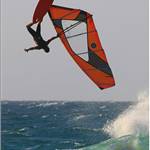
The same sail rigged with a Flex Top and a Hard Top mast respectively.
If we think of rigging the same sail with the two mast-extremes respectively (for instance a Neil Pryde mast with soft top and a Maui Sails mast with stiff top), we shall try to predict the differences. It's important to note that this is not science - just a kind of common "knowledge" among the gang of old windsurfers from the local beach:
With the Neil Pryde mast the sail shall have a big depth (much profile) in the bottom and in the middle of the sail, while the top of the sail shall be pretty loose. Often the change from the area with big depth to the loose area shall be very "sudden" with a lot of wringles. The center of effort shall probably be placed forward (and deep) in the sail, and the camber inducers shall have a lot of pressure. Actually it could be necessary to remove a couple of spacers - or to file off some of the plastics - to make them rotate. As the mast is pretty stiff in the middle sections, a lot of downhaul is probably needed.
With its loose top the low-end pull from the sail comes from the deep profile in the bottom and the middle sections. And often the angle of incidence around the mast pocket shall be pretty rounded, so that the air flow over the sail shall be very attached and make it easy and steady to sail.
With the Maui Sails mast the sail shall appear pretty flat (little profile) in the bottom and middle sections, and the top shall not be very loose. The change from the flat bottom to the not-especially-loose top is spread over a large area, and the sail shall have a rather harmonic appearence - gradually twisting towards to the top.
The center of effort shall probably lie a way back, and the camber inducers most often shall not press very hard on the mast - in fact sometimes you shall have to place some spacers between the battens and the inducers. As the mast is relatively soft in the middle, you shall probably not use a lot of strength to downhaul the sail - and using too much downhaul force might almost collaps the sail in the middle.
With the flat bottom and middle sections of the sail, the low-end pull are caused from the relatively tight leech high up the sail - and from the fact that the center of effort is placed a way back.
Often there's a tendency that the angle of incidence around the mast pocket shall be rather "sharp" (the sail is almost cutting its way through the air), and in this way it is pretty easy to over-sheet the sail. As the air flow over the sail is always at risk of being turbular, it is easy for the sail to loose its power. A sail with a sharp angle of incidence might be exellent for very good sailers, but for us mortals it might be a little nervous.
Some findings when measuring masts.
Here is a link to some measurings of masts. Even if the measurings shown are selected, the figures are still mostly raw data - but here under you'll find some of the simliplified and generalized conclusions, you can make from the material:
The mast neither changes stiffness nor bend curve, as the temperature changes. Even though you by means of the IMCS test can't find any difference, if it is 0 degrees celsius or 25 degrees celsius, of course you might speculate, if the mast perhaps gets a little "slower" in the lower temperatures - that is if the "flex response" is dampened.
If you shorten the mast (from the bottom!), it gets softer and doesn't change its bend curve. Of course it's not wise to cut off so much that the mast foot/extension doesn't fit the mast - or that the boom is fixed above the extra strong boom area. And as indicated - never shorten the mast from the top.
If you extend the mast it gets stiffer (most with Flex Top, a little less with Constant Curve and least with Hard Top masts), and it almost doesn't change bend curve. Of course you shall not extend the mast so much that you clamp on the boom below the strengthened area.
When you try to find a way to calculate, what approximately happens to a mast that you extend, you'll have to decide what you'll understand with "extending". For instance, how long extension are we talking about (in numbers or relatively)? How much extension in the mast are we talking about (in numbers or relatively)? What is the stiffness of the mast to extend? What is the bend curve of the mast to extend? And so on and so forth ...
If we make a fast decision and say that we are talking about a 30 cm extension of the mast by means of a 50 cm extension device (that's of course 20 cm up in the mast), then - based on numerous measurements - you can (very) roughly say that ...:
All masts keep (approx.) their bend curves when they are extended.
All masts become a little stiffer (according to the IMCS standard) when they are extended.
Hard Top masts become relatively least stiffer (around 2-3%).
Flex Top masts become relatively most stiffer (around 6-7%).
Constant Curve masts become stiffened up between Hard Top and Flex Top masts (around 3-6%).
This can roughly be "translated" in this way ...:
If you extend a Hard Top mast with 30 cm, so that it reaches the length of the next mast in the line, the extended mast is supplied with 1/6 - 1/4 of the extra stiffness necessary to get on level with the next mast in line.
If you extend a Constant Curve mast with 30 cm, so that it reaches the length of the next mast in the line, the extended mast is supplied with 1/4 - 1/2 of the extra stiffness necessary to get on level with the next mast in the line.
If you extend a Flex Top mast with 30 cm, so that it reaches the length of the next mast in the line, the extended mast is supplied with 1/2 - 3/4 of the extra stiffness necessary to get on level with the next mast in the line.
The more mast with or without extension that are measured, the more precise the ability to predict what happens as to change in stiffness - and the less likely it is that mentioned general rules have to be changed.
If your mast has become "excentric", this doesn't change the bend curve significantly. However, as the mast now is a little "pre-bend", it equals it has grown a little softer.
There is a tendency that the increasing softness that follow heavily use, are most noticeable in the areas that work the most - that is the top of the mast. But - you have to use the mast very much, before you face any problems in this respect.
In short, paring mast with sail (race sail/race mast).
If you use the mast the sail producer recommends, you don't risk anything.
Never use a Neil Pryde mast with a Gaastra or Maui Sails sail.
Never use a Gaastra, a Fiberspar (the longer masts) or a Maui Sails mast with a Neil Pryde sail.
Think about it, before you use any of the obove mentioned ("extreme") masts with other sail brands (North, Severne, Gun, Naish, Sailworks, Aerotech etc).
If you choose a "detuned" Gaastra or a Maui Sails mast (for instance the Maui Sails SRS 75 % mast), there is a tendency that these masts fit in the Constant Curve scope. The same is true for the older and longer Neil Pryde Freeride Pro masts.
A lot of 100% carbon masts are manufactured in two Italian plants. Even if the sail producers say that they order their masts from their own specifications, it is a well known "secret" that you might be lucky enough to buy a a cheap mast (for instance a GUN Dominator) with IMCS numbers that is hardly distinguishable from the numbers associated with one of the much more expensive masts from one of the well reputed (and expensive) sail producers (Neil Pryde for instance). Of course this is just an example!
Footnotes.
*) There is a little further information to get in the calculation for bend curve than just the figure ("10" in the example). If you compare the 1/4-deflection and the 3/4-deflection mentioned (65% and 75 %) with for instance deflections of 63% and 73 %, you'll end up with the same bend curve figure. However, intuitively you might see that the 65/75 mast is a little more "U-shaped" than the 63/73 mast, that is a bit more "V-shaped." Admitted, this is perhaps a little nerded.
**) There are exceptions - Sailworks seems to be honest about their masts.
***) The new sail designer for Gaastra (Dan Kasseler) came from Naish Sails, where he designed sails around some (probably) traditional Constant Curve masts. At Gaastra he inherited the top stiff masts from Barry Spanier and Phil McGain, and he has built the new Gaastra race sails (the Vapors) around these masts. Kasseler says that he'll continue to design sails around those original Gaastra (former "Ignition") masts - but let's see ... At Naish Sails he had a great success building sails around traditional masts - for instance the sail that helped Finian Maynard making his World speed record in the autum of 2004.
In an all new video at the Maui Sails homepage, Phil McGain one more time tells us that his SRS 100% masts are Constant Curve. But the truth of this statement doesn't grow with the reiterations of the falsity. Maui Sails race masts are and have always been Hard Top - Constant Curve!
****) The bend curve of the longest (and seldom used) Neil Pryde race mast (the X9 580) is placed around 12.