Came across an interesting article while wandering aimlessly thru the WWW. It's quoting from 1991, from well back in the days of full headed sails!
www.tspeer.com/Planforms/Planar.htm"
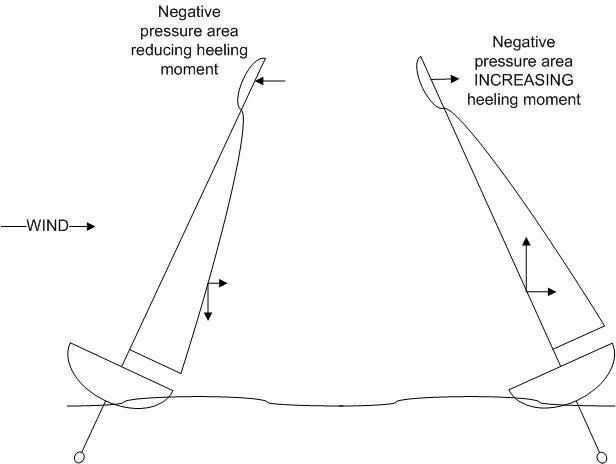
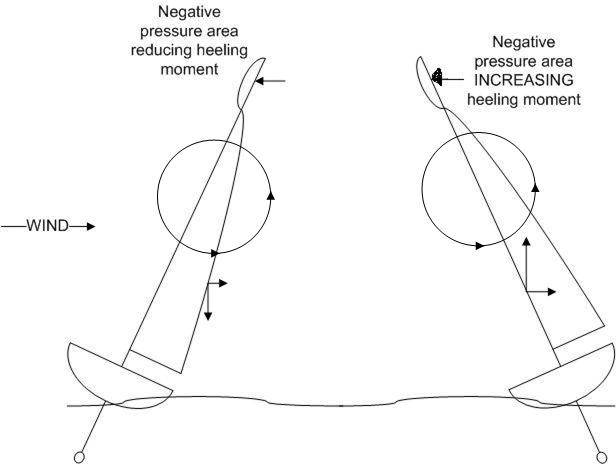
Day (1991) used simulated annealing with a lifting line analysis to determine lift distributions which maximized the performance of a sailboard. Both induced drag and a simple viscous drag estimate were used to model the sail. He found that due to a constraint on heeling moment, the optimum spanload distributions had a negative lift at the head. "
and a bit further on
"
Reduced Moment Sail Rigs. The heeling moment of the sail rig can be reduced by changing the design induced velocity distribution so that it tapers linearly from a maximum value at the foot to a minimum value (which may be negative) at the head. In principle, there is no limit to one's placement of the center of effort, provided that it is
permissible to have negative lift at the head of the sail. It is even possible to have the center of effort at the surface for complete cancellation of the heeling moment. However, there are practical limits to this, as will be seen."
These were about the only two paras I tried to follow, it's a bit mathematical in places, but it seems like they are proposing a bit of twist past neutral to provide lift in the reverse direction Because this little bit of negative lift is acting right at the top of the sail its slow-down effect is counteracted by its benefit with the righting moment. You can then more than compensate by designing for more lift down low (It's a small force but on a long lever arm). If you sheet out the top would increase angle of attack and help with overpowered situations?
Because our current twisty sails only twist under air pressure from the windward side I doubt that they reduce lift up there all the way to zero. I couldn't see how they are currently twisting to negative?
I liked the inclusion of the word "permissible". Of course! What we need up there is a latch to hold it super twisted with a negative angle of attack, maybe latch it in with one or two big pumps after each gybe.