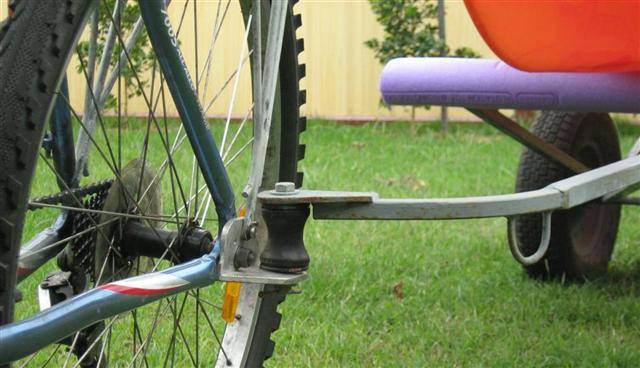
I have a special project coming up and I figure that a windsurfer universal would be the perfect attachment but it will need to take some reasonable compression loads. I thought I'd seen somewhere a metal uni joint but can't think where it was. Alternatively, if anyone has used a uni in a compression application I'd like to hear about it. Thanks
take a look at http://www.chinooksailing.com/products/index.php?cPath=2_76
I would think that the "boge" joint would work well in compression as it is a nice fat rubber block.
What load, angle of deflection (cant) do you want, and how many cycles per second/min/hour do you want to achieve?
I wouldnt have a lot of confidence in the tendon joint or windsurfing mechanical joint in any application other then that for which they were designed..
I would think that in normal windsurfing use there would be a fair bit of compression on the uni joint, what with all the mastfoot pressure etc.
Yeah, that mechanical joint looks the go. I'm doing a tower for my TV aerial and the angle of the stay base has to be quite narrow which, in turn, imparts a fair bit of compression onto the base when it's loaded up by wind. Tough to calculate how much as the surface area is hard to know. I liked the idea of the uni as it will have a bit of give to bending loads rather than a fixed base.
I would have thought that if the stay base is small then the bending moments at the base would have been very low anyway (unless you are using shockcord as a stay, but I agree that the compression loads will be large).
But I suppose that if you are worried about the mast "working" at its base then a UJ will kill any bending moments whatsoever.
Alternatively you can get rid of the tv and become one with nature.
I'm assuming on what you may be doing - if I've got it wrong just ignore.
Try Double stay (guy wires) to the same ground anchorage point, dividing the mast into two levels.
Top half of mast - from the 1st(top) stay level to the 2nd stay level (say mid point roughly)- will work as a beam, transfering a lot of the load at that mid point level, to the bottom stays.
A universal base may allow twist and bending putting your reception out on sailing(windy) days.
If you have the stays connected to your mast correctly, then there will be minimal bending moments on the base of the mast, which will completely alleviate the need for a universal joint at the base. I think you're over complicating a problem that has been solved many many times over already.
The only situation I can think of where a joint of any kind at the base would be useful, would be so you could lower the mast, much like sailboats do for going under bridges, in which case a pin joint hinge will work just fine.
ps. don't take anyone's word that using something for a purpose that it was not designed for is not a good idea. Hacking is part of the inventor's spirit.
If the mast is fixed at the base then there will be bending moments, irrespective of how stays are connected to the mast.
Yachts use massive tensions to minimise the movement of the mast (and sails of course), but I doubt that Jethrow wants to use such forces to keep his antenna vertical.
By using light tensions he can have a lower cost solution (no requirement to cater for dissipating forces at stay anchors), and a UJ will keep the foot fixed (with the additional benefit of dissipating bending moments).
The comment about "something for a purpose that it was not designed for" referred to a specific type of UJ. Yes - it is based on opinion, not knowledge, but I hardly think I tried to discourage Jethrow from trying things!