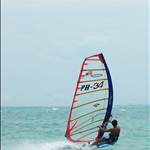
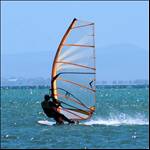
Think of a narrow angled wedge, a large movement of the wedge will cause a small movement of something resting on it, conversely a small movement of the something will cause a large movement of the wedge. Sort of a gearing effect, well if you're sailing a broad reach, your sail is like the wedge and the wind hitting it can drive you faster than it's blowing. How fast depends on power to drag ratio,
Or, by vector analysis. Draw a right angle triangle with the two perpendicular sides representing the actual wind speed (say 10knots) and your speed (also 10knots), the hypotenuse now represents the apparent wind. From pythagorus's theorum or geometry you can now find the apparent wind is abt 14 knots, like magic you've made more wind to play with but its now blowing from 45 deg on the bow. Bear away more and work out more triangles and you will see how the apparent wind is more important than the true wind.
I have heard people say that it is possible to faster than the wind..
Is this possible?
How? is it something to do with going across the wind or power to weight? If so can anyone explain the science behind it....
Many thanks
Can't explain why, but yes in light to moderate winds it's easy for a windsurfer to go faster than the wind, about double the wind speed.
but why is it AA at 40plus kts. of wind can only make near 50kts. is it just his equipment that isn't as slippery than drag
once the wind reaches a certain strenght then drag comes into play,i'd like to see more effort spent on designing windsurf gear that can reach speeds of 40knts in only 15-20knts of wind.
talking less drag.. I saw some Moths in the harbour the other day, ( they kind of have a hydro foil type thing happening, when they get up to speed they pop up out of the water which allows the entire hull to get out of the water, and they fly .....has any one tried anything like that with wind surfers, i recon it might reduce the drag but then controlling the board would be another issue...
Yeah its been tried on windsurfers but as you can see from the end of the video, given current technologies, it's slower than a conventional windsurfer. It also looked insanely hard to control.
That's a great vid. You can see how delicate the control issue is.
There are other hydrofoil windsurfers. (no link sorry)
In theory (as I understand it) they should develop the same lift as a planing hull with less wetted area. As well as that they are not perturbed by bumps so they should be faster.