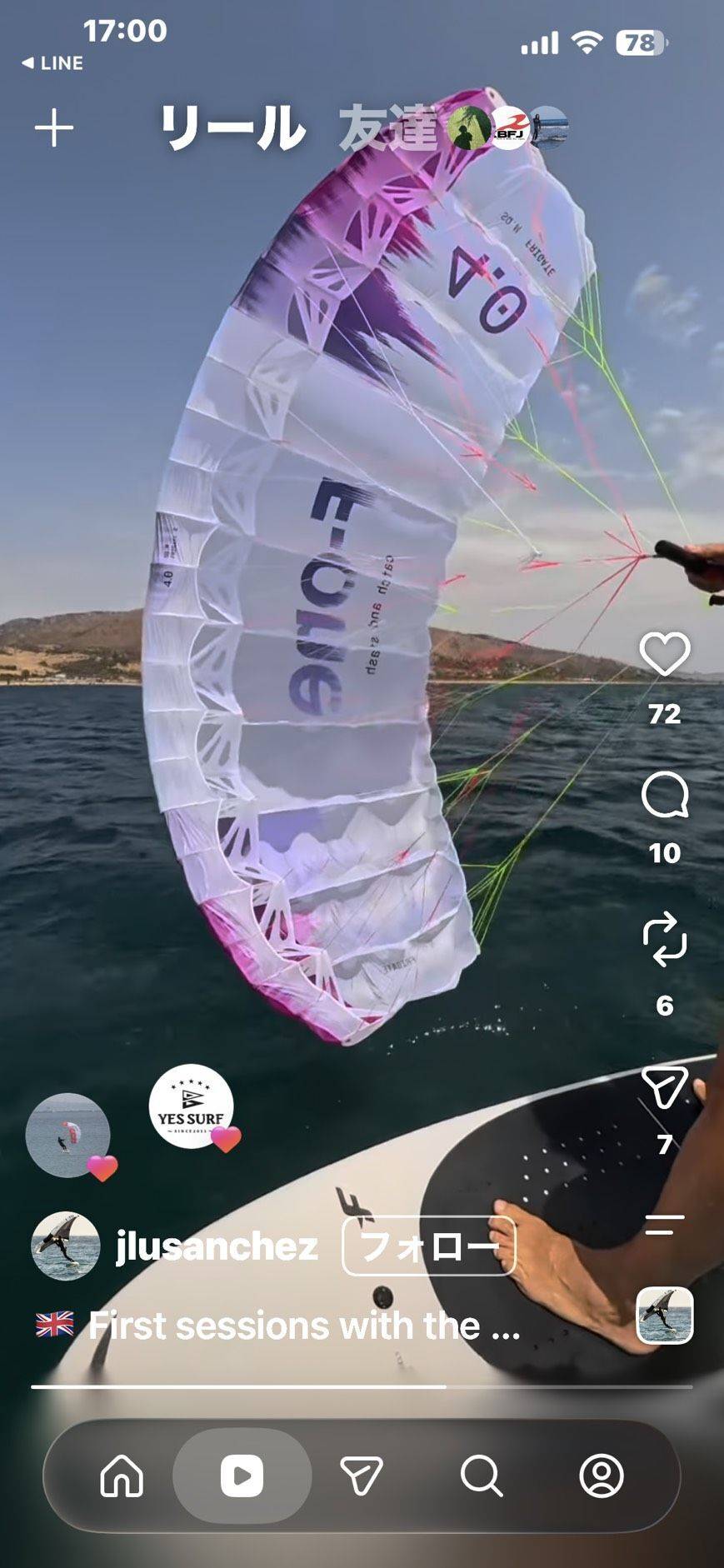
I don't think this was supposed to be published, but here is what seems to be the dealer info on the new Frigate v2. Seems like F one goes a significantly other way than Ozone.
fulltiltfoiling.com.au/products/f-one-frigate-v2?srsltid=AfmBOooO4rgj-A6JIfcSYIuHRYdmFFer72KThcdBPalouY1cl1XpYJcf&variant=45380942430323 F-One Frigate V2 Pocket Wing
PREORDER NOW for the Frigate 2, available in 3.0m, 3.5m, 4.0m and 4.5m - arriving September 2026!!
Why the V2 Frigate?
The Frigate V2 project was initially meant to be a direct evolution of the Frigate V1 — this is in fact the concept shown at the Dakhla show. But during development, the brand identified the limit of that concept: the V1 base had already been optimized to its maximum. To go further, it was necessary to break from it rather than evolve it.
A change of base, not a simple update
The Frigate V2 is built on an entirely new shape, with different forms and bridle layouts than the V1. At the same time, an internal project for a higher-performance wing — developed independently — was integrated into the V2 program to combine the best of both approaches. The result: a product that no longer has much in common with the prototypes tested at Dakhla.
The guiding thread of the design: reducing points of complexity
The design philosophy rests on a simple principle communicated internally: potential problems increase with the square of the number of line attachment points. With a three-line system, 3×3 = 9 possible sources of problems; with two lines (dynamic dual bridle), 2×2 = 4. This logic guided the architecture of the V2, in contrast to the yoke or bridge solutions adopted by much of the competition to simplify their bars.
What's New
⇄ Dynamic dual bridle
Inherited from the Quest. The hand can travel the full length of the bar to the wing without any blocking effect at maximum sheet-out — unlike yoke systems, which beyond a certain point have no more effect on the wing. Result: a complete and progressive sheet-out, a wing that stays healthy even when fully sheeted in, and reduced central luffing when sheeted out (less drag, less performance loss).
↗ Increased aspect ratio
Like the Bandit → Banger → Trigger progression on the kite side, a higher aspect ratio gives more acceleration ("0 to 100"). Every gust is better exploited, every pump is more efficient for getting going in very light wind.
◫ 11 ribs instead of 9
More structure, a stiffer wing that's more responsive to pumping and sheeting — a compromise chosen after testing a 22-rib prototype, judged excessive. For comparison: the Pocket Rocket V2 (Ozone) stays at 9, the Afterburner goes up to 22.
— Shortened, fully spliced lines
Lines 10 to 15 cm shorter than the V1 (the biggest gain on medium sizes such as 4 / 4.5). From the bar to the wing, the lines are now 100% spliced as on the Quest: no more drag or friction in the hands.
◐ Targeted weight reduction (relieved canopy)
Cutouts are made on the diagonals and the front of the wingtips to save weight without losing performance. The rear areas are deliberately not relieved, since they bear significant pulling angles linked to the dynamic dual bridle. This makes relaunch more technical and reserves the wing for already-experienced riders (full detail in Part 4).
▤ Redesigned trailing edge
The triangular facets of the V1 give way to a continuous rounded curve, further reducing flapping in strong wind — a point several competing brands have since tried to match.
▦ Lighter fabric on the larger sizes
On the 5.5 and 6.5, the rear two-thirds of the wing use a fabric 20% lighter than the one used at the front. Result: remarkable hang time from as little as 8-9 knots.
▣ New technical backpack
A backpack that can be used directly on the water, quick-drying (a few minutes in the sun), drawstring closure, integrated water drainage in case of waves. A single reference regardless of wing size. Pack-assist kept identical to the Quest for simple, fast folding.
V1 VERSUS V2 FRIGATE
Performance consistency across the wind range
Frigate V1 — high peak, drop-off outside the optimal range.
Frigate V2 — near-constant performance from light to strong wind.
Number of ribs
V1 — 9
V2 — 11
QUEST V2 FRIGATE
The Quest and the Frigate V2 will coexist in the range for the long term. They don't target the same rider profile and don't cannibalize each other: this is a complementary duo to present together in-store.
On pure peak performance (speed/angle ratio within the optimal range), the Frigate V2 and Quest are comparable. The difference appears as soon as you leave that optimal range: in a gust or a lull, the Frigate V2 keeps performing where a Quest-style sheeted wing stays stable without progressing. The gain is only noticeable for a rider already committed to their practice — no point selling it to a customer who rides permanently "sheeted out."
The Wrap Up Points on the V2 Frigate
1 A consistent wind range, from light to strong wind
Unlike the V1, performance no longer drops off outside the peak.
2 Acceleration that never stops
"The more I sheet in, the faster I go" — even beyond 30 knots. The rider becomes the limit, not the wing.
3 Up to 2 sizes saved in the quiver
A 6.5 can now cover what previously required a 6.5 and a 4.
4 Safer to use: over-sheeting is no longer possible
The risk of going into reverse, present on the V1, is virtually eliminated.
5 The best of both worlds, without the drawbacks of a hybrid
The sheeting and gentleness of a Quest, plus the performance, without the extra weight or folding complexity of a double-chamber wing.
6 A coherent range duo, not cannibalization
Quest for accessibility and versatility, Frigate V2 for committed perf ormance: two products, two customer profiles, at nearly the same price.