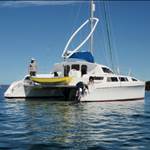
Just a quick note about our new Pypilot autopilot. On its second run it did about 10 miles in a sloppy seaway and it worked beautifully.
My son bought Sean Depaigner's Pypilot
pypilot.org/ and a motor controller. He did all the hard electronic stuff. My job was to make a motor and steering assembly. We used a 70 watt worm drive with toothed belt led to the steering cables. It pivots aft to engage the steering cables.
The system works so much better than my Raymarine X5, it is in a totally different category. The cat was on rails and I am getting a handle on adjusting gains. I couldn't ask for a better autopilot. The motor is so powerful compared to the anaemic Raymarine wheel pilot.
I had an issue with setting the peak current too low for the motor, I changed it from 7 to 12 amps. I also loved using the cheap garage door remote as I was singlehanded and it was a game changer to be able to furl the reacher up front and adjust course with the remote.
The Pypilot steers as well as me, and after 2 hours in a sloppy sea had used only 2 amp hours. I can't quite figure that out but it seems as though it uses little power because it keeps the boat straighter and doesn't struggle all the time like the Raymarine X5. So I get much much better steering and low power use.
We paid about $300-400 for the whole setup and it steers incredibly fast and true. I had been hoping for a great new autopilot and it looks as though this may be a game changer for anyone who can understand small computers and make their own drive system. I can adjust the different gains on the PID controller - it took a while to start getting my head around the gains but they do make sense, especially if you understand some basic maths and calculus (of sorts). Gains and the rest are adjusted on a phone, but I hope to be able to have the whole thing running through OpenCPN soon.
The drive system I built works pretty well. It uses a 70 watt worm drive motor in a swing arm assembly. A toothed belt is attached to the steering cables. To engage, I pull on a small tackle and the arms swings aft and tensions the belt. It all lies under my helm seat in the cockpit.
Kankama is on the slips now and when she comes back home she will have all her electrics and interior redone. I am really glad I got to trial the PyPilot before I redid the electrics as it seems like it will be a super effective autopilot as less than 1/15th of the price for an equivalent one.
It was just a short sail, from Lake Mac to Newcastle to get on the slips, but the sea was sloppy and I was running pretty fine tolerances when running deep angles on the reacher. I could sit inside or up front, with the cheap garage door remote control in one hand adjusting angles 2 or 3 degrees as the wind shifted. We did a few surfs and it was the first time the cat just tracked straight as she surfed - I have never had a really nice autopilot before. There was a TP52 out sailing so we came in together and I could clean the boat up, furling the reacher, hauling it down, putting ropes away, wandering around with the remote in hand adjusting course slightly as the wind changed direction and keep the boat sailing so that the TP didn't overhaul us quickly. I could certainly get used to having a fast, strong autopilot with remote control. For anyone who wants one, take a look at the Pypilot forum. There don't seem to be many setups completed yet, but I am obviously happy we went this way.
Cheers
Phil