Sandman1221 said..
That basics page was from MIT professors, who likely have dozens, if not more, of published papers to draw from, see main website below, these are the guys that our foils are based on in one way or another!
It would be great if reading the web site from experts would make you an expert, since we would not have most of this discussion.
Mark Drela is one of the world's most knowledgeable people about foils. To give just one example, he's published XFoil, a program used extensively in the design of windsurf fins.
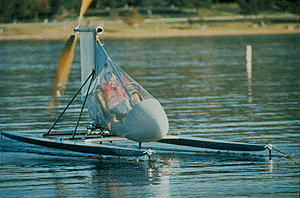
His Decavitator project is actually a very good example to learn what the difference between cavitation and ventilation is, because it touched both issues over the development. It was drive by muscle power, and older designs used propellors in the water, which encountered cavitation problems. It therefore used a large air propellor to
avoid cavitation problems at the propellor (not the foil).
The first version of the foil had a V-wing, but "
Tow tests revealed serious ventilation problems with the V-foil design" (anyone who ever used the original MUF Delta fin in chop will understand). Note that these problems were so large for the v-foil that they never managed to even get the boat out of the water - so it happened even at very low speeds. That's a logical consequence of the entry angle.
So the initial version of the Decavitator suffered from ventilation problems at quite low speeds. In Nico's case, the speed was substantially higher, and there was considerable sideway pressure, basically pushing the foil mast into an non-zero angle of attack.
For ventilation to occur, 4 criteria need to be met: (
people.eng.unimelb.edu.au/imarusic/proceedings/18/170%20-%20Binns.pdf):
1. a region of sub-atmospheric pressure,
2. a concurrent region of flow separation or cavitation,
3. proximity to a free surface and
4. a path of low impedance to air flow that stretches from the atmosphere to the region of sub-atmospheric pressure
The sub-atmospheric pressure is created by the foil aspect of the mast when it is pushed from the side. The pressure drop will increase directly with the angle of attack (so, in first approximation, with the amount of sideway pressure), and with the square of the foil speed.
Flow separation is the critical issue that sanding addresses. The chance of flow separation also increases with higher speed, and with a higher pressure differential. It's a complex issue, since the effect of surface structure and hydrophobicity on flow separation depends a lot on speed, angle of attack, and shape. There are plenty of theoretical arguments why a
certain surface roughness would minimize flow separation. Practical experience from foilers seems to indicate you can reach this by careful wet sanding.
Practically, this is primarily an issue to racers, since they reach both the speed and the sideway pressure necessary to get close to flow separation. The average foiler may well be perfectly fine with a non-sanded foil, and sudden catapults are more likely to be due to sailor error or hitting something.