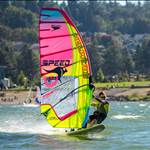
SurferKris said..It seems to me like some people are looking for problems that do not exist. A twisting sail is a good thing, it compensate for the lower windspeed near the water surface and it also act as "wash-out" on airplane wings, i.e. ensures that over-sheeting is not done at the top of the sail and that a stall would start at the lower part of the sail.
A sail that flops a little at the top on an upwind course, will be just right when going downwind:

And some people have actually tried to learn from the world experts like Professor Mark Drela. who designed the world-record human powered aircraft and designed and pedalled the world record human powered boat as well as designing America's Cup wingsails and being the guru in aerodynamics at MIT, one of the world's great unis. Some have also sailed with guys like John Bertrand of Australia II (he did his masters thesis on small craft sails) and Grant Simmer (who has won about seven America's Cups as a sailmaker, sailor or design leader). These guys aren't morons so it would be wrong to ignore what they say.
With respect, wind shear is not the whole answer. Wind shear affects all craft and yet extreme twist only makes a few craft go faster. If wind shear was the answer then Laser dinghies, which have a mast about as high as a windsurfer, would go faster with the same amount of twist as a windsurfer - in fact they go dog slow with the same amount of twist as a shortboard. So does a longboard. So does a high performance cat. So wind shear is not the answer, and we can tell that from getting out on the water and seeing that the wind does not shear as much as a high-wind windsurfer sail twists. We can do that very easily by looking at sail tufts, which often show that there is not actually much wind shear at all, and that wind shear is almost never as large as the twist in a fast windsurfer sail. On a big boat we can be looking at tufts that show us wind shear from about three metres above the waterline to about 30m above the waterline, and it's basically never as big as a windsurfer's twist is. The same applies in smaller scale on things like Moth or Laser rigs.
The Moth guys may well be going faster than the windfoilers a lot of the time and they are going to great trouble to REDUCE twist. Look at this pic of top Mothies going upwind - where's the huge twist like shortboards carry? If windsurfer twist was all about wind shear then why don't the top Moths, which are a similar height off the water, also twist off to suit the wind shear?

Here's the Olympic Laser gold medallist going upwind. Like the Moths, he is using massive amounts of vang tension to REDUCE twist, yet his mast height is similar to that of a board and so the wind shear would also be the same - so why does he not ease mainsheet and vang to twist off the sail if twist was faster? Answer - because windshear isn't a big factor.

Here's a taller mast but on a very efficient boat - the A Class cats. On these tall sticks there should be lots of wind shear but the fast guys don't carry anything like as much twist as a windsurfer sail. The world foiling A Class champ, by the way, is an America's Cup champ/sailmaker who probably earns more than all the windsurfer sail designers do put together and he has access to F1 style wind measurements and tech. The non-foiling division world champ is a sailmaker and Olympic medallist, so these guys are not morons who are ignoring wind shear.

Wind shear is very well known to big boat sailors because when you are sailing in light winds and ocean swells, the swells mess up the windspeed low down and cause wind shear to be absolutely critical to correct trim a lot of the time - and yet no fast big boats carry twist like windsurfers and if you give them that much twist they go slow. So it's a lot more than wind shear.
There's no particular reason why rigs need washout to control stall like an aircraft wing does as far as I know. There's plenty of boats where you can adjust the rig to stall at the head first and it's not disastrous; in fact in some conditions (flat water and light/medium breeze in medium-speed boats) it's actually very fast.


 Myself, Pascal Maka and Jeff Magnan