The Kill Cord: Clip On Before You Idle

Quick summary
A kill cord clips to you at one end and to a cut-off switch at the helm or on the outboard at the other, so the engine stops the moment you are pulled away from the wheel.
The part that matters is sequencing: clip on before you turn the key, tug-test the switch once so you know it actually kills, then wear it any time the engine is running.
The how-to
After reading this you can rig, test and wear a kill cord so an ejection at the helm leaves you with a stopped boat instead of a circling one.
Preparation: check the cord, not just the boat
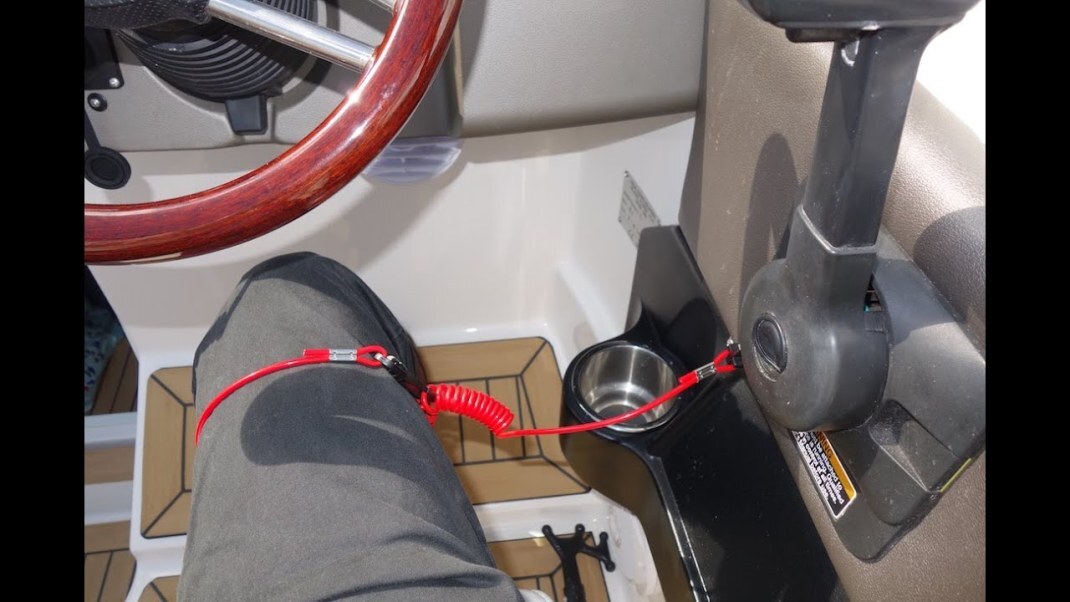
Find the switch first, because on many Australian trailer boats between 4.5 and 6 m it sits low on the side of the console or tucked under the wheel.
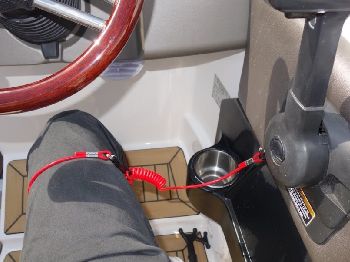
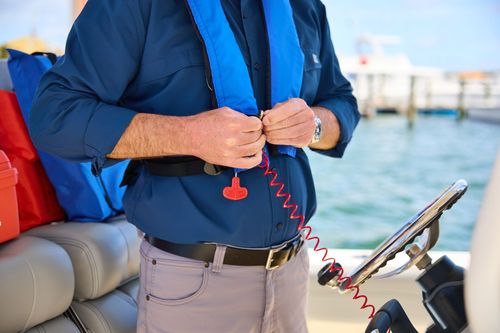
The red coiled lanyard hanging off that switch is standard fit on most outboard rigs, and it is the part people never think to inspect.
Pull the cord out straight and look hard at the clip, the crimp and the plastic tab that seats into the switch body.
Faded, chalky plastic and a cracked clip mean it has spent years in the sun, so replace it before the next trip rather than after it fails.
Check the length while it is stretched, because the cord has to reach your hip without leaving enough slack for you to leave the boat first.
Coil or clip the excess so the tether cannot wrap the wheel, the throttle or the switch in a way that stops it pulling free.
Decide where it clips onto you before you are standing at the ramp with a queue of trailers behind you.
Good attachment points are a lifejacket zipper D-ring, the dedicated kill-cord loop on a PFD, or a belt loop that will not tear under load.
Weak jacket pockets, board short drawstrings and anything that lets go before the switch does are not attachment points.
Initiation: the two seconds that set the habit
Clip on before you start, not after you clear the ramp, because the sequence you practise is the one you repeat when you are rushed.
Australian Maritime Safety Authority recreational boating safety practice treats the lanyard as the thing that stops the engine when the operator leaves the helm, which only works if it is already on your body.
BoatSafe Queensland licence training drills the same order before a candidate's first solo run, for exactly the same reason.
Push the tab into the switch, clip the other end to your lifejacket or belt loop, then reach for the key.
If you start the motor and then go looking for the cord, you have already rehearsed the wrong habit for the day.
If the cord is not on your body before the engine fires, you are relying on luck to keep the boat under you.
Execution: test it, then wear it all day
Tug-test it once, with the boat still made fast or idling in a clear patch of water with nothing downwind of you.
Give the cord one sharp pull, watch the engine die, then clip back on and restart before you go anywhere.
A switch that does not kill is worse than no switch at all, because you have spent the whole day trusting it.
Contacts corrode, tabs wear round and wiring chafes behind the dash, so the test is the only proof that today's cord works today.
Wear it whenever the engine is running, including idle at the ramp, coming on and off the plane, and easing up to a skier.
Most ejections happen at low speed near the transom or when a passenger falls as you punch off, not at top speed on flat water.
Passengers who may take the helm need their own clip-on habit, or a second lanyard if the boat is set up for one.
Do not hand a running boat to an unclipped mate while you go forward to sort out the anchor.
If the cord trips while you are still aboard, pull the throttle to neutral first, clip on again, then restart.
Restarting in gear with the wheel hard over is how a small stumble turns into a lurch across someone else's bow.
If you do go over the side and the motor stops as designed, the boat stays near you, which is the entire point.
Failure diagnosis: five ways a fitted cord does nothing
Not clipped at all is the most common failure, and it usually happens on the quick jobs where you are only shifting the boat off the ramp.
Clipped to the boat is next, where the cord ends up on the wheel, the throttle or a grab rail because it felt like it was in the way.
A cord joining the switch to the helm does nothing except make the switch look occupied.
Too much slack is the failure nobody talks about, and it is worth understanding properly.
The cord is not a jewellery item for the ignition, and length is the whole mechanism.
If there is enough slack that you can fall out of the boat without pulling it, it will not save you.
The useful length is short enough to yank the switch before you hit the water.
Sitting on the cord traps it under your thigh or a cushion, so your body weight rather than your movement decides whether it pulls.
A dead switch is the quiet failure, where the tab pulls out cleanly and the engine keeps running because the circuit never opened.
Cable ties, a spare clip left permanently in the switch and dummy plugs all produce the same outcome: an unmanned boat that keeps going.
A kill cord does not replace a proper lookout or the lifejackets your state requires, and a sensible launch window helps too, so check the Hobart wind forecast before a cold-water run down south.
Can I clip the cord to a belt loop instead of my lifejacket?
Yes, if the loop is strong enough to pull the tab before it tears, though a lifejacket D-ring or a PFD kill-cord loop is the better anchor.
Do I really need it at idle?
Yes, because low-speed work near the transom and pick-ups are where people most often end up in the water.
How often should I test the switch?
Once every trip, on the first start, so you learn about a faulty switch before it matters.
What if the cord is missing?
Replace it before you launch, since a coiled lanyard costs very little and the switch is useless without one.
Compare lanyard lengths, switch positions and PFD attachment points with other skippers in the Seabreeze forums .