The Pre-Start: Checks Before You Launch

Quick summary
The pre-start is a fixed order you run every trip: bung in, kill cord on you, lifejackets sorted, fuel and battery checked, then the key.
Plenty of ramp sinkings start because the bung went in last, after the hull was already floating and quietly taking water.
The how-to
By the end of this you will have a repeatable park-bay routine that gets you off the ramp in one shot without a scramble.
Your pre-start is not a checklist you read at the water; it is an order you burn in until your hands run it for you.
Working BoatSafe instructors on the Gold Coast drill the same sequence with every candidate: bung, cords, jackets, then the key.
Park-bay prep
Pull into the rigging bay rather than the ramp, and finish every dry-land job while the boat is still high, level and out of the way.
Bung first. Fit the drain plug before you back down, and if your hull has twin drains, check both by hand instead of by memory.
A bung fitted after the boat is floating means you have already loaded the bilge, so you spend the morning pumping instead of fishing.
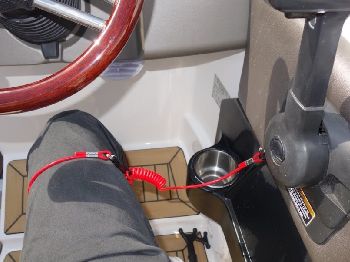
Kill cord next. Clip the engine cut-off lanyard to your leg, your jacket strap or your wrist, and never to the wheel or a grab rail.
Clipped to the boat it does nothing useful: you go over the side, the motor keeps running, and the hull turns back under power.
A belt loop is no better, because the stitching tears out long before it pulls the switch.
Clip it on every single start, and accept that the motor stopping is exactly the point.
Lifejackets out of the locker. Count them, match them to who is aboard, and stow them where hands reach them, not under the anchor rope.
Your state's marine safety rules set the level required, so a Level 50S can be fine inshore while Level 100 is expected offshore or on a bar.
Kids wear theirs for the whole trip, and adults wear theirs crossing a bar, running at night, or any time the kill cord matters.
AMSA's recreational guidance covers the wider picture as well: lifejackets, distress beacons, weather, and telling someone your trip plan before you leave.
Tell someone ashore where you are heading and when you expect to be back, because that message is what starts a search early.
Fuel by thirds. One-third out, one-third home and one-third in reserve, worked out in the driveway rather than at the far mark.
Squeeze the primer bulb until it is firm, open the tank vent, and look through the fuel-water separator bowl for water or rust.
Water in the separator means you drain it now, in the carpark, not when the motor stumbles in a following sea.
Battery on. Switch the isolator on, watch the voltage come up, and if you run dual batteries, confirm which one is feeding the cranking circuit.
A flat starting battery at a busy ramp on a Saturday morning ends your day and delays everyone queued behind you.
Every job you can do on dry land, do on dry land: the ramp is for launching, not for finding out.
Trailer and lights. Plug the trailer in at home, walk around it, and confirm indicators, brake lights and any override or electric brakes are alive.
Check the coupling is latched and pinned, the safety chains are crossed under the hitch, and the breakaway cable is connected if one is fitted.
Chains crossed under the drawbar catch the tow eye if the coupling lets go, which keeps the trailer tracking instead of digging in.
Keep the winch strap tight and the separate safety chain on the bow eye, because a strap alone lets the hull run forward under hard braking.
Weather and tide before the driveway. Read the wind, tide and bar conditions at home, where changing your mind still costs you nothing.
Tide sets your ramp depth, your bar timing and your return window, so check the tide times for your ramp rather than the nearest city.
A 15 knot (28 km/h) sea breeze against an outgoing tide builds a chop that a 25 knot (46 km/h) offshore never will, so read direction too.
Southeast Queensland crews can pull a local wind forecast the night before, then compare it against what the water is actually doing at dawn.
On the ramp
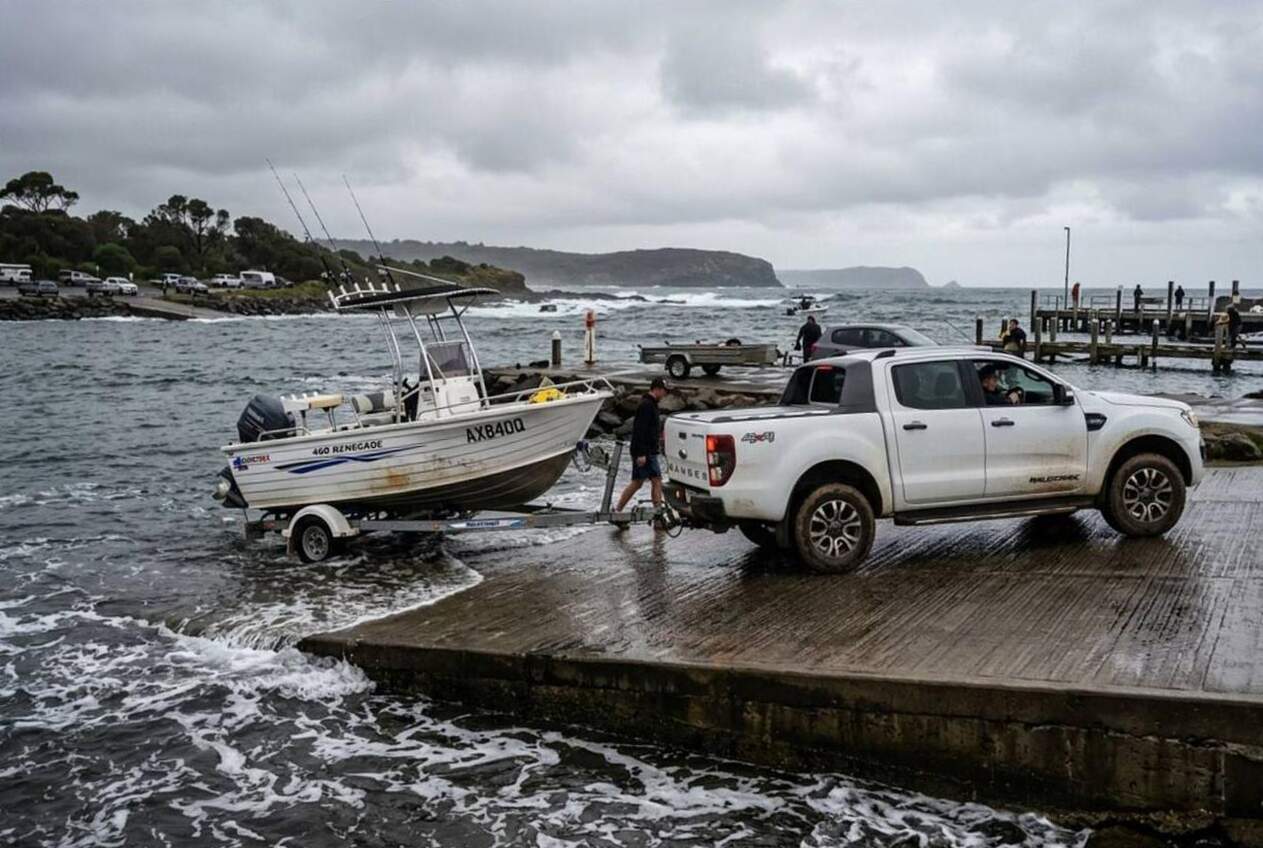
You get one shot down the ramp, so arrive with straps off, motor trimmed up, keys in, and lines and fenders already tied on.
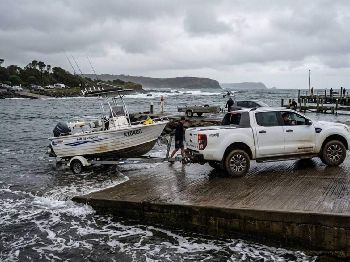
Back in straight, float the boat off, and move it clear of the ramp face before anyone starts sorting rods, eskies or sunscreen.
Do not park the tow vehicle at the top of the ramp while you rearrange gear, because the queue behind you is chasing the same tide.
First 30 seconds afloat
Start the motor at the pontoon, then look for a steady stream of cooling water and listen for any alarm to clear.
Watch the bilge for water rising, which is your last chance to catch a missed bung or a perished hose while retrieval is still easy.
Check the gauges, then turn the wheel hard both ways to confirm full steering travel before you are inches off a piling.
Select reverse, feel it bite, and come back to neutral, because a gearbox that will not go astern turns docking into a collision.
Switch the radio on, set it to channel 16, and run a quick radio check so you know it works before you need it.
Failure diagnosis
If it will not crank, suspect the isolator, a loose battery terminal, or the lanyard clip sitting out of its slot.
If it cranks but will not fire, work back along the fuel path: closed vent, soft primer bulb, stale fuel or water in the separator.
If water is coming in, get the bow back on the trailer and diagnose it on the hardstand, not afloat with the pump running.
What changes when you run a single battery and an electric-start four-stroke instead of a dual bank with a house circuit?
How do you adjust the routine on a steep, weed-covered ramp where the trailer wheels lose grip on retrieval?
Which parts of the pre-start move earlier when the day opens with a bar crossing on a falling tide?
What do you learn next: anchoring under power, or bar timing and reading the run of the swell?
Next session, run the sequence out loud in the rigging bay so your crew hears it: bung, cords, jackets, fuel, battery, key.