sailortrash forum posts in last 60 days

sailortrash
sailortrash
26 posts
26 posts
22 Aug 2026 1:44pm
Ok, that interesting - why? In my mind it would not just stabilize pitch, but allow you to go faster without increasing front foot pressure

but again - that’s the hypothesis
sailortrash
sailortrash
26 posts
26 posts
21 Aug 2026 5:25pm
azymuth said..

Grantmac said..
I don't think we need a mechanical system since we can shift CofG very quickly, because the sailor is by far the heaviest part of the system.


I agree - the easiest foiling axis to control is pitch 😀


Not need to have - nice to have!
sailortrash
sailortrash
26 posts
26 posts
20 Aug 2026 10:54pm
Your discussing stuff I built an app for!
basic, but check it out. There’s an attempt to define “control” in terms of how much pitch a rider can handle by shifting body weight back/forth and sheet in/out

i also find the speed estimates somewhat true, for me at least

3hxyqkzsskexg9sja54q3l.streamlit.app/
sailortrash
sailortrash
26 posts
26 posts
20 Aug 2026 10:18pm
jaumet said..


thedoor said..
If we keep asking Jaumet questions maybe he will hit image posting status😂

Hi Jaumet

From your article


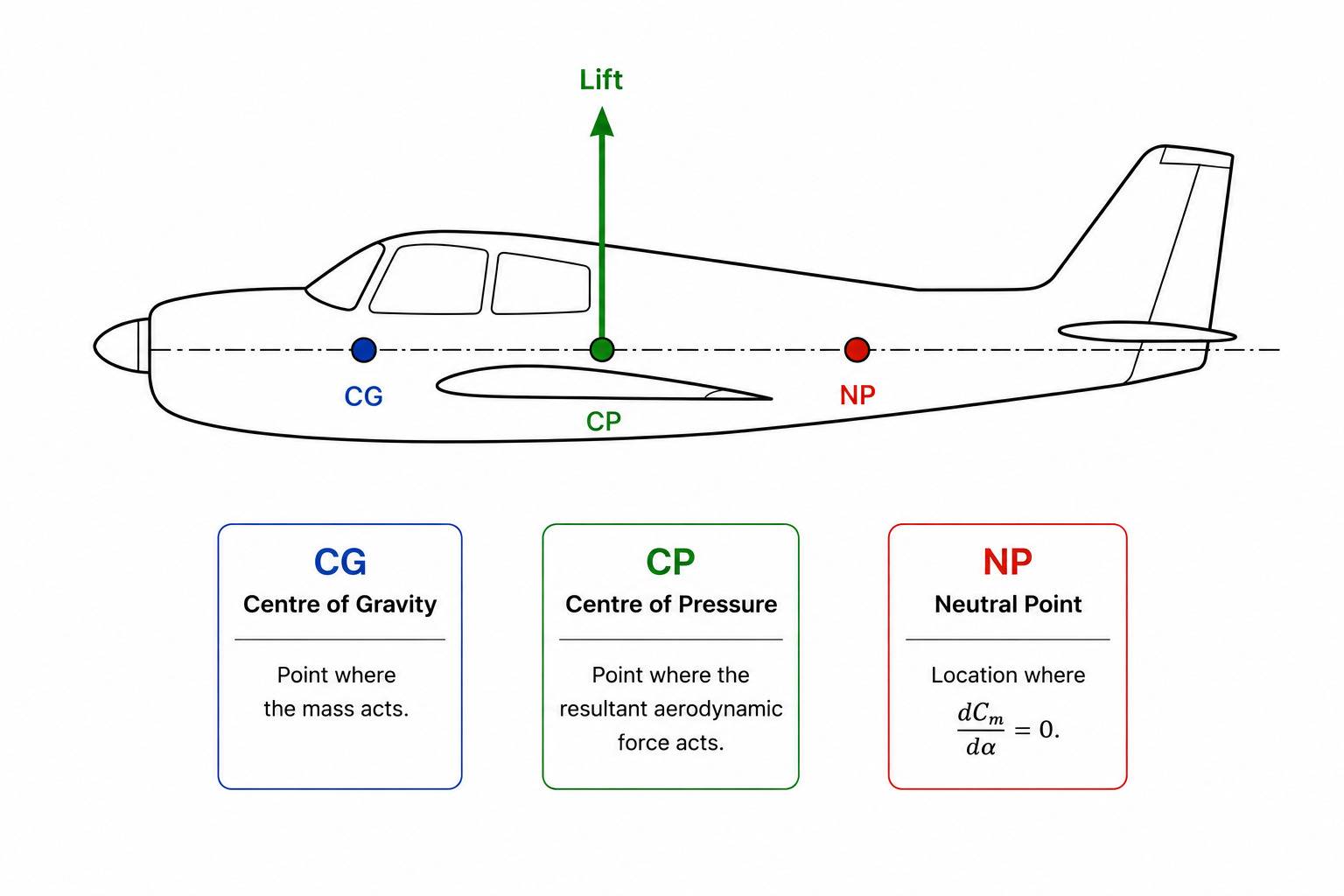
What I am hearing is that for pitch stability the further the COG is from the Neutral Point the more likely the craft will continue on its pitch. From practical experience I totally get that. Longer heavier boards and longer fuselages seemed to be easier to gybe because if you messed up your inputs it would tend to carry on its flight path . However, when navigating swells or jumping shorter boards and shorter fuselages were necessary to unlock the pitch control.

So if I have that correct, then if the goal was to improve stability we could ride with more board out in front. How do we estimate the Neutral Point of the system (foil, board and rider)?

I guess I am wondering how we could manipulate moving the neutral point aft by changing gear or geometry.

One more question: I am assuming that as you move the COG forward, you need to generate more lift with the foil to get the craft to fly?


Hey thedoor!

Yeah you got it right.
If you want to improve pitch stability on an wing-tail configuration you can either move the CG forwards or moving the NP Aft.
In these foiling craft the position of the CG is driven mainly by the weight of the Rider. However, the position of the rider cannot be arbitrarily set like in an aircraft (a wingfoil has no control surfaces) and so its position is a consequence of the overall external pitching moments (Drag and Lift of the Foil, Board and Sail). Lets say that the rider position is the control surface for pitch balance.

Therefore the only thing that we can actively in this case to improve Stability to move the NP aft is to increase the Tail Volume (again aircraft terminology).
In plain english this is to produce as much lift and as far aft as possible. This can be done by means of a larger fuselage (longer lever) or by making the stab larger or running it at a higher angle of attack.

Making the board longer from the front would not impact the stability as it does not affect the weight or the forces on the system much.

Hope this answers your question


Did you just say that board length doesn’t matter for pitch stability? That’s not my experience

jaumet said..


sailortrash said..


jaumet said..


utcminusfour said..
Welcome, Jaumet!
I am keen to learn and discuss, but I am not an expert on airfoil theory. I have picked up a little through school, work, and my own interest in foils, but this discussion may be slightly beyond my depth, so a couple of questions first.
Could you clarify how you define camber and reflex, and what distinguishes one from the other? I have heard reflex described as a convex hook (down) in the aft portion of the lower surface. In that description, it is related to the camber line but treated as a separate feature. You seem to be describing reflex as the aft portion of the section turning upward, or effectively moving the trailing edge up. Some clarifications of the nomenclature would help me a ton.
We also need to get you the ability to post pictures. I would really like to see two comparable sections, one with the stronger nose-down pitching moment and one with the subtle reflex that reduces it. I think seeing the difference would make this click for me. Maybe PM me the images and I can post them?
I think I found the Takeoff Technologies home page, but not the article you mentioned. Regardless, it looks like an amazing resource that was not on my radar. Thanks for posting!


Thanks utcminusfour,

I am planning on doing more posts like this here,
Its nice to engage with the community, so hopefully I can get the ability to upload soon.
Meanwhile you can find the article with images here:
app.takeoff-technologies.com/community/blog
It makes it easier to follow

best,
Jaume


Wouldn’t an “auto” adjusting stabilizer be a good for the kind of foils we use (one mast, one wing, one stab)? On the water, i get the sense that a given AoA of the stab works well within a certain speed range, but ideally AoA would change with speed.


looks like you could support this open source project


jaumet said..


utcminusfour said..
Welcome, Jaumet!
I am keen to learn and discuss, but I am not an expert on airfoil theory. I have picked up a little through school, work, and my own interest in foils, but this discussion may be slightly beyond my depth, so a couple of questions first.
Could you clarify how you define camber and reflex, and what distinguishes one from the other? I have heard reflex described as a convex hook (down) in the aft portion of the lower surface. In that description, it is related to the camber line but treated as a separate feature. You seem to be describing reflex as the aft portion of the section turning upward, or effectively moving the trailing edge up. Some clarifications of the nomenclature would help me a ton.
We also need to get you the ability to post pictures. I would really like to see two comparable sections, one with the stronger nose-down pitching moment and one with the subtle reflex that reduces it. I think seeing the difference would make this click for me. Maybe PM me the images and I can post them?
I think I found the Takeoff Technologies home page, but not the article you mentioned. Regardless, it looks like an amazing resource that was not on my radar. Thanks for posting!


Thanks utcminusfour,

I am planning on doing more posts like this here,
Its nice to engage with the community, so hopefully I can get the ability to upload soon.
Meanwhile you can find the article with images here:
app.takeoff-technologies.com/community/blog
It makes it easier to follow

best,
Jaume


Looks like u could support this open source project!

3hxyqkzsskexg9sja54q3l.streamlit.app/


Yes of course!
This is what aircraft do! They change the AoA of their Horizontal Tails depending on the speed and CG (fuel is burned over time).
Its just hard to manufacture at these small scales.

Your project, looks very nice!
Unfortunately, I am quite busy devloping our Conceptual Design Tool.

You can check it out in: app.takeoff-technologies.com
You can also use many of the features for free!

best,
Jaume


Nice to get my “instinct” from time on foil confirmed by theory. I think it could be done fairly easily with a mechanical solution. U need a hinge solution with a recoil. Waterflow will push the stab down, with increasing speed the stab will move towards 0/neutral. When speed/waterflow recess, the recoil will pull the stab back towards a higher AoA. A couple of hours with tinkercad should do it, easy 😆
sailortrash
sailortrash
26 posts
26 posts
19 Aug 2026 12:15am
jaumet said..

utcminusfour said..
Welcome, Jaumet!
I am keen to learn and discuss, but I am not an expert on airfoil theory. I have picked up a little through school, work, and my own interest in foils, but this discussion may be slightly beyond my depth, so a couple of questions first.
Could you clarify how you define camber and reflex, and what distinguishes one from the other? I have heard reflex described as a convex hook (down) in the aft portion of the lower surface. In that description, it is related to the camber line but treated as a separate feature. You seem to be describing reflex as the aft portion of the section turning upward, or effectively moving the trailing edge up. Some clarifications of the nomenclature would help me a ton.
We also need to get you the ability to post pictures. I would really like to see two comparable sections, one with the stronger nose-down pitching moment and one with the subtle reflex that reduces it. I think seeing the difference would make this click for me. Maybe PM me the images and I can post them?
I think I found the Takeoff Technologies home page, but not the article you mentioned. Regardless, it looks like an amazing resource that was not on my radar. Thanks for posting!


Thanks utcminusfour,

I am planning on doing more posts like this here,
Its nice to engage with the community, so hopefully I can get the ability to upload soon.
Meanwhile you can find the article with images here:
app.takeoff-technologies.com/community/blog
It makes it easier to follow

best,
Jaume


Wouldn’t an “auto” adjusting stabilizer be a good for the kind of foils we use (one mast, one wing, one stab)? On the water, i get the sense that a given AoA of the stab works well within a certain speed range, but ideally AoA would change with speed.


looks like you could support this open source project

jaumet said..

utcminusfour said..
Welcome, Jaumet!
I am keen to learn and discuss, but I am not an expert on airfoil theory. I have picked up a little through school, work, and my own interest in foils, but this discussion may be slightly beyond my depth, so a couple of questions first.
Could you clarify how you define camber and reflex, and what distinguishes one from the other? I have heard reflex described as a convex hook (down) in the aft portion of the lower surface. In that description, it is related to the camber line but treated as a separate feature. You seem to be describing reflex as the aft portion of the section turning upward, or effectively moving the trailing edge up. Some clarifications of the nomenclature would help me a ton.
We also need to get you the ability to post pictures. I would really like to see two comparable sections, one with the stronger nose-down pitching moment and one with the subtle reflex that reduces it. I think seeing the difference would make this click for me. Maybe PM me the images and I can post them?
I think I found the Takeoff Technologies home page, but not the article you mentioned. Regardless, it looks like an amazing resource that was not on my radar. Thanks for posting!


Thanks utcminusfour,

I am planning on doing more posts like this here,
Its nice to engage with the community, so hopefully I can get the ability to upload soon.
Meanwhile you can find the article with images here:
app.takeoff-technologies.com/community/blog
It makes it easier to follow

best,
Jaume


Looks like u could support this open source project!

3hxyqkzsskexg9sja54q3l.streamlit.app/

sailortrash
sailortrash
26 posts
26 posts
5 Aug 2026 12:04am
I ride the 909 alot, and it’s not a high lift wing for its size. It has a good low end, but i use it as a high wind wing, from 20 knots or so it gets really nice with small sails. I doubt u ll get rid of the problem with smaller wings, they’re just trickier to gybe and will be mote brutal up n down.


Windfoiling, as opposed to windsurfing, is even more about getting that power right. U need to work manually om sheeting angles, and trust the glide of the foil. Swell adds to the challenge and if u go downwind and catch one during a gybe u can hardly sheet in at all until u reach a new broad reach as the swell will power the foil up completely