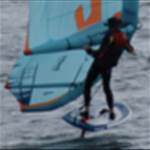
After trying several methods for launching, I discovered that the rodeo method works the best for me. I’m posting this to show you what works for me in the hope that it will help a few other aspiring wing-foiler out there. Enjoy the learning journey. Of course, we are all unique, having different skill sets, body types, and flexibilities. So, I am not suggesting that other methods won’t work better for other people. Please watch this video to see how I launch after a fall. Below are some pointers on my technique. Please comment and let me know what you think. I start by holding the wing from the front handle and I vault onto the board by swinging my leg over the nose. To combat the corkiness, it’s important to reach the exact center point of the board and stay low. Once seated with legs dangling in the water, I am able to lift the wing and obtain greater stability to absorb waves & chop. I can sit through powerful gusts (40kts) and bigger rollers (4 feet) without trouble. Importantly, the corkiness issue affects only a short period from the vault onto one's board until when you lift your wing. Next, after giving a slight pull and gaining some forward momentum, I hop from a sitting position to a kneeling position completely on top of the board. This action is the trickiest to master, and the most prone to err. This maneuver involves 3 actions: 1. Hop off your butt and pull your weight upwards using your wing, 2. Squeeze you knees up over the rails in front of you, and 3. Slide your feet under your butt. From the time you hop until you are squarely kneeling on top, you have very little control of the board. In addition, one has to counteract an unfortunate tendency to sink the nose, because the knees reach the deck before the feet. This can be accomplished by leaning back and applying pressure with your feet as soon as they are up and over the rails. With the wing aloft, this kneeling position provides stability and control of the board. At this point, the next step is to pop-up to a standing position. This is the same as the stink-bug, except you’re already moving and your wing is up. Use the wind to pull your weight upwards, hop off your butt, and pop your front foot all the way forward to its natural riding position. Be careful not to drag your toes! You can jump onto the back foot at the same time, or after a slight delay, whatever feels right. It’s the front foot that requires focus in this step. And, you’re flying. When dealing with corkiness climbing onto the board, keep in mind that you can lean on your floating wing for balance, like a pontoon. Secondly, remember that the degree of corkiness is proportional to the fraction of your body, and its height, that is above the board. Keeping low helps, and sometimes even dunking your head into the water while supporting your weight on the floating wing can save you from getting bucked off. I’m sure this looks hilarious, but so far no one has caught this on film :P One caveat about the rodeo technique is the potential to scrape your ankles and shins on the board. This is only an issue if you’re not wearing a wetsuit. But it happens, in the same spot, too. I’ve got some scars to demonstrate. They remind me of my skateboarding days. In my experience, a “sinker” board of 0.8 (L-volume / kg-weight) is much easier to start than 0.54. Being closer to the surface results in a more corky experience, however accelerating requires much less effort; less awkward balancing and less pumping. Minimizing struggle = longer sessions. I started with a 0.54 sinker 2 years ago, and due to the lighter-winds in my area, I could only realistically ride this sinker 2-3 times a year. Now, with my 0.8 board, I ride it about 50% of the time. The difference is that I am closer to the surface and better able to gain the momentum that is necessary to launch, and require less wind. To be clear, I only use my 0.8 board when I have decent wind and power in my w