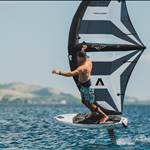
In this in-depth comparison video, Tucker and Mr. Jeff from MACkite take a close look at two wing foil products on opposite ends of the price and performance spectrum: the 2025 Cabrinha AER Wing and the Ozone Flux V2 Ultra X. Their discussion centers on how these wings serve different rider needs, budgets, and riding styles, while both delivering impressive performance in their own right. The Cabrinha AER Wing is positioned as a surprisingly high-performing wave wing at a very accessible price point—around $900 for a 5m size. Despite being a budget-friendly option, the AER is not just for beginners. Instead, it’s a stripped-down, ultra-light surf machine. The design philosophy behind the AER is "deconstructed performance": remove anything unnecessary, keep it light and simple, and retain great handling in the surf. It features soft, minimalist handles and a featherlight frame that make it intuitive and floaty, especially ideal for flagging out while riding waves. Both Jeff and Tucker were genuinely impressed with its ability to disappear in the rider’s hands, allowing full focus on foil placement and wave engagement. They emphasized how its balanced front-hand pressure and drift capabilities exceeded expectations for a wing at this price point. By contrast, the Ozone Flux V2 Ultra X is a premium, high-performance powerhouse, priced at approximately $2500 for a 5m model. It's designed for the rider who wants to push the limits in speed, upwind performance, freestyle, and even amateur-level racing. The Flux Ultra X features cutting-edge materials, including Aluula, and a high-tension canopy. It also features long carbon handles with grip-enhancing bumps and batten-reinforced profiles. It delivers a stiffer, more connected ride that responds with precision and power. This wing is the “sports car” of the two—engineered for speed, aggressive carving, and tight control under load. It’s ideal for skilled riders who enjoy going fast, jumping high, and riding with power. Jeff and Tucker noted its exceptional performance in nearly every category—upwind ability, low-end power, high-end stability, wave riding, and freestyle agility. A key aspect of the discussion centered on the balance between value and performance. The AER impressed as a “sleeper” wing, delivering lightweight performance typically reserved for wings costing double or more. It's an ideal option for riders who prioritize wave riding, travel with compact gear, or want an affordable addition to their quiver without significant performance compromise. The Flux V2 Ultra X, on the other hand, is for those who want no compromise at all and are willing to pay for the best materials and design available. Interestingly, Tucker pointed out that despite not using Aluula, the AER actually felt lighter than the Flux V2 Ultra X in hand. Its exceptional lightness allowed for effortless flagging and unique back-hand trailing techniques that made wave riding smoother and more fluid. Jeff compared it to early F-One wings that were beloved for their soft handles and surf-style lightness, suggesting the AER could fill that niche for riders who miss those designs. The duo also discussed long-term durability, noting that while the Flux Ultra X’s premium materials justify its price with greater longevity and stiffness retention, the AER may fatigue faster under heavy use or powered conditions. Still, for riders primarily focused on surf and light wind cruising, the AER could last a long time while keeping costs down. Both wings, despite their differences, were praised as excellent options depending on a rider’s goals. The AER was called an “everyman wing” that rides incredibly well in the waves without the intimidating price tag. At the same time, the Flux Ultra X was described as a no-holds-barred high-performance tool for speed demons and progression-oriented riders. Jeff summarized it well with a car analogy: the AER is a reliable, simplified truck that gets the job done and rides bett