Hey Kev,
you're right, clarification required!

A "C" kite jumps with the pendulum effect so the harder you direct the kite back, the higher you go ... as a general rule. With a "bow" kite, I have been jumping best by turning the kite directly "up", as if in line with a fixed point on the water from where you started the turn.
I sheet in progressively and smoothly starting from the moment I turn the kite (1/2 powered and smooth increase in bar pressure until you take off from the water at which time you should be at full power and the kite above you (12 o'clock), pointed into the wind or ever so slightly back and you still travelling forwards as a result of your speed and inertia. A smooth sheet in will result in a less disturbed airflow over the canopy.
Your forward speed will carry you past the kite (which should be facing into the wind) and will still give you some of the pendulum effect, but you will get much greater hangtime without washing off all of your forward speed from sending the kite in the opposite direction.
Bow kites have an efficient use of their lift generating surface compared to a "C" which is why it is important to keep the airflow over the kite to generate lift throughout the jump. Turning the kite in the opposite direction reduces apparent wind speed over the foil and the sharp turns required, see only half of the canopy producing minimal lift as they pivot on their inside wing.
Of course you need to load for take off and this is best acheived by easing your edge momentarily before loading which allows the kite to drift back deeper into the window and reduces line tension before you load them hard as you release your edge with a smooth carve turn more upwind. A classic load and take off.

In general It's similar to a "C" kite boost with less aggressively sending the kite back.
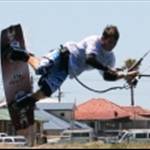
My jumps, at mid point, tend to see the kite at around 1 o'clock (assuming a port tack jump) and facing directly into the wind, fully sheeted in. At the apex, I redirect my kite forward in two parts, a short pull on the front hand to get it pointing in the right direction but basically still over my head for additional loft and finally a hard pull forward to get speed just before I hit the water. I keep the bar sheeted in all the way through the landing to aid in a softer landing.
I hope this helps, Sorry it got a bit techy in the end

Good jumps are very technical, and timing and execution are critical to going big, thats why it is so hard and so few go huge on such efficient kites. It's also why it is worth your time practicing.

Good luck


 Mite be easier to describe in person as this is how i was taught...Hope it helps non the less