Science quiz question of the week

> 10 years ago
Reply
Register to post, see what you've read, and subscribe to topics.
KIT33R
KIT33R
NSW
1716 posts
NSW, 1716 posts
16 Mar 2010 2:55pm
Does the wind have more force on a yacht's sail in humid conditions, as in the tropics, because of the higher water content of the air?
wal269
wal269
WA
718 posts
WA, 718 posts
16 Mar 2010 11:56am
Less
suface2air
suface2air
QLD
701 posts
QLD, 701 posts
16 Mar 2010 2:03pm
I would say less it is hotter therfore is expanded then cooler less humid air .
Trant
Trant
NSW
601 posts
NSW, 601 posts
16 Mar 2010 3:40pm
Just read the same question on the back pages on New Scientist, I assume you picked it up from there too.

Made an interesting read
koma
koma
VIC
760 posts
VIC, 760 posts
16 Mar 2010 4:03pm
Air density would be lower, but the moisture in the air may serve to reduce permeability in a sail reducing the amount of pressure lost through the sail.

Computer says too many variables, not enough information. ;)
I'm going to have to read that New Scientist bit now. I think i've got the last one sitting at home.
JTheron
JTheron
VIC
46 posts
VIC, 46 posts
16 Mar 2010 4:28pm
Without readingthe answer I will take a guess, I am a bit bored at work.

I would say more (my guess). With the air being more dense it should have more energy related to the momentum it has (p=m(ass)v(elocity)) so more energy gets transferred to the kite making the reaction to the wind, more.

I'll stand in the corner and shut up if I am wrong
nebbian
nebbian
WA
6277 posts
WA, 6277 posts
16 Mar 2010 2:58pm
Water vapour is less dense than air. You'd think it would be more because water is heavy, but it's actually less due to the molecular weights of H20 vs N2.
Andrash
Andrash
WA
637 posts
WA, 637 posts
16 Mar 2010 10:47pm
Water molecules are just extra objects for the wind / air to move, so there is less force on the sail. Cool air is denser, and as long as it is dry it should be the most forceful on the sail.

At the end, can you flash up the appropriate answer from the New Scientist....I am too lazy to look....
Thanks
jquigley
jquigley
WA
205 posts
WA, 205 posts
17 Mar 2010 1:51pm
nebbian said...

Water vapour is less dense than air. You'd think it would be more because water is heavy, but it's actually less due to the molecular weights of H20 vs N2.


Wot he said^^^^^^

While on the topic, something I've been wanting to know for a while now is just how much force is generated by a kite? And how to calculate and express in terms other than 'fully lit' or 'going off',cranking or 'blowing it's tits off'

So a little research reveals.......

Force equals Wind pressure x Shape co-efficient x Surface area

Definitions.

Wind Pressure (or stagnation pressure, see below)

Wind pressure is pretty straightforward using the formula 1/2 mass x velocity squared. Air mass is commonly given as 1.25 kg/m^3 and velocity is measured in units of metres per second. So for a 25knot breeze we get 12.5m/sec and come up with 1.25kg /2 x 12.5^2 = 97.66 Pa of wind pressure.

The stagnation pressure is half the density of the fluid times the velocity
squared. For example, in Sydney the wind velocity used for design (100 year
return wind) is 47 m/s.

therefore:
velocity 47 m/s
density 1.2 kg/m3
pressure 1.325 kPa


Shape Coefficient
The Shape co-efficient refers to the resistance that the shape of the object presents to the wind. Engineering standards specify coefficients for various shapes, for example: parabolic dish equals 1.2 and a flat plate equals 2.0

The actual force applied to the object in the wind is dependant on the shape
of the object and how much crossection it presents to the wind flow. The
effect of the shape and orientation of the object is quantified by
coefficents. There is a drag coefficent and a lift coefficent. For example
an aeroplane's wing is designed to have a low drag coefficent and a high
lift coefficent which acts in a vertically upwards direction.

Antenna elements, on the other hand are not designed for their
aerodynamic properties and actually usually have a larger drag coefficent
and a smaller lift coefficent. The easy and conservative approach to this is
to assume a drag coefficent of 1.0 and that it can act in any direction as
wind and the turbulance it casuses can act in almost any direction.


This is a pretty hard one to specify without putting your kite in a wind tunnel and even then there are an infinite number of combinations of the drag coefficient and the lift coefficient. For these purposes I'll just use a coefficient of 1 but being aware that it's potentially 2 if you liken it to a flat plate that is perpendicular to the wind direction (as in your kite directly downwind) and possibly more with the coefficient of lift generating even greater forces.

Surface Area
Surface Area equals......surface area
Let's say 12m for arguments sake.

Now let's see if we come up with anything that is remotely realistic!

Pressure 97.66 x Shape coefficient 1.0 x Area 12m = 1172N

Convert N to Kgs, 1172/9.81 = 119kg

Hmmmmm.....sounds reasonable

I weigh 87 kgs so it's enough to lift me off the water and there's some spare to get me some acceleration too.

J-P

gorilla
gorilla
WA
48 posts
WA, 48 posts
17 Mar 2010 4:01pm
Jquigley posts some interesting thinking there. I think a correction that needs to be made is that for the surface area, you need to use projected area (i.e. a 12m kite has a projected area of less than 12m).

Another way to measure the force would be to put a loadcell between the spreader bar hook and the chicken loop so that you can get the instantaneous force at a point in time. With a suitably designed setup, you could work out the force vectors. Add in an accelerometer attached to the kite and you can link the the force on the chicken loop to the movement of the kite.

An engineering student took a Flysurfer (if I remember correctly) and did a bunch of wind tunnel tests on it; the results may only be relevant for foils, but it would be interesting to see the outcome.

Maybe there is a Seabreeze user out there who has some CFD skills and a bit of free time on their hands who might be willing to whip up a quick model to see what's what
jquigley
jquigley
WA
205 posts
WA, 205 posts
17 Mar 2010 5:51pm
There's so many variables here that it's pretty much only ever going to be a theoretical exercise/stab in the dark.

I like the idea of putting a load cell at the chicken loop. Add to that a GPS so vertical and horizontal velocity and acceleration can be measured, have them both synched and put the data into some whizbang engineering software and see exactly what forces are at work - or in this case at play...

Are there any brainy computer technophiles out there?

What's CFD? Contracts for difference? Computational Fluid Dynamics?

I give up, my brain hurts.

J-P
SamS
SamS
QLD
20 posts
QLD, 20 posts
17 Mar 2010 9:40pm
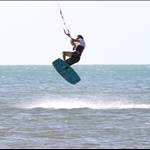
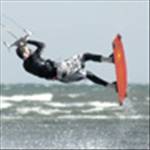
If you're after a rough guide to what forces can be provided by a kite, at the apex of a jump (rider acceleration = 0) the upward force of the kite will equal the weight (f=ma) of the rider (and his board etc). So an 80kg rider will need an uplifting force of 80(kg)*9.8(m/s/s)= about 800Newtons. Or 80kg up
Bulk
Bulk
VIC
19 posts
VIC, 19 posts
18 Mar 2010 12:22am
SamS said...

If you're after a rough guide to what forces can be provided by a kite, at the apex of a jump (rider acceleration = 0) the upward force of the kite will equal the weight (f=ma) of the rider (and his board etc). So an 80kg rider will need an uplifting force of 80(kg)*9.8(m/s/s)= about 800Newtons. Or 80kg up


All those calculations for "80kg up" ...........
jquigley
jquigley
WA
205 posts
WA, 205 posts
17 Mar 2010 9:39pm
SamS said...

If you're after a rough guide to what forces can be provided by a kite, at the apex of a jump (rider acceleration = 0) the upward force of the kite will equal the weight (f=ma) of the rider (and his board etc). So an 80kg rider will need an uplifting force of 80(kg)*9.8(m/s/s)= about 800Newtons. Or 80kg up


And you forgot the kite......

What's gonna hold it up?

Or is it full of helium?

SamS
SamS
QLD
20 posts
QLD, 20 posts
17 Mar 2010 11:56pm
Well i did say rough. The kite only has a small mass compared to the rider
sleek1
sleek1
VIC
672 posts
VIC, 672 posts
18 Mar 2010 2:44am
Aaah. Now i understand why their is so much dingle dangle.
Please Register, or first...
Topics Subscribe Reply