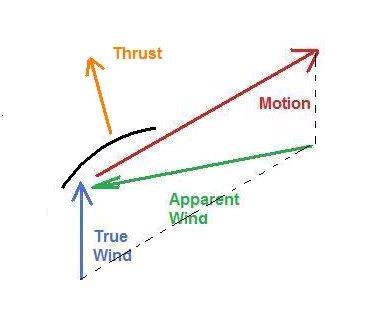
Apparent wind is a very simple concept that continues to mystify many people who have been sailing for years. It is the combination of two winds: the one derived by the board moving through the air and the wind produced by nature—the true wind. Thus, it is the wind you feel on the board.
Imagine yourself standing up in a convertible. It is a calm day, so there's no true wind. As the convertible starts forward, you will begin to feel a breeze on your face that increases as the speed of the car increases. At 10 mph you will feel a 10-mph breeze on your face. This is apparent wind.
Now imagine yourself in the same car heading north and there's an easterly wind of 10 mph blowing. This nature-produced wind from the east is what we call true wind. It is hitting the right side of your face. As the car starts forward you will not feel two different winds, one on the side and one on the front of your face, but a resultant wind coming from an angle forward of the true wind. What you feel is the apparent wind and apparent wind is always forward of true wind.
Kiteboarding and apparent wind: the kite's speed relative to the surrounding air. When kiteboarding in a straight line, the kite's apparent wind is a combination of the wind speed and the speed of the kite and rider over the surface, but since the kite is highly steerable apparent wind can vary widely depending on how the kite is being flown.
Most ways of increasing power from the kite involve giving it a higher apparent wind somehow, i.e. diving the kite, riding faster, or riding at a greater angle into the wind. Any of these raises the kite's apparent wind speed.
(www.seabreeze.com.au/Articles/Kitesurfing/Kitesurfing-Terminology-Lingo_1185759.aspx)