
VIC
19 posts
Hey,
I want to learn to do kite loops, and today i started doing some loops while riding along, without doing any jumps.
I understand how they work just need to practice a little and grow some / go out a tad underpowered on my 8.
i was just wondering as a friend of mine said i should try kite loop transitions to start off with. Which one is easier and how would you do a loop transition?

VIC
760 posts
The way i've got people comfortable with looping in the past is to start doing top-loops as you come down from a jump. That will start teaching you about the time it takes to initiate a loop and have the kite complete a loop in those conditions.
Then just start pulling the trigger earlier and earlier.
So in simple steps:
1. The top loop (heli-loop)
Jump and leave the kite at 12, wait till you feel yourself start coming back down, then with the bar all the way in pull on your back hand as hard as you can. The kite will loop above you and will give you a tiny bit of speed as you come in for your landing.
2. The side loop (transition loop)
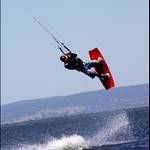
Jump and let the kite drift further across the top of the window than you usually would (ie. if travelling left, let the kite get to 1), as you get to the top of your jump pull on the back hand as hard as you can. The kite will loop over in the opposite side of the window and will give you a light/moderate pull. Make sure you point your board directly downwind and be prepared to ride away in the opposite direction that you took off on... hence why they can be used as a transition.
2.5 The back roll loop transition
Ride in slower than you usually would to do a back roll. Initiate the back roll using less force and momentum than you usually would and look over your front shoulder. As you get half way around the back roll crank on the back hand to have the kite loop in the same direction as you are rotating; the pull of the loop will pull you out of the back roll and have you land riding in the opposite direction as you would for a transition.
3. The loop
Load up, jump and crank on your back hand before the kite gets to 12. The kite will loop deep in the wind window and pull you moderately hard. If you got enough height and the kite turns fast enough then it'll complete the loop and catch you before you hit the water at speed. If not, then be prepared for a hard landing.
The part where you're likely to get hurt is stepping it up to #3. It's just really a matter of slowly but surely initiating the loop earlier and earlier, building confidence and learning the timing as you go.
You can practice all of these in light winds, but a proper kite loop will only work in moderate-high winds where the kite has the speed to complete it's loop and get to the top of the wind window to catch you before you hit the water. If the kite is fast enough you may also have to do a top/heli-loop on your way down after the initial kite loop, or if you're really hammering in hard you can use a top/heli-loop behind you to slow you down before you hit the water (see some of Lenten's mega-loop videos).

QLD
131 posts
I've been doing a few jump downloop transitions (i.e. send the kite, jump, then pull hard on old front hand/new back hand), which seem pretty tame so far (in 22kts) as the kite starts the loop high, but you still finish with a nice bit of speed going to opposite way. They probably have a proper name?
WA
2119 posts
downloop transitions are so much easier to time properly, as your lines wont go slack like a normal jump transition. Kiteloops are explaine fully on Progression Advanced CD, check out u-tube, you can learn heaps!