Water start worries

> 10 years ago
Reply
Register to post, see what you've read, and subscribe to topics.
VRBones
VRBones
130 posts
130 posts
22 Feb 2017 10:34am
ajs18s said..
And what is this "EDGE" you all talk about? Is it when you dig the side or edge of the board into the water? I felt that I could lean onto my heals whilst traveling along the cable, but was unsure how far I could lean or put pressure onto my heals. I could not find this edge you all talk about. The board still felt slippery.


Short answer is yes, dig the edge of the board into the water.

Long answer:
Try turning your board completely on its side (1 long edge facing directly up, 1 long edge directly down) and submerging 1/3 the board into the water (up to the footpads). You should be able to glide the board quite easily forwards & backwards (running along the sunken edge), but be very difficult to move the board sideways (pushing the board through the water in front of you). You have effectively made the board into a big, long fin that likes moving only along the direction it is pointing. You can test this by trying to push the board 1/2 towards the front and 1/2 towards the side; the board will want to go only toward the front.

When riding you will likely never have the board standing vertical in the water, but the more vertical it is, the more the board will act like a big fin, limiting the movement sideways and making movement in the direction of travel more and more easy to maintain.

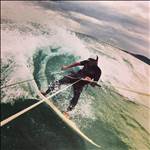
If you are practicing at a cable park (or on water starts) try to imagine the edge of the board as a big knife that you are slicing into the water, rather than a flat board bouncing on top of the water. To get this right, lean back against the pull so you can really dig the edge in more vertically and push hard on your heels to push the board deep into the water as you start to turn. This is especially true for your back heel as you want the bottom edge of the back of the board to be the deepest part of the slice as this part has the greatest fin-like effect. Since digging in the nose of the board can lead to bad wipeouts, it's also preferable to not use the front of the board much, so keeping the nose completely out of the water and only using the back part of the edge is fine (as seen in the pic above, 1/2 the edge in the water, back part of the board digging in deep).

Hope this helps.

jonnydiesel
jonnydiesel
WA
43 posts
WA, 43 posts
22 Feb 2017 12:36pm
Like you, have suffered the same issues.

Don't complicate it too much, as it is simpler than you think.

Once you get a feel, for the kite pulling you from the water, just turn downwind, by pushing your front foot forward and you will start to plane.

Then weight your rear leg, bending your knee, found this is the key.

The next part is to let the bar out, then pull on the bar till you feel the power, then let it out, then pull it in.

You will find the "sweet spot" and just work it on and off.

Have found, its about learning to let go.

Hope this helps.
surpher
surpher
VIC
81 posts
VIC, 81 posts
22 Feb 2017 8:30pm
TL;DR

To avoid sinking, when you get up out of the water push the bar out a bit,away from your body, to allow the kite to "breathe" a little bit. That willkeep it in the better position in the wind window where it will catch more wind into the canopy which will generate more powah!

When you're able to get pulled out of the water okay and ride for a bit to then "sink", there is a simple reason why that happens, and an even easier solution to it - above.
You are most definitely pulling on the bar all the way in and keeping it there all the way pulled in. What that does is it chokes the kite's power. Pulling the bar in generally means "give me more powah!", but that doesn't apply here. Pulling all the way in pushes the kite too far to the edge of the wind window where it doesn't have enough wind in the canopy, that makes it choke, it looses power, you sink.

Also there are other things that help, like stated above by riding a bit downwind and then edging, but that's another story.

Don't worry, it's a common mistake people do it when first getting out there with a board. I did it myself. But luckily a mate of mine told me what I was doing, so the 3rd tack, literally, up and riding and coming back in at the same spot.
ajs18s
ajs18s
QLD
60 posts
QLD, 60 posts
22 Feb 2017 7:46pm
Hey guys, thank you all for that, it does make sense for sure. VRBones thanks for clearing that up for sure.
UTB
UTB
26 posts
UTB UTB
26 posts
23 Feb 2017 8:59am
Jhana said..

ajs18s said..
I have had about 5 sessions so far with water starts, I do get up and travel about 5 meters but fall back, the board feels like it is slippery and just chopping over the water, if that makes sence.
Am how ever going to the cableski park as I have never surfed, skated or any kind of board sports.


Hi Ajs,
You mentioned you fall back in the water or you face plant when water starting.
I had the same problem - I took a lesson with a great teacher and he solved my problem with this technique in one session.
Here is what he made me do.
Without the board

1. Go into the water with just the kite

2. Dive the kite into the power zone (over 12 oclock) and at the same time push the bar away from you. (This will take the forward power out of the kite)

3. Then just after you have pushed the bar away pull the bar in - not sharply. (you will feel the forward power of the kite and it will drag you forwards through the water on your chest).

There are two distinct movement happening here.

The first movement of diving the kite and pushing the bar away gives lift, the second movement of pulling the bar in will give you forward movement.

When you dive the kite into the power zone and push the bar away at the same time this will give you lift because the kite is going through 12 o'clock and this is the lifting part of the wind window and you need lift in the water start to get you out of the water but not pull you over the board.

When you water start with a board you have to have lift to get you out of the water but you don't want forward movement immediately because forward movement will pull you over the board onto your face.

So when you are ready for the water start dive the kite through 12 and push the bar away.

This will lift you out of the water - then as the lift gets you standing up on the board pull the bar in (not sharply)and you will then get the forward movement and you will feel the control because the more you pull the bar in the more forward power you will have.

Practice without the board to get the feel for the two distinct movements of the bar.

Good luck


Gave this a try yesterday and its top advice.

Many thanks
Kit3kat
Kit3kat
QLD
202 posts
QLD, 202 posts
26 Feb 2017 9:13am
ajs18s said..
Hey guys, thank you all for that, it does make sense for sure. VRBones thanks for clearing that up for sure.


an easy way to get the "edge" is to just lift your toes up as much as possible. The natural result will be to get pressure on your heels which will edge the board. it IS that easy. :)
ajs18s
ajs18s
QLD
60 posts
QLD, 60 posts
26 Feb 2017 7:11pm
Once edging do you lose speed or speed up?
Gateman
Gateman
QLD
409 posts
QLD, 409 posts
26 Feb 2017 8:51pm
ajs18s said..
Once edging do you lose speed or speed up?


Your board needs to have some speed before you can edge, edging changes direction and is what drives you upwind. If you just kept your board flat, you would follow the kite downwind, the harder you edge the further upwind you go. Have a look at a couple of the "how to ride upwind" tutorials on YouTube.
FlyByKite
FlyByKite
WA
103 posts
WA, 103 posts
27 Feb 2017 5:17pm
ajs18s said..
Once edging do you lose speed or speed up?


You can control your speed by how hard you edge.
When kites had 2 lines and no depower the amount you edged was the only way to control your speed.
Kit3kat
Kit3kat
QLD
202 posts
QLD, 202 posts
1 Mar 2017 7:38am
ajs18s said..
Once edging do you lose speed or speed up?


you gain speed as you edge but only until your speed is equal to the "squarerootsomethingformulayouneedtobeanaerospacengineerfor" speed which has something to do with how fast the kite blows downwind compared to your own speed.

Your maximum speed going downwind without sining the kite is the speed of the wind (same as a yacht with a spinnakre or bliester). Once you edge the kite you will move crosswind which will drag the kite further downwind (as it's like a wing). This in turn means you move faster crosswind which means it pulls even harder downwind which means you can edge even harder crosswind which means the kite pulls even further downwind which means you can edge even harder - you get the idea. The fastest course therefore between 45? and 90? to downwind.

At some point you reach an equibilibrium where the kite can't pull you any harder downwind because the force of you edging your board is too much. At that point your speed won't increase. Once you stop edging/breaking you will be pulled with a lot of force downwind. This will either cause you to fall over as a newbie but if you quickly turn your board towards the kite you will speed towards it (you still have the crosswind momentum). The kite at that point stops going crosswind so isn't moving as fast downwind as you are therefore your lines will go slack and you will loose speed again. You then either have to edge again or sine the kite if you have enough kitetension left. Otherwise you slow down until you almost sink into the water. The kite at that point will start blowing downwind and eventually have line tension and pull you at slowish speed again. - at strong winds this is much less off an issue for obvious reasons.
VRBones
VRBones
130 posts
130 posts
1 Mar 2017 11:10pm
ajs18s said..
Once edging do you lose speed or speed up?


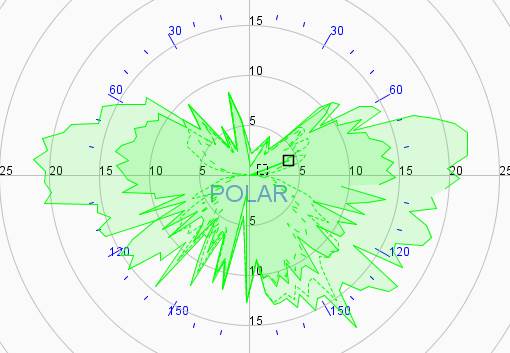
To back up the others, here is some data from about an hour's worth of kiting. To read the polar graph:
- up (0 degrees) is directly into the wind.
- The light outer layer is max speed in the given direction relative to the wind (the rings indicate speed in knots)
- The darker inner layer is average speed.

Going across wind while holding an edge gets the most speed, but an aggressive upwind tack (at 60 degrees) doesn't go as fast but is almost the same aggressive edge. Edging allows you to change your direction, but it's more the direction of travel that determines the maximum speed. From no edge and going with the wind (180 degrees) to edging across the wind you will generally gain speed. Once you start going upwind you will generally lose speed until you get to about 60 degrees where the speed falls off dramatically.


timmybuddhadude
timmybuddhadude
WA
862 posts
WA, 862 posts
3 Mar 2017 9:08pm
Vrbones

Where did that image come from???

Thanx
VRBones
VRBones
130 posts
130 posts
3 Mar 2017 10:26pm
It's a polar graph from a program call GPS Action Replay (www.gpsactionreplay.com), which is used a lot to diagnose speed runs. It takes GPS data files (.gpx) exported from whatever device you have and runs analysis on it (5sec, 10sec averages, tack efficiency, upwind velocity, etc). I think I ran into it in the kiting speed forums when digging around for GPS watches.
QLD, 481 posts
15 Jun 2017 10:51pm
Lots of pointers here, so heres my 10cents worth everyones different, I've seen guys get going first time and other guys take much longer irrelevant of life skills . My advice is simple fly your kite more get better at one thing at a time, when your kite skills improve your brain will have more time to think about the board .
Hope this helps
Please Register, or first...
Topics Subscribe Reply