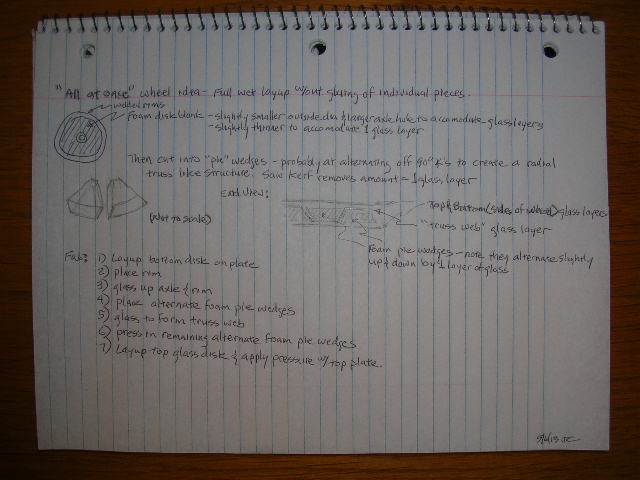
Single cure wheel idea (?)

> 10 years ago
Reply
Register to post, see what you've read, and subscribe to topics.
JunkSmith
JunkSmith
23 posts
23 posts
7 May 2013 6:05pm
aus230's post spawned a thread about hot wire foam cutting and that got me thinking...

Landyacht, aus230 or other master wheel builder/experimenter, what do you think of this idea:


Wheel building sure would be much quicker if the whole process could be reduced to just one curing cycle - but you gotta be quick with the layup And although this idea came about from the discussion of hot wire foam cutting, this might just as well be done by cutting the foam on a bandsaw.

Also, I seem to recall a recommendation that the pink foam was more compatible with all resins, whereas white styro may need a barrier layer (paint or packing tape) when used with some resins (maybe it's when thinned with acetone).


I'm still gathering parts for Landyacht's great mini design, but can see I might also attempt a cl5 with a set of those nice hookworm wheels at some later date
landyacht
landyacht
WA
5921 posts
WA, 5921 posts
7 May 2013 8:13pm
In regard to the foam,polystyrene foam will be dissolved by polyester resin,and polyeurathane foam wont. BUT polyeurathane foam dust is rather carcenogenic, and really itchy. putting a barrier layer on polystyrene foam can go wrong if the resin gets through in even 1 pinhole.
I beleive the different colours like pink and blue foam may relate to the density rather than the chemical composition(type) of foam.
nobody in our area has any stocks of polyeurathane foam , so I salvage old surfboards and cut them up for really good dense foam.
the biggest problem i would have with a single lay up process would be trying to keep up with the curing. i had some epoxy go off on me yesterday whilst working on a 16" wheel, so a 26 would be interesting
stumcgoo
stumcgoo
WA
15 posts
WA, 15 posts
7 May 2013 10:18pm
I agree single cure would be great and I had same idea as you a few months back but when you work out the volume of polyurethane foam required (density 50-80 kg/m3) it gets heavy quick. Well over 1kg of foam for the wheel I was looking at.

Polystyrene is lighter (approx 15-30 kg/m3) but you need to use epoxy or it will melt. Epoxy is 5x more expensive than polyester so that ruled it out for me
stumcgoo
stumcgoo
WA
15 posts
WA, 15 posts
7 May 2013 10:45pm
My current thinking for a semi single cure and to reduce "wet work" is to make 5 PVC foam (cheap and easy to work with) spokes similar shape to those landyacht and aus230 did (full width of rim and along the rad whoius lines by say 10mm thick) then glass all around each spoke, place in rim on flat surface, forming hub in centre then clamp this from otherside and let it cure. At the same time lay up disc sides and cure between 2 flat surfaces. Once it all goes off glue( using polyurethane adhesive) the disc sides.

Comments?
JunkSmith
JunkSmith
23 posts
23 posts
8 May 2013 4:39am
LY - yeah, catalyst cured products can be tricky some times - they accelerate like mad when the day is hot and/or get contaminated by leftover catalyzing stuff on the stirrer or cup. I thought the pink/blue (corning/dow chem) stuff was different materials here in the states but I'll have to check. And you're right about the pinhole vulnerability. Maybe I'm recalling most who have used a barrier were working on a lost foam project and not as heavily immersed in resin as I had suggested.

stumcgoo - thanks for the weight info. I keep imagining polystyrene (the dissolving stuff) and not polyurethane or polyisocyanurate. But I also like the idea of squeezing out excess resin and possibly incorporating thinner glass layers. If the foam layer is well bonded it is hoped to be part of the structural strength much like a SIP building panel (that's an OSB,foam,OSB building product more common in colder climates. The OSB is akin to the flanges of an I-beam and the foam serves as the web - sorry don't know if that is common down under).

Here's some stuff on a lost foam project - but please don't spend too much time there, we want you back building land yachts!
www.fieldlines.com/index.php/topic,144470.351.html

and some pics of sips as roof panels - they do duty as the structural rafters also.
www.fischersips.com/our-projects/under-construction

carry on!
john
gibberjoe
gibberjoe
SA
956 posts
SA, 956 posts
8 May 2013 6:56am

what about that foamy stuff drillers use when they strike bad ground?

from what i know [that's little] its real light, strong and can be worked

possibly could fall off the back of a truck at Kal. maybe could be used as a filler

and then a finishing smick coat.
landyacht
landyacht
WA
5921 posts
WA, 5921 posts
10 May 2013 8:03pm
stumcgoo said..

My current thinking for a semi single cure and to reduce "wet work" is to make 5 PVC foam (cheap and easy to work with) spokes similar shape to those landyacht and aus230 did (full width of rim and along the rad whoius lines by say 10mm thick) then glass all around each spoke, place in rim on flat surface, forming hub in centre then clamp this from otherside and let it cure. At the same time lay up disc sides and cure between 2 flat surfaces. Once it all goes off glue( using polyurethane adhesive) the disc sides.

Comments?


Never heard of PVC foam.
re the polyurathane glue. I have tested 3 brands as a woodglue and have concluded that it is useless in any situation where there might be any kind of stress,strain or shock. Its rather useless as a woodglue
I only use it as a glue for foams. to hold things together until it can be glassed over.
if you are carving a spoke then glassing over it. why not just make a U shaped mold , glass into that , then you dont need the foam, and you get a consistent width spoke.
joe , the drillers foam is polyurathane
polyurathane glues have a property where if you dampen the surfaces to be glued the glue will foam up and fill gaps, so its great for rough glueing.
but hardens to a brittle finish very quickly.
i would suggest that if you plan to use it on any project, make some test joints, then destruction test them ,drop them in water,.
I trialed 1 boat building glue that dissolved when it got wet!!!!! .
when you break the joint it should crack in the wood or whatever you are glueing, and NOT along the joint

Please Register, or first...
Topics Subscribe Reply