Going Upwind.... Faster!

Saturday
Reply
Register to post, see what you've read, and subscribe to topics.
dachopper
dachopper
WA
1819 posts
WA, 1819 posts
31 Oct 2026 7:23pm
If there's one thing I've noticed consistently over the years, it's how hard everyone finds it to work out the best speed to go upwind, especially on new gear or in a new class. Whether you're new to the sport or a seasoned sailor, getting upwind well is one of the hardest and most time-consuming things to nail. Which sail, which foil, how much power, how high to point, how fast to go? It's easy to spend whole sessions going up and down without knowing whether you actually made ground. On a relaxed sail, an efficient upwind leg means less effort, more fun, and getting there sooner. On the race course, it's the difference between rounding the top mark first and chasing the fleet all the way back to the bar.

One of the funniest races I've ever witnessed was a kitesurfing race with a whole field of novice riders. I'd just come in from my heat in second place when a friend borrowed my kite, and I gave him one piece of advice: "Whatever you do, don't go at top speed when you're heading upwind." Some job that advice did! The start was meant to be a close reach, sailing slightly upwind. Instead, the whole fleet launched and accelerated to top speed, with massive rooster tails, spray and board wakes everywhere. It seemed to start with one rider pulling away out front, and soon the entire fleet was racing at full tilt, legs burning and all. They flew past the reach turning mark, hundreds of metres too low, leaving those of us on shore wondering whether they'd been hit by a 30° wind shift. The real cause showed up when they tacked back to start their "upwind journey". Most of the fleet, rooster tails and all, barely made it back above the start line, all because their VMG at top speed was practically zero 😂😂. That ended up being a looooong race!

VMG stands for Velocity Made Good: your speed directly upwind or downwind, as opposed to the speed you're actually travelling. Sailing apps on watches, phones and tablets can now take the guesswork out of it. Many show live VMG, and some give you polar or radar charts or speed-versus-wind-angle graphs. You can check these while racing, or back on shore to see exactly what worked and what didn't.
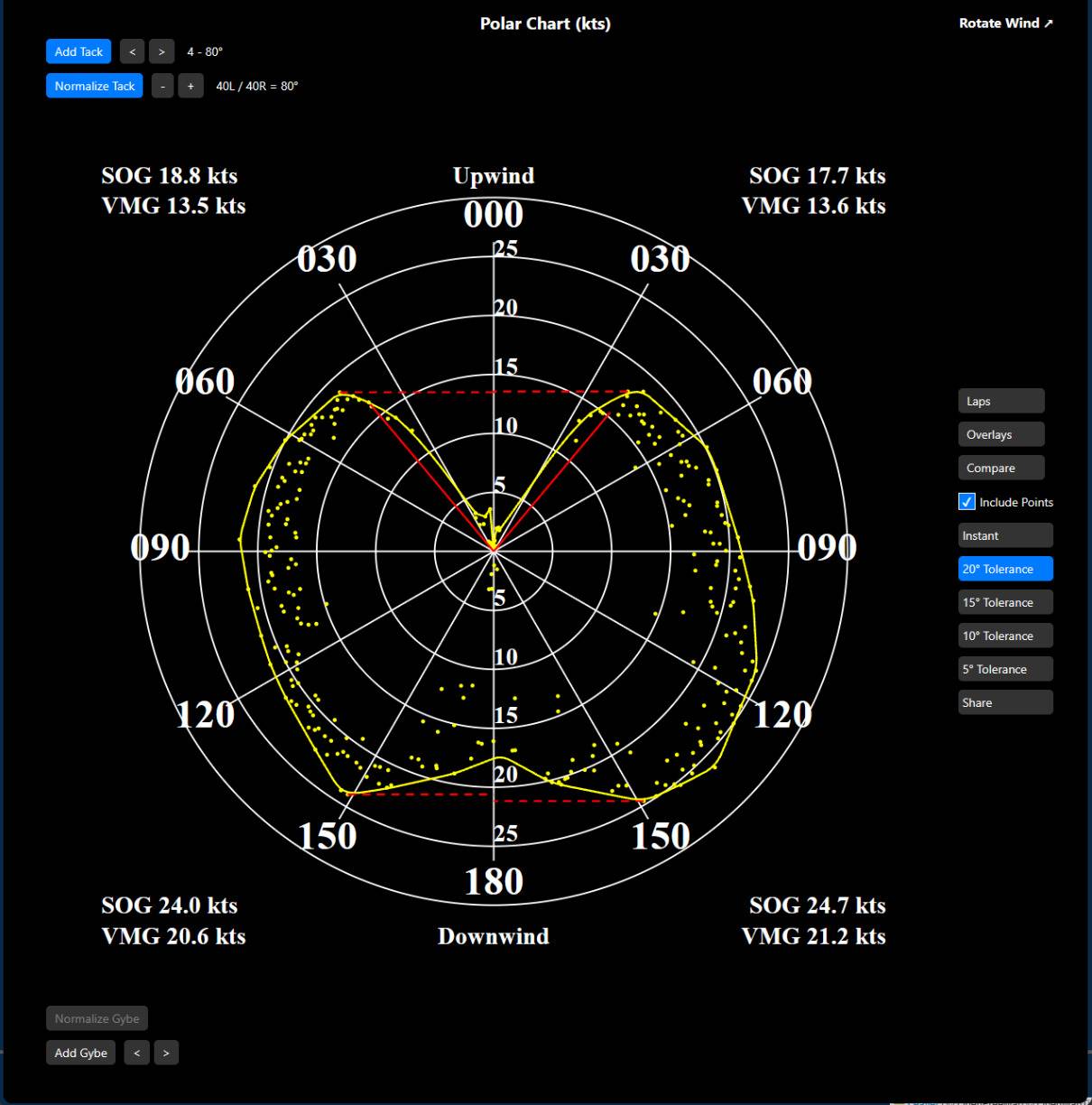


Here's a polar from one of my recorded hydrofoil sessions. The wind comes from the top of the chart. Each dot is a moment in the session, plotted by its angle to the wind and its speed, and the yellow line traces the best speeds at each angle. VMG is the part of that speed going straight into the wind. Pinch too high and your speed collapses; sail too low and you go fast but don't gain much ground. The sweet spot here was about 40° off the wind at around 18 knots of speed over ground (SOG), giving about 13.5 knots of VMG on both tacks. So my upwind target on this gear in these conditions is simple: hold about 18 knots. If I'm slower than that, I bear away to build speed. If I'm well above it, I can point a bit higher.

The red lines show an 80° tack angle, 40° each side of the wind, and that's a little tight for this gear. Port tack holds its speed well, but on starboard I couldn't quite reach 18 knots that high. Sailing about 85° tack to tack would have kept my speed up and my VMG closer to its best, and less speed would have been lost in each tack.

You can also use the VMG number on the water. If your watch app lets you set the wind direction, point the wind axis accurately into the wind and it will read out a live VMG. There are a couple of ways to do this, but as a guide using the numbers from above: target speed 18 kts, VMG should be 13 - 14kts. When my VMG drops by more than 15% and it's a real header, if it looks like it will hold for more than 35 to 40 seconds and I'm not near the layline, it's worth a tack.
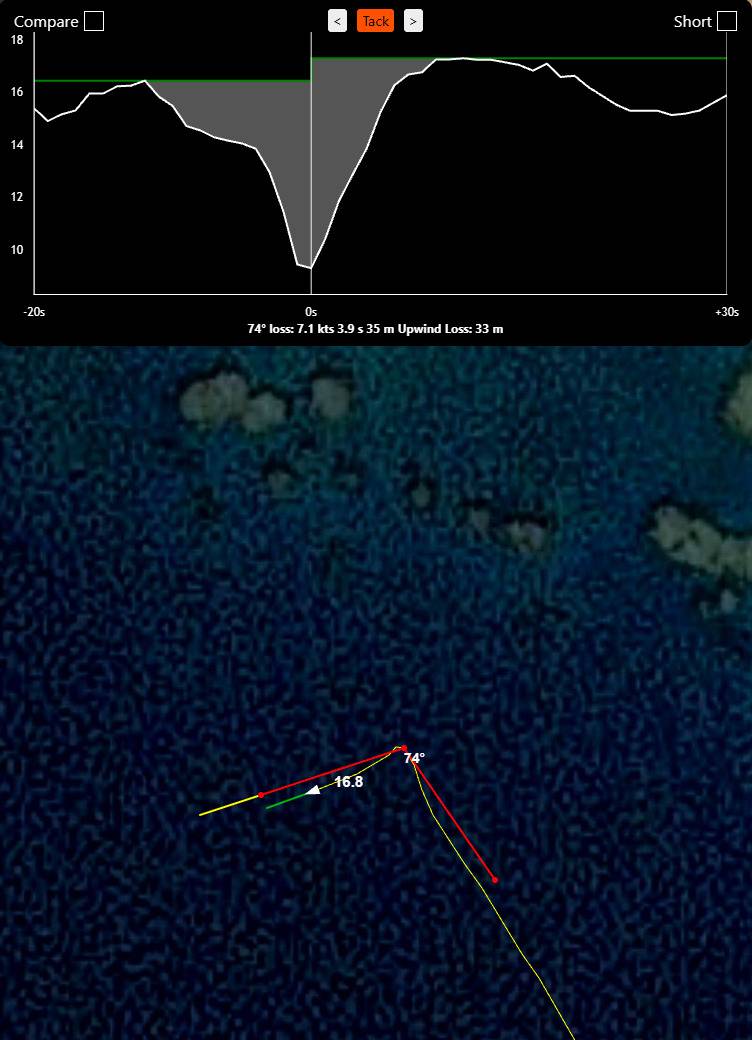


Every tack costs time and distance. The easiest way to measure it is in seconds: how many seconds of progress you give away. On my foil, a good 88° tack dropped me from 18 to about 10 knots and cost about 23 m upwind, which is around 3.3 seconds. A sloppier 74° tack in the same session cost 33 m, or about 4 seconds. Displacement boats lose fewer metres because they're slower, but about the same in seconds or more. A keelboat typically loses about one boatlength per tack in flat water and up to three in chop.
In one measured example, a 6 knot keelboat took 15 seconds to complete its tack but lost only about 5 seconds of upwind progress because it keeps moving towards the wind as it turns.

When should you tack on a header?
A header forces you further from the wind, so your VMG drops. Tacking onto the lift gets it back, but it only pays off if the shift lasts long enough to cover the cost of potentially 2 extra tacks.

Rough guide (when not close to the layline )
Multiply your tack loss in seconds by 11 for a 10 degree shift.
If you think the header will last at least that long in seconds, it's worth tacking into and out of again.

On my foil, a 10° header that costs me two extra tacks needs to last about 35 to 40 seconds before it pays off. Boats ahead and upwind can be a good indicator of what is to come. A keelboat in flat water needs about a minute, and one in chop needs 2 to 3 minutes. A dinghy with a slick roll tack in light air can profit from shifts of only 10 to 20 seconds. Smooth tacks and flat water let you use more shifts, while chop and stalled tacks mean only the big, long ones are worth chasing.

The best part is that you don't need to guess your numbers. A GPS debrief will show your target upwind speed, your VMG on each tack, and exactly how much each tack cost you.

*Full disclosure: I'm the developer of SailRacerPro, which does polar, VMG and tack-loss debriefs from any GPX or FIT file, plus Garmin watch apps for sailing, kite, windsurf and wing. Happy to run anyone's track through it if you'd like to see your own upwind numbers, or try it out for free yourself at www.sailracerpro.com

JonE
JonE
VIC
675 posts
VIC, 675 posts
1 Nov 2026 10:11pm
First up, you cant sail to vmg when heading upwind. If you steer the boat (up) to get a higher number, the number goes really high, then the boat stops.

Second you're only getting COG not heading from the GPS.

If meaningful data could be deduced by gps alone and occasionally going head to wind, we would have had it for 20 years.

On a lake with a sub 5 meter mast this might be useful. Everywhere else we have leeway, wind shear, tide, wave direction. So many reasons why you might go faster, or think you're going faster on one tack vs another.

Wanting to judge tacking performance is worthwhile but without having fantastic true wind angle information you cant make those claims about the cost of a tack based on shifts.

true wind is not possible without good STW, realtime wind, heading and calibration tables.

So 15 minutes a week spent on tacking practice with a stopwatch is going to be time better spent?
dachopper
dachopper
WA
1819 posts
WA, 1819 posts
3 Nov 2026 6:38pm
JonE said..
First up, you cant sail to vmg when heading upwind. If you steer the boat (up) to get a higher number, the number goes really high, then the boat stops.

Second you're only getting COG not heading from the GPS.

If meaningful data could be deduced by gps alone and occasionally going head to wind, we would have had it for 20 years.

On a lake with a sub 5 meter mast this might be useful. Everywhere else we have leeway, wind shear, tide, wave direction. So many reasons why you might go faster, or think you're going faster on one tack vs another.

Wanting to judge tacking performance is worthwhile but without having fantastic true wind angle information you cant make those claims about the cost of a tack based on shifts.

true wind is not possible without good STW, realtime wind, heading and calibration tables.

So 15 minutes a week spent on tacking practice with a stopwatch is going to be time better spent?


Thanks JonE, good points and I agree with a few of them.

You're right that you can't steer to VMG upwind. Chase the number and you pinch, and the boat stops. That's why I steer to a target speed (18 kts in that example) and only use the live VMG as a header alarm. If speed holds but VMG drops 15% or more, the breeze has probably shifted.

Also agreed that GPS gives COG, not heading, and I'm not claiming true wind angle, leeway or proper instrument-grade true wind.

Where I'd push back a little is that for racing, the ground is what counts. Leeway, tide and current are all baked into COG and SOG, and they're exactly what decides who gets to the top mark first. Comparing within one session (same boat, same tide state, similar breeze) still shows which tack angle and which speed got you upwind fastest over the ground. The wind axis comes from averaging your own tacks, so it's an estimate, and a tide change or big shift shows up as noise you can see in the track. But what if the shifts tend to be in the same spot, as you approach the shore or between island for example, you see it and take advantage of it.

Same with tack loss. Metres of ground made good lost per tack is a fair relative measure. It won't tell you why one tack was worse, but it tells you which ones were.

15 minutes a week of tacking practice with a stopwatch is great. Or just record it on the app which adds a GPS track, so you can see which of those tacks actually cost less ground rather than which one felt better

Happy to run one of your sessions through tracks through it if you'd like to see where it holds up and where it falls down.
The closing offer is the important part. If he takes you up on it, it turns a sceptic into a public test case.
lydia
lydia
1950 posts
1950 posts
5 Nov 2026 4:40am
Wrong way around d, easy upwind where as modern boats downhill where very smaller difference in apparent wind amplify boat speed far more.
Trek
Trek
NSW
1242 posts
NSW, 1242 posts
6 Nov 2026 6:48pm
I dont get why you cant sail to best VMG upwind. I always have in racing. If you get too close to the wind or pinching VMG drops and you need to turn slightly down. I spent time before racing measuring lat and long of each mark so VMG to the mark would be accurate. For example, 15 knots at 45° produces the best VMG to the mark, even though the boat can sail faster at 50° so sail at 45. I won trophies doing exactly that. Choosing when to tack can be tricky. What am I missing?
JonE
JonE
VIC
675 posts
VIC, 675 posts
6 Nov 2026 8:37pm
Trek said..
I dont get why you cant sail to best VMG upwind. I always have in racing. If you get too close to the wind or pinching VMG drops and you need to turn slightly down. I spent time before racing measuring lat and long of each mark so VMG to the mark would be accurate. For example, 15 knots at 45° produces the best VMG to the mark, even though the boat can sail faster at 50° so sail at 45. I won trophies doing exactly that. Choosing when to tack can be tricky. What am I missing?


You're doing 7 knots upwind. Lets say vmg is 5 knots. It's perfect, you're at the optimal
angle.

Start to luff up (shoot). What happens to your VMG?
JonE
JonE
VIC
675 posts
VIC, 675 posts
6 Nov 2026 8:45pm
And it's not VMG to the mark that's CMG.

VMG doesnt tell you when to tack and CMG doesnt until you hit the layline,

VMG just quantifies the best compromise between pointing and boat speed but the GPS can't tell you VMG because it doesnt know where the wind is.

This is why you have to create polars by which you need to rigorously measure VMG at different angles whilst doing maximum boat speed and plot it. Someone cite me one reliable reference to how to create polars without accurately calibrated true wind, STW and heading. I have read everything I can get my hands on and it appears there is no shortcut. Hence my disagreement with this "advertorial" post.


Trek
Trek
NSW
1242 posts
NSW, 1242 posts
7 Nov 2026 6:02am
Quote from Sailing World:

America's Cup yachts race primarily to achieve the best VMG (Velocity Made Good), rather than maximum boat speed.
This applies both upwind and downwind.
1. Upwind sailing
The AC75 foiling yachts balance pointing angle against speed to maximise progress.
2. Downwind sailing
The same principle applies downwind.
AC75 yachts sail at angles to the true wind rather than directly downwind because their foiling speed generates strong apparent wind. They gybe between angles that maximise downwind VMG.

From David Dellenbaugh, tactician aboard the winning America³ team in the 1992 America's Cup.
“One combination of pointing and speed will maximize your VMG (your velocity-made-good) to windward.”

From Peter Isler — America's Cup winner - explaing his success “I experimented with sailing deeper angles downwind and finding the best downwind VMG.”

From Tom Slingsby's actual race communication, “Happy sailing VMG,”
cammd
cammd
QLD
4631 posts
QLD, 4631 posts
7 Nov 2026 8:05am
JonE said..
And it's not VMG to the mark that's CMG.

VMG doesnt tell you when to tack and CMG doesnt until you hit the layline,

VMG just quantifies the best compromise between pointing and boat speed but the GPS can't tell you VMG because it doesnt know where the wind is.

This is why you have to create polars by which you need to rigorously measure VMG at different angles whilst doing maximum boat speed and plot it. Someone cite me one reliable reference to how to create polars without accurately calibrated true wind, STW and heading. I have read everything I can get my hands on and it appears there is no shortcut. Hence my disagreement with this "advertorial" post.


Predict wind data hub claims it will create AI polars for your boat over time based on actual performance of your boat.
Chris 249
Chris 249
NSW
3626 posts
NSW, 3626 posts
7 Nov 2026 10:58am
I like the ready reckoner for calculating tacking time lost and the shift required to make up for it. We do that based on feel but it could be interesting to formalise it a bit.

I do share the reservations about the fact that you can’t take into account chop, wind shear, etc.


Trek said..
I dont get why you cant sail to best VMG upwind. I always have in racing. If you get too close to the wind or pinching VMG drops and you need to turn slightly down. I spent time before racing measuring lat and long of each mark so VMG to the mark would be accurate. For example, 15 knots at 45° produces the best VMG to the mark, even though the boat can sail faster at 50° so sail at 45. I won trophies doing exactly that. Choosing when to tack can be tricky. What am I missing?


VMG is determined by the wind direction and not the placement of any mark.

Even ignoring every other factor, choosing when to tack depends enormously on the wind strength, because that changes optimum pointing angle dramatically - polars for lots of boats show that they change their optimum pointing angle by up to 8 degrees (even more in some cases) depending on wind strength. Add in chop etc and any pre-determined tacking point becomes extremely problematic.

If the wind is skewed say 5 degrees to the right of the course axis, your "VMG to the mark" will be better on starboard tack than on port tack. However, if you therefore sail on starboard tack initially you may be sailing in two knots of extra adverse current, five knots less wind, etc and therefore end up miles behind the boats that take a hitch on port and sail into better wind, less tide and a better angle.

The ideal time to tack changes down to the second and depends on exactly where the opposition is placed, how the mean wind direction is shifting, what the strength is doing in different areas of the course, what the chop is doing, which part of each individual puff you're in, whether you're knocking or lifting and how much, how long that's going to last and how far back it will shift, what powerboat wakes are coming, etc etc etc. Almost none of that can be calculated beforehand.

Local club handicap events are normally run on PHS, so they don't actually measure who is sailing better. I'm not saying that you weren't sailing well, just that winning trophies in such events is in itself not meaningful.


shaggybaxter
shaggybaxter
QLD
2704 posts
QLD, 2704 posts
7 Nov 2026 10:21am
S%$# in, S%$# out.
I loved poring over my GPS plots post race and always had VMG/VMC targets in racing. It was always worthwhile playing back and reviewing your overall race position and strategy and performance against polars.
But I also logged TWA,TWS, Heading, SoW, Heel, Pitch, Heave, Leeway, Barometric pressure and Density Altitude. And used all of that data religiously doing any review. None of those datasets you get with a GPS driven plot alone.

It's fun to use GPS to roughly estimate polars. But no way would I use GPS driven polars in an actual race, it's missing all of the other data that makes sailing to numbers worthwhile. Any decent boat has multiple polars for different sea states/environmentals, the different polars come from all of the data you don't get with just a gps device and a bit of software.
I get it when hydrofoilling at 20knots plus. You're not offshore, flatter water and less tidal influence. But as your speed drops, the higher the propensity in erroneous data.
For keel boats doing a passage race? I'd posit a post race function where you can review a GPS trace on a chart might be more beneficial.

Not trying to diss on you DaChopper. If peeps are doing keelboat racing without electronics, or play in OTB pickleforks or suchlike, then knock yourself out.
But polars derived from a GPS plot would be useless for me in keelboat racing (sans WAGs), especially using that data to affect decisions in the actual race itself. Way too many missing bits of info.
My two cents!


Trek
Trek
NSW
1242 posts
NSW, 1242 posts
7 Nov 2026 11:34am
Chris 249 said..
I like the ready reckoner for calculating tacking time lost and the shift required to make up for it. We do that based on feel but it could be interesting to formalise it a bit.

I do share the reservations about the fact that you can’t take into account chop, wind shear, etc.


Trek said..
I dont get why you cant sail to best VMG upwind. I always have in racing. If you get too close to the wind or pinching VMG drops and you need to turn slightly down. I spent time before racing measuring lat and long of each mark so VMG to the mark would be accurate. For example, 15 knots at 45° produces the best VMG to the mark, even though the boat can sail faster at 50° so sail at 45. I won trophies doing exactly that. Choosing when to tack can be tricky. What am I missing?


But 15 knots at 45 degrees doesn't produce the best VMG to the mark unless the mark is exactly upwind and the wind strength and tide are uniform across the course. The ideal time to tack changes down to the second and depends on exactly where the opposition is placed, how the mean wind direction is shifting, what the strength is doing, what the chop is doing, which part of each individual puff you're in, whether you're knocking or lifting and how much, how long that's going to last and how far back it will shift, what powerboat wakes are coming, etc etc etc. Almost none of that can be calculated beforehand.

If the wind is skewed say 5 degrees to the right of the course axis, your "VMG to the mark" will be better on starboard tack than on port tack. However, if you therefore sail on starboard tack initially you may be sailing in two knots of extra adverse current, five knots less wind, etc and therefore end up miles behind the boats that take a hitch on port and sail into better wind, less tide and a better angle.

Local club handicap events are normally run on PHS, so they don't actually measure who is sailing better.


Quite right, one tack to the mark is usually better. VMG tells you that immediately. If you tack and find VMG to the mark is slower bad decision. Theres a thing called TakTik or similar that theoretically tells you when to tack. Has anyone used one?
Chris 249
Chris 249
NSW
3626 posts
NSW, 3626 posts
7 Nov 2026 11:37am
Trek said..
Quote from Sailing World:

America's Cup yachts race primarily to achieve the best VMG (Velocity Made Good), rather than maximum boat speed.
This applies both upwind and downwind.
1. Upwind sailing
The AC75 foiling yachts balance pointing angle against speed to maximise progress.
2. Downwind sailing
The same principle applies downwind.
AC75 yachts sail at angles to the true wind rather than directly downwind because their foiling speed generates strong apparent wind. They gybe between angles that maximise downwind VMG.

From David Dellenbaugh, tactician aboard the winning America³ team in the 1992 America's Cup.
“One combination of pointing and speed will maximize your VMG (your velocity-made-good) to windward.”

From Peter Isler — America's Cup winner - explaing his success “I experimented with sailing deeper angles downwind and finding the best downwind VMG.”

From Tom Slingsby's actual race communication, “Happy sailing VMG,”


But that's VMG to the wind direction, not the course to the mark.
Chris 249
Chris 249
NSW
3626 posts
NSW, 3626 posts
7 Nov 2026 11:54am
Trek said..


Quite right, one tack to the mark is usually better. VMG tells you that immediately. If you tack and find VMG to the mark is slower bad decision. Theres a thing called TakTik or similar that theoretically tells you when to tack. Has anyone used one?


But with respect, just working the tack that gives you better VMG to the mark will rarely give the optimum choice. Take the example of a mark set directly to the north, and a wind at 10 degrees true. If you tack from starboard to port your velocity to the mark will drop - but that has very little to do with whether the tack is a good decision or not. If taking that port tack reduces your velocity to the mark for five minutes (or ten seconds) but takes you out to a different wind that's three knots stronger, in half a knot less tide and is blowing from 30 degrees true then the port tack may well turn to be the better decision. And of course if the wind over the longer term shifts to 330 degrees, that port tack may turn into a loss. There's no way of knowing well in advance which is the best option for a day race, especially when the boat's optimum tacking angle will often change by about 16 degrees depending on the wind strength.

I've raced with navigators who have won the America's Cup, had multiple Fastnet wins etc and they haven't used pre-determined tacking points before the start of a day race. They may calculate lay lines but only as a warning in case they get close to them.
Trek
Trek
NSW
1242 posts
NSW, 1242 posts
7 Nov 2026 1:09pm
Quite right. But for the technical discussion of VMG Im considering wind and speed to the mark only. Of course there are wind shifts, currents, dirty air, swell, chop and competitors boats in the way.
Chris 249
Chris 249
NSW
3626 posts
NSW, 3626 posts
7 Nov 2026 1:38pm
The confusion seems to arise because the term VMG customarily is about true wind, not about the mark.

That's the way it's used on polars; sas.orc.org/sasapi/cc/261059

en.wikipedia.org/wiki/Velocity_made_good
JonE
JonE
VIC
675 posts
VIC, 675 posts
7 Nov 2026 4:44pm
Shaggy,

I haven't got my **** together with true wind yet, despite having h3000 and good quality, if dated, gear that will do it.

for mine, and everyone else's edification- roughly how many minutes would you guess you spent tuning in order to get a decent true wind number? From what I've read, it looks like a solid few hours recording and tweaking plus a good 10-15 minutes before every race to tune it for conditions.
Quixotic
Quixotic
ACT
266 posts
ACT, 266 posts
7 Nov 2026 5:17pm
I’m not a racer’s left elbow, and I also don’t know the inner workings of the calcs that underlie the numbers on my display that aren’t direct outputs (eg depth). But to calculate TW on a moving boat with an angled and moving mast in a swell, there has to be a fair bit of vector math going on and there has to be inputs that give basis for corrections for boat speed, heel, pitching and current etc. and it must be averaged over at least a short period to remove noise.


For mine, you sail to apparent, not true, as that’s what the sails’ experience.

But maybe I’m talking through my hat -as per the disclaimer at the start, I don’t race.
Please Register, or first...
Topics Subscribe Reply