If there's one thing I've noticed consistently over the years, it's how hard everyone finds it to work out the best speed to go upwind, especially on new gear or in a new class. Whether you're new to the sport or a seasoned sailor, getting upwind well is one of the hardest and most time-consuming things to nail. Which sail, which foil, how much power, how high to point, how fast to go? It's easy to spend whole sessions going up and down without knowing whether you actually made ground. On a relaxed sail, an efficient upwind leg means less effort, more fun, and getting there sooner. On the race course, it's the difference between rounding the top mark first and chasing the fleet all the way back to the bar.
One of the funniest races I've ever witnessed was a kitesurfing race with a whole field of novice riders. I'd just come in from my heat in second place when a friend borrowed my kite, and I gave him one piece of advice: "Whatever you do, don't go at top speed when you're heading upwind." Some job that advice did! The start was meant to be a close reach, sailing slightly upwind. Instead, the whole fleet launched and accelerated to top speed, with massive rooster tails, spray and board wakes everywhere. It seemed to start with one rider pulling away out front, and soon the entire fleet was racing at full tilt, legs burning and all. They flew past the reach turning mark, hundreds of metres too low, leaving those of us on shore wondering whether they'd been hit by a 30° wind shift. The real cause showed up when they tacked back to start their "upwind journey". Most of the fleet, rooster tails and all, barely made it back above the start line, all because their VMG at top speed was practically zero 😂😂. That ended up being a looooong race!
VMG stands for Velocity Made Good: your speed directly upwind or downwind, as opposed to the speed you're actually travelling. Sailing apps on watches, phones and tablets can now take the guesswork out of it. Many show live VMG, and some give you polar or radar charts or speed-versus-wind-angle graphs. You can check these while racing, or back on shore to see exactly what worked and what didn't.
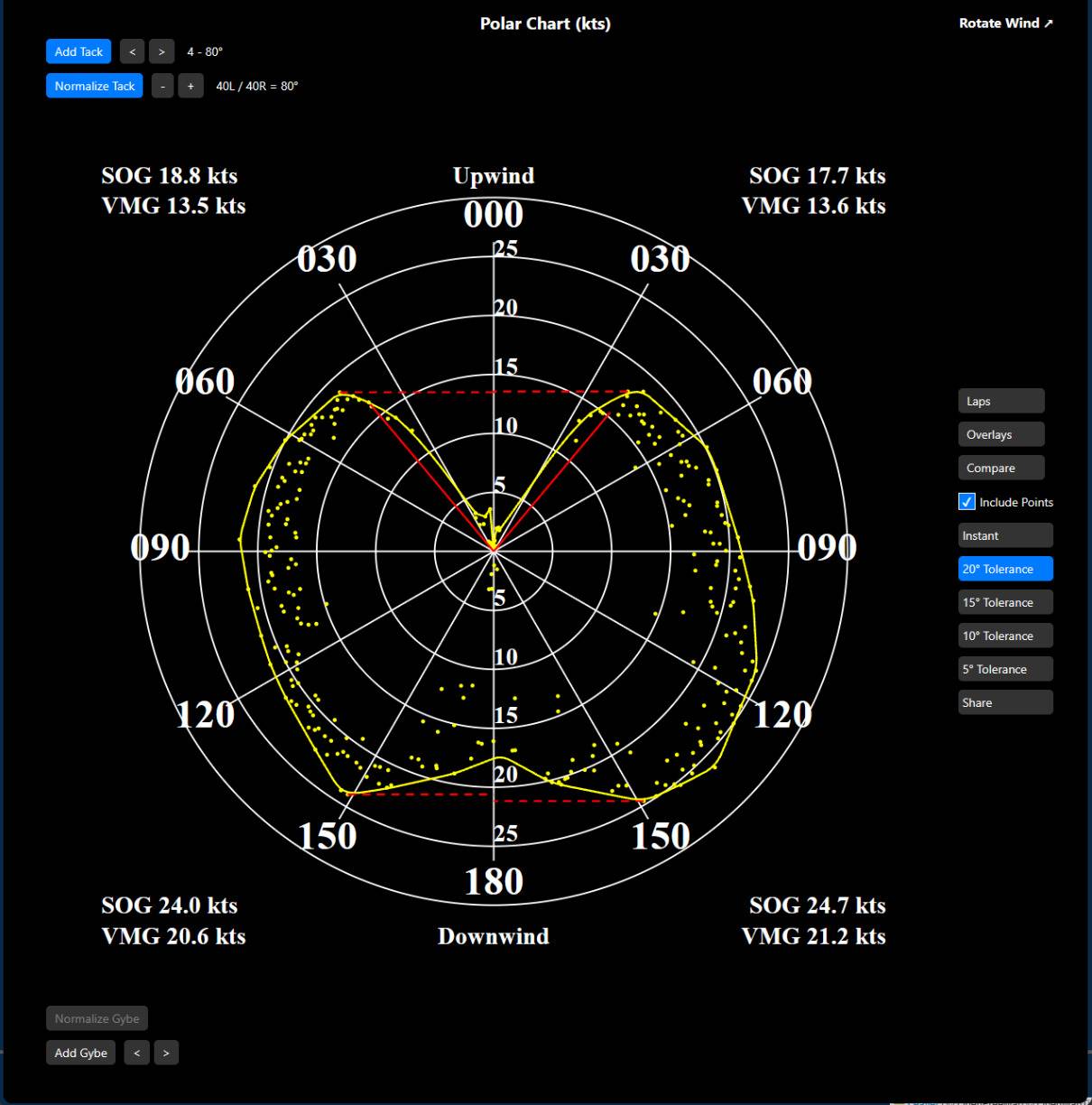
Here's a polar from one of my recorded hydrofoil sessions. The wind comes from the top of the chart. Each dot is a moment in the session, plotted by its angle to the wind and its speed, and the yellow line traces the best speeds at each angle. VMG is the part of that speed going straight into the wind. Pinch too high and your speed collapses; sail too low and you go fast but don't gain much ground. The sweet spot here was about 40° off the wind at around 18 knots of speed over ground (SOG), giving about 13.5 knots of VMG on both tacks. So my upwind target on this gear in these conditions is simple: hold about 18 knots. If I'm slower than that, I bear away to build speed. If I'm well above it, I can point a bit higher.
The red lines show an 80° tack angle, 40° each side of the wind, and that's a little tight for this gear. Port tack holds its speed well, but on starboard I couldn't quite reach 18 knots that high. Sailing about 85° tack to tack would have kept my speed up and my VMG closer to its best, and less speed would have been lost in each tack.
You can also use the VMG number on the water. If your watch app lets you set the wind direction, point the wind axis accurately into the wind and it will read out a live VMG. There are a couple of ways to do this, but as a guide using the numbers from above: target speed 18 kts, VMG should be 13 - 14kts. When my VMG drops by more than 15% and it's a real header, if it looks like it will hold for more than 35 to 40 seconds and I'm not near the layline, it's worth a tack.
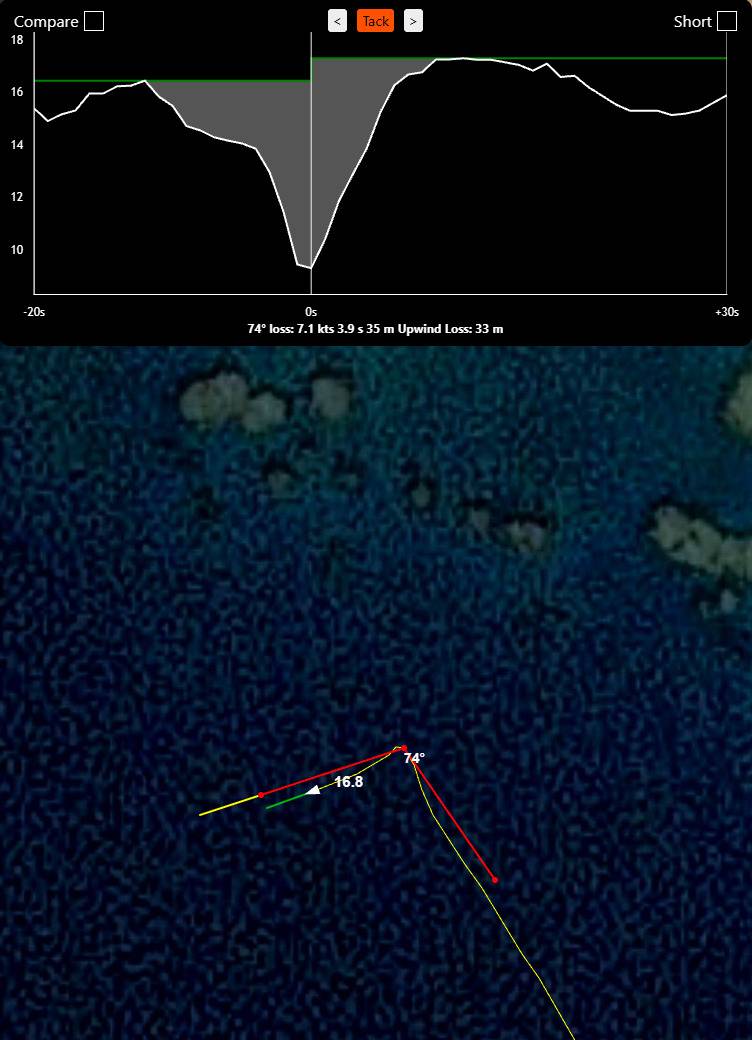
Every tack costs time and distance. The easiest way to measure it is in seconds: how many seconds of progress you give away. On my foil, a good 88° tack dropped me from 18 to about 10 knots and cost about 23 m upwind, which is around 3.3 seconds. A sloppier 74° tack in the same session cost 33 m, or about 4 seconds. Displacement boats lose fewer metres because they're slower, but about the same in seconds or more. A keelboat typically loses about one boatlength per tack in flat water and up to three in chop.
In one measured example, a 6 knot keelboat took 15 seconds to complete its tack but lost only about 5 seconds of upwind progress because it keeps moving towards the wind as it turns.
When should you tack on a header?
A header forces you further from the wind, so your VMG drops. Tacking onto the lift gets it back, but it only pays off if the shift lasts long enough to cover the cost of potentially 2 extra tacks.
Rough guide (when not close to the layline )
Multiply your tack loss in seconds by 11 for a 10 degree shift.
If you think the header will last at least that long in seconds, it's worth tacking into and out of again.
On my foil, a 10° header that costs me two extra tacks needs to last about 35 to 40 seconds before it pays off. Boats ahead and upwind can be a good indicator of what is to come. A keelboat in flat water needs about a minute, and one in chop needs 2 to 3 minutes. A dinghy with a slick roll tack in light air can profit from shifts of only 10 to 20 seconds. Smooth tacks and flat water let you use more shifts, while chop and stalled tacks mean only the big, long ones are worth chasing.
The best part is that you don't need to guess your numbers. A GPS debrief will show your target upwind speed, your VMG on each tack, and exactly how much each tack cost you.
*Full disclosure: I'm the developer of SailRacerPro, which does polar, VMG and tack-loss debriefs from any GPX or FIT file, plus Garmin watch apps for sailing, kite, windsurf and wing. Happy to run anyone's track through it if you'd like to see your own upwind numbers, or try it out for free yourself at www.sailracerpro.com