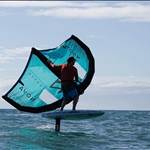
First attempt on the Infinity 84 yesterday. Initial tries were disastrous: "OMG I just broke the bank, and it doesn't work". I couldn't get it up on foil, I'd catch a wave, give it the little pop, and it would dive. I tried adjusting angle of attack, moving mast forward and back ... then realized the culprit ... had the fuselage upside down, so the rear wing was also upside down. What a kook! Reversed it and got a few waves, but by then the tide had dropped and wind increased, so not really a fair test of the wing from that point. Although it did lift quickly in the small waves, as expected, and I think it'll be nice and stable once the balance points are figured out. I am confident more fun times are on the way.
Does raise an interesting question though ... please excuse me while I nerd out for a moment (I expect most will stop reading at this point).

As I understand foil design, front wing gives lift, rear wing gives drag/drop (reverse lift). We are standing on a seesaw, we lift it on takeoff, then find the balance point that allows forward momentum without breaching the wing (too much lift) or pearling the board (too much drag). On my kite foil, the wings are flat on one side, so the front wing has flat side down, rear wing has flat side up, so it's pretty obvious which wing is doing what.
On the slingshot wings, the front wing has very obvious lift profile, but on rear wing, it's not as obvious from looking at it which way is "up". If the rear wing in its proper position is providing drag, then its seems logical that if it's upside down, it would instead be providing lift -- like a canard set up, with two lifting wings. It seems logical that adding further lift instead of drag should lead to uncontrolled lifts and breaches -- but the reaction was the opposite, I could not lift the nose on take-off.
Thinking about it more, I recall a similar experience playing around with canard set up on kite wings, where using a too large rear wing, it would dive uncontrollably, even though both wings had lift (and the foil would lift easily if the wings were reversed in a non-canard set up). Clearly a balance problem, but what explains it? It seems counter-intuitive that adding lift means not able to lift at all. But maybe once you get an extreme lifting force it gets to a point that there can't be enough speed/force to make it rise? I picture a jet attempting to take off with huge flaps set at 90% -- too extreme an angle to make it work. Sound about right?



 that's just the information I needed. I would be happy to get a wing with fairly easy lift in 1 foot waves as well as 5ft waves with good stability. I was starting to decide more towards the 84 wing for the more suttle fuller waves & use the H4 for the more steeper & general surf. Plus use the H4 for balance training. I have yet to find the sweet spot position on the board for the H4. I put it all the way forward for the first time ever in my last surf session & found myself up & running easily & balance was quite surprising that I had enough time on the flat water to muck around with turning & pumping. Lol! But then after about an hour I started to lose the balance etc & maybe got back to old habits or just a bit of fatigue setting in.
 Heres a pic of SS infinity 84 versus GoFoil IWA, M200 and M280