Decoding Reflexed Airfoils

7 hours ago
Reply
Register to post, see what you've read, and subscribe to topics.
jaumet
jaumet
WA
1 posts
WA, 1 posts
12 Aug 2026 6:02pm
Hey guys - I am new around here.
I am a fellow Americas Cup and Hydrofoil designer and I thought I'd say hi with a topic we all have discussed time again.
(Unfortunately I still can't paste images here so you can find the original article in the Takeoff-Technologies Community Hub)

Decoding Reflexed Airfoils
Airfoil reflex is one of the most misunderstood topics in the hydrofoil community. The goal of this article is to clarify what reflex is and how it influences the performance and handling of a hydrofoil.
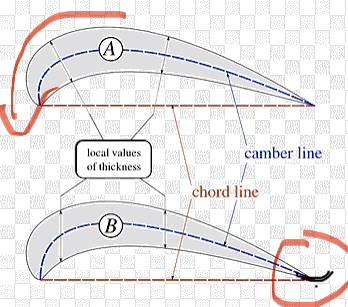
One of the simplest ways to increase a profile’s maximum lift coefficient (Cl) and tailor its performance to specific operating conditions is by adding camber. Tailoring a good camber distribution increases lift generation while reducing drag at the targeted design points. However, this inevitable also increases the section's nose-down pitching moment (its pitching moment coefficient (Cm) becomes more negative).

To fly in equilibrium, this nose-down moment must be balanced by an opposing nose-up moment which is typically generated by the rear stabilizer or, to some extent, by rider weight transfer.

What Is Pitch Stability, and Where Does Cm Fit In?
For a hydrofoil to fly comfortably, two independent conditions must be satisfied:

- Trim: The foil must be able to trim to its required operating lift coefficient, meaning the total pitching moment is zero (Cm=0) at the corresponding angle of attack.
- Static Stability: The system must be statically stable. If a wave or gust disturbs the craft, it must naturally return toward its trimmed attitude.

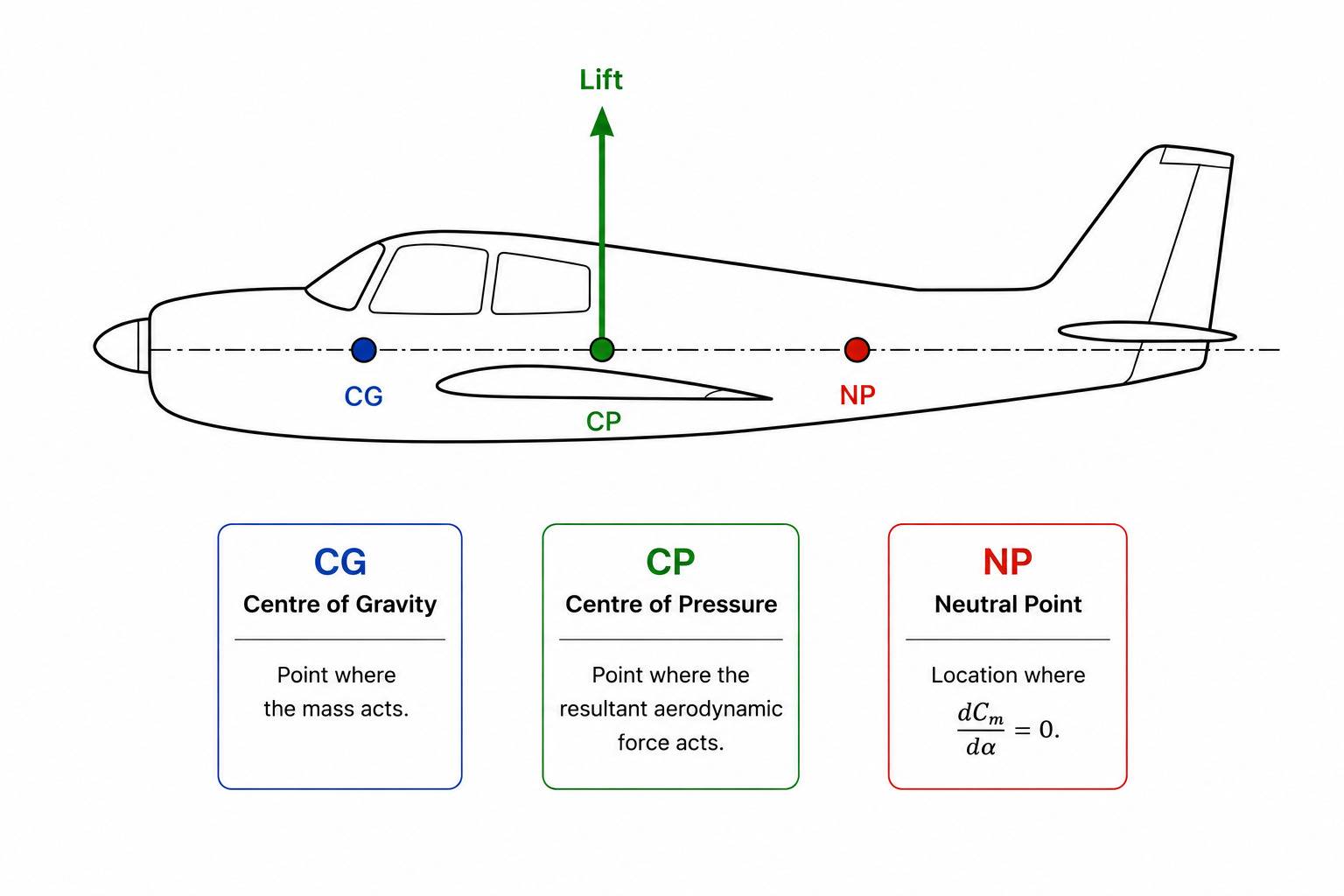
Longitudinal stability is governed by the position of the craft's Neutral Point (NP) relative to its Center of Gravity (CG). For positive static stability, the Neutral Point must lie behind the Center of Gravity. The distance between them, known as the static margin, determines how strongly the craft resists to pitch disturbances.

Mathematically, the static margin sets the slope of the pitching moment curve with respect to the angle of attack: dCm /da
- Positive Static Margin: Produces a negative pitching moment slope (dCm/da < 0). If a gust increases the angle of attack, the craft naturally generates a restoring nose-down moment, returning it to its trimmed condition. A larger static margin creates a stronger restoring tendency and a more "locked-in" feel.
- Small Static Margin: Produces a gentler restoring moment, resulting in more responsive, agile handling.

The Role of Airfoil Geometry and Cm
The Neutral Point is determined primarily by the geometry of the complete system: main wing sweep, stabilizer area, fuselage length, and their respective lift characteristics.
By contrast, the airfoil section's pitching moment coefficient (Cm) has little influence on the neutral point itself. Instead, it determines how much balancing force the stabilizer must generate to achieve trim. This is because the section pitching moment remains nearly constant over the normal operating range, changing Cm shifts the entire pitching moment curve up or down without significantly changing its slope.

How Reflexed Airfoils Can Help
A highly cambered airfoil produces a large nose-down pitching moment, requiring the rear stabilizer to generate a continuous balancing force. That balancing force incurs additional induced drag reducing overall efficiency.
By curving the trailing edge upward, a reflexed airfoil reduces the section's nose-down pitching moment, moving Cm closer to zero.

Because the baseline pitching moment changes while the pitching moment slope (dCm/da) remains essentially unchanged, the hydrofoil retains the same static stability but requires less trim effort:

- Lower Trim Drag: Reduced downforce requirement on the stabilizer lowers total system drag.
- Greater Control Authority: The stabilizer retains more control range because it isn't working as hard just to keep the craft in static equilibrium.

Summary
Reflex does not make a hydrofoil inherently more or less pitch stable. Instead, it improves the efficiency with which a stable hydrofoil can be trimmed.

Lets open the discussion!
utcminusfour
utcminusfour
818 posts
818 posts
12 Aug 2026 7:39pm
Welcome, Jaumet!
I am keen to learn and discuss, but I am not an expert on airfoil theory. I have picked up a little through school, work, and my own interest in foils, but this discussion may be slightly beyond my depth, so a couple of questions first.
Could you clarify how you define camber and reflex, and what distinguishes one from the other? I have heard reflex described as a convex hook (down) in the aft portion of the lower surface. In that description, it is related to the camber line but treated as a separate feature. You seem to be describing reflex as the aft portion of the section turning upward, or effectively moving the trailing edge up. Some clarifications of the nomenclature would help me a ton.
We also need to get you the ability to post pictures. I would really like to see two comparable sections, one with the stronger nose-down pitching moment and one with the subtle reflex that reduces it. I think seeing the difference would make this click for me. Maybe PM me the images and I can post them?
I think I found the Takeoff Technologies home page, but not the article you mentioned. Regardless, it looks like an amazing resource that was not on my radar. Thanks for posting!
Please Register, or first...
Topics Subscribe Reply