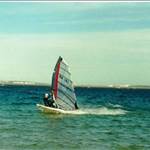
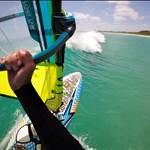
Gusty? Nah this is normal

4 months ago
Reply
Register to post, see what you've read, and subscribe to topics.
RumChaser
RumChaser
TAS
639 posts
TAS, 639 posts
21 Apr 2026 10:48am
Just wanted to start a thread about techniques and strategies for sailing when it is gusty conditions. I sail in a bay with choppy conditions which is fine but to add a bit of spice, the prevailing wind is a Westerly and it is always gusty. You can be ensured that the gusts are going to be twice the base wind. So on a 10 knot day the gusts will be 20 knots.
Boards are a 149 litre JP Magic Ride and a 114 litre JP FSW. Big boards you say? What would you like to be on when you are in the middle of the bay and the wind drops to 10 knots? To further add to the problem, I am now the wrong side of 60 and I am getting a bit stiff in the back and legs. I can't get on the smaller board to uphaul but I find the Magic Ride stable enough to get back on. So for this board I use a smaller sail, typically a 6 metre. Board for the lulls, sails for the gusts. By the way, the Magic Ride has been great and doesn't feel like a big board to me. It performs very well.
I have the FSW for stronger winds and I have set it up as a wave sail with the straps in-board, one centre strap on the back. When the gusts hit and it is going a bit pear-shaped, I move my weight over the centre of the board, similar to what I imagine a foiler may do. I can then ease out on the boom and open the sail like you would on a sailboat by easing off on the main sheet. The board gets under control and I can vary the power in the sail as much as I like because I am not using it for balance.
I would be very interested in picking up any other tips people have for these conditions. And yes, getting a planing gybe is a bitch.
mareks360
mareks360
138 posts
138 posts
12 Jul 2026 12:46am
I will share some Conventional and Unconventional Wisdom for gusty conditions.

Conditions:
The most challenging wind direction at my location is SW direction where wind gets really shifty and gusty because of topography (hills and high rise buildings).
It can drop to 0mph any moment and can gust to 25-30mph in a next (back and forth).
I still use one sail (usually around 11m) for gusts up to 25mph but I am heavy. 200LB (90kg) net, often over 220LB in full gear.

I have a tendency to dive really deep, I will first do the highlights then I can elaborate on any specific item in case there is an interest.
I can also provide some videos that support what I wrote below.

So let’s start:


Sail:

Highly Cambered:
My preference for gusty conditions is to use race sails (highly cambered) and stable in wide wind range. They luff does not collapse in heavy gust, additional “bear wrestling” avoided.

RAF (no cams):
Counterintuitive: For 10.8m Loft Oxygen sail, I use adjustable outhaul to minimum tension in heavy gusts and longer boom setting. Therefore if no gust then boom tension downwards (seat harness) keeps the leach close but when gust hits the upper sail twists, opens and depowers.


Board:
There are several effects that are your enemies in heavy gusts:
1. Wetted area = drag (no matter wide or narrow)
2. Narrow board = board sinks in the chop in lulls instead of staying on top (vs Formula boards, wide boards stay on top and plane the earliest)
3. Fin vs hydrofoil – adding well balanced for speed (slippery) race hydrofoil can enhance early planing while avoiding excessive lift and induced drag
4. Weight of the overall gear: more inertia = less immediate acceleration


The Technique:
Being heavy back footed, and using seat harness with generating MBP (mast base pressure) gives you opportunity to react to the gust and shift weight forward.
I had many “wise guys” who are heavy front footed who tried to convince me that it is a better way, but they like “face planting” or they have never been in conditions where you have 0mph one moment then next 20mph.


AI.Dave
AI.Dave
TAS
189 posts
TAS, 189 posts
12 Jul 2026 7:18am
hey mate are we talking Georges Bay? The eastern end might get the cleanest wind in a westerly

Moving your footstraps forward will promote early planing and glide thru lulls, at the expense of top speed

Unsure about freeride gear, but with wave sails tuning with minimal downhaul/outhaul does wonders for your low end - more draft and tighter leech. Plus having a light rig


RumChaser
RumChaser
TAS
639 posts
TAS, 639 posts
12 Jul 2026 8:36am
Yes Dave, the famous Georges Bay. The wind is probably better in the East but the water surface is like a washing machine with swells coming in all directions. I've tried the Western side but the cliffs at Chimney Heights cause a wind shadow effect that is a real pain.
I do have an update though. Bought a wind foiler and plan to use that in the Westerlies. From what I have seen and read they are better in the gusts and their better upwind performance should help me with getting out away from the wind shadow. Always have my windsurf gear for blasting when it swings back around to the North-East.
Imax1
Imax1
QLD
4980 posts
QLD, 4980 posts
12 Jul 2026 8:49am
I learnt in gusty conditions. I started with my back foot in the straps first to combat catapooooolts. I still use that technique today and it works for me. Easier to bare off , use a bump or gust.
jdfoils
jdfoils
472 posts
472 posts
12 Jul 2026 8:22am
The answer of gusty holey conditions is to foil
mathew
mathew
QLD
2191 posts
QLD, 2191 posts
12 Jul 2026 11:01am
jdfoils said..
The answer of gusty holey conditions is to foil


A very small movement of feet or change in mast-foot pressure, does require a change to pitch/roll/yaw/height. ( This is a result of physics and nothing to do with opinion. )

Are you suggesting as a way to improve technique - as it certainly wont be less-sensitive to gusts than on a fin ?
mareks360
mareks360
138 posts
138 posts
12 Jul 2026 1:00pm
JDfoils and Mathew,

What are your preferences ?
Shall we create a separate topic under Windsurfing / Foil : "What a foil can do for you in gusty condition ?"
OR
Shall we continue here ?

We should first start that in windsurf foiling there are "main streams" and "side streams".
BUT there are at least 2 completely different styles explained by Starboard Tiesda Yu:

a) large foil, smaller sail - boards goes directly from slogging to foiling (due to foil early lift) - mainstream of windfoiling

b) smaller foil (often high aspect, high efficiency ), larger sail - board builds speed first, transitions from slogging to planing, to foiling - more traditional windsurf feel

First 2 minutes explain most (“a” versus “b”):


In my case, I clearly prefer "b) " for gusty conditions due to "a)" induced drag component from large foils, low aspect and low efficiency are additional factors.
I can elaborate more.
In my case, I am using high efficiency Starboard Race Foil M1000 with 115++ fuse (Starboard calls it high performance geometry), with proper shim set, the board accelerates in gust forward and you do not get "the elevator effect".
This is extremely stable (with correct shim adjustment) in wide wind range.
You do not need to shift your balance in gust. This is completely different from when I use any Slingshot Shovels: i76, i84, i99 in otherwise the same setup.

Here is more info on Starboard high efficiency concept:
2021 FREERIDE PLUS – Starboard Foils
starboardfoils.com/pages/2021-freerideplus

I can elaborate more with links, videos in case there is an interest.


SurferKris
SurferKris
506 posts
506 posts
12 Jul 2026 5:59pm
I sail mostly at a fairly big lake and I don't think that is any single magic trick, but there are few things that helps:
- Choose a sailing spot where the wind is along the shore and has no islands in the way of the wind.
- Pick a rig that is about right for the average wind but that you can also handle in the strongest gusts.
- Always rigg with full downhaul (otherwise the sail will not handle well when you have a proper wind-strength).
- Use an adjustable outhaul, even on wave sails. You don't have to tune a wavesails as often as you would on a Formula sail, but it is were nice to be able to tune on the go rather than at the beach. On wave-booms I use the simpler strap adjustment on one side of the boom only, not the full-on race version (I only use that on race and Formula stuff).
- Pick a board that will carry the chosen sail size and still float you home if needed (for me it means about 78l or larger, depending on the sail size).
Chris 249
Chris 249
NSW
3594 posts
NSW, 3594 posts
13 Jul 2026 7:26pm
RumChaser said..
Just wanted to start a thread about techniques and strategies for sailing when it is gusty conditions. I sail in a bay with choppy conditions which is fine but to add a bit of spice, the prevailing wind is a Westerly and it is always gusty. You can be ensured that the gusts are going to be twice the base wind. So on a 10 knot day the gusts will be 20 knots.
Boards are a 149 litre JP Magic Ride and a 114 litre JP FSW. Big boards you say? What would you like to be on when you are in the middle of the bay and the wind drops to 10 knots? To further add to the problem, I am now the wrong side of 60 and I am getting a bit stiff in the back and legs. I can't get on the smaller board to uphaul but I find the Magic Ride stable enough to get back on. So for this board I use a smaller sail, typically a 6 metre. Board for the lulls, sails for the gusts. By the way, the Magic Ride has been great and doesn't feel like a big board to me. It performs very well.
I have the FSW for stronger winds and I have set it up as a wave sail with the straps in-board, one centre strap on the back. When the gusts hit and it is going a bit pear-shaped, I move my weight over the centre of the board, similar to what I imagine a foiler may do. I can then ease out on the boom and open the sail like you would on a sailboat by easing off on the main sheet. The board gets under control and I can vary the power in the sail as much as I like because I am not using it for balance.
I would be very interested in picking up any other tips people have for these conditions. And yes, getting a planing gybe is a bitch.


If the gusts are going to overpower your back hand too much, moving into the centre and easing the sail out is a great technique. Much of the skill in handling gusts is knowing when to grunt hard and when to move into this depowering position.

Most people lean back too far in gybes, which increases drag on the board and therefore slows the board which increases the apparent wind and makes sheeting in harder. Another key point IMHO is that you don’t have to pull in the back hand when you sheet in after the gybe; it’s better to make sure that when the boom is swinging over, the mast is close to your face. That keeps the rig close to your body and when you get your hands back on the boom they are also close to your body,. That allows you to sheet in by straightening the front arm, rather than pulling in the aft arm. Straightening the front arm is much faster and easier.

Obviously it’s also important to change course in the gust, bearing away to reduce overpowering.


bel29
bel29
426 posts
426 posts
14 Jul 2026 10:39pm
Lots of variables, but on the whole, in extreme gusty conditions I would (1) prefer foil over fin, and (2) a slightly larger front wing/smaller sail combo than I would use if the wind was more stable in the middle of that wind range.

That being said, it also depends on ability; very gusty conditions can be challenging on foil, but if you are a reasonably good foiler you will be able to have more fun in such conditions than on fin, which is much more 'stop & go' even with optimized gear choices.
Sandee
Sandee
QLD
277 posts
QLD, 277 posts
17 Jul 2026 10:01am
Great choice to go with the foil! You can choose a smaller sail, and quickly adjust your sailing direction to increase /decrease your own apparent wind much more than is possible with any surface craft. Have fun with it!
RumChaser
RumChaser
TAS
639 posts
TAS, 639 posts
18 Jul 2026 8:01am
Thanks for the info guys. Had a couple of goes on the foil. Just slogging so far and so a bit early to tell how it will go. However, at least I have been on the water and not at home cursing the wind!! Having a new skill set to learn has been great as well.
Please Register, or first...
Topics Subscribe Reply