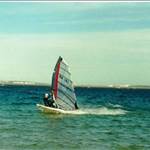
Some of my older posts on Local North America Pacific NW Windtalk Site start losing the Pictures, Graphs & Attachments.
Ther is a "ring buffer" that deletes those for older posts. At some point I will need to repost some IMHO more important posts here on Global Windsurfing Forum. BTW Hey, I am still Aussie Citizen

My old Post is still there with more Details, Graphs and Pictures on (nested objects still there):
"Science of fluid flow, wind shadow, laminar vs turbulent flow"groups.io/g/nw-windtalk/topic/85734803For example: You will find Reference to Estimate of downwind wind shadow (behind the object) as ratio 1 to 10 or 1 to 20 based on object height. Obviously the object width also plays a role in it.
There are probably 2 Things that have to be added to that post due to their importance and the significance of the effect:
1)
If the Terrain is Down sloping for sufficient distance, the air velocity, due to Newton's First Law, causes the reduction of wind shadow (comparing to flat terrain). That is why I had so many debates on NW Windtalk as to why SSP (Sail Sand Point) often is so great (and even better than Maggie/Magnuson) on Southerly Winds. However, I am the only person taking the advantage of that apart from Sailboat Racers who practice there regularly in any season of the year.
There is a reason why they practice exactly there.
I also have proven in many of my session reports with GPS track speeds plotted over the map (Garmin Connect Feature) that there are Independant "Air Corridors" and each can be active independently from each other just within 2 miles Lake Washington Width in this area.
Often there is more wind where nobody expect it to be therefore nobody goes there.
When I present it. I get response: "Windsurfers have been going to Maggie/ Magnuson for at least last 40 years, therefore that is where more wind is, use Beaufort Scale".
BTW The water is flat downwind from SSP as it is off-shore wind on Southerly therefore you can enjoy more speeds and use shorter foil masts.
Also think about when someone tells you to use Beaufort Scale (wind strength estimation based on water condition) how good is it if you are sailing on Lake George ?
Some of my "fellas ova heya" would never sail on Lake George arguing there is no wind

Seeing you Blokes riding it, they ask: "Is it a hoax ?!" I am Serious.
2)
Marek's Rule of Thumb (or Fist):I often mention that
Science can be Beautiful, Clear & Simple when you "filter noise", put "none-dominant factors" into perspective (or ignore them completely) and only focus on
Dominant Factors:
It is not few % accuracy that matters for the
"Bigger Picture". It is all about Relative References, e.g. area where specific hydrofoil beats all the other.
Also it is often about
Indexing (Ratios, Multipliers) to verify if something
"Makes Sense" or not.
BTW: We came to interesting conclusions taking to different sailors at much different weight and indexed it:
1) Dividing Sail Size by sailor weight - heavier sailor needs bigger sail
2) Multiplying weight by e.g. max speed - heavier sailor will have lower max speed (in specific wind range).
More Details at:
Ratios, Multipliers & Science - More Analysis for Geeksgroups.io/g/nw-windtalk/topic/79300663Therefore:
Everybody has different
fist size and
arm length (I mean distance between your eye and fist when the arm is stretched) BUT wouldn't you expect that a person with longer arm (bigger person) will have statistically larger fist?
Again, it does not Matter exactly for "
The bigger picture" when we are trying to Estimate (Not necessarily measure) building height and distance ratio (for wind shadow estimation) using our arms to fist size ratio.
You would also expect that my measured arm length to fist ratio should be very similar to any other person therefore can be used on the water as a powerful tool.
So here is the picture I made for You:

Like on the picture, if you rotate the fist, stretch your arm in front of you and you compare how your fist width (now height) at the arms length compares to building height then you know more less the if the distance from the building is also 1 to 10 ratio.
Therefore, you can estimate if you are in the wind shadow or not.
Simpe. Isn't it ?
Sure, you can also "read the water" but that depends on many factors and could be topic for separate discussion (if needed).