yoyo said...icesurf said...
The Tunnel Hull is worth exploring, but think with twin fins there is too much induced drag.
Too much drag maybe but NOT induced drag. Induced drag is proportional to the angle of attack. With an extra fin the AoA would be lower and so would be the induced drag. Of course the profile drag and surface drag would be greater with the extra fin.
Tunnel hull power boats have the apparant wind dead on and the weight of an engine and fuel tank to support. A speed windsurfer has the wind abeam to ~45 degrees , weighs >5kg and often already has too much nose lift..
Tunnel hulls are to reduce hull/water drag but if there is no board in the water anyway there is not much to be gained.


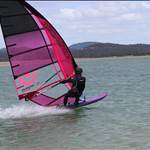
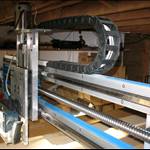
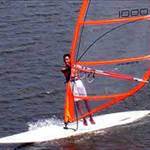
Images courtesy Shane Baker
1st reply from a newbie yank

, but theoretically, a two fin setup can have less induced drag than one fin, according to biplane theory. If you add this to a number of points made earlier, like 2 fins being smaller, aoa as result being smaller, and, I suppose, if the tunnel was shaped to allow it, the two fins would sealed at the top endplate (the hull) if the side hulls (sponsons?) are in the water, and the AR would be thinner, which might be good, esp. if the span of the 2 fins is the same as the single fin would be.
That be the theory, at any rate. I don't know if there's any practical experience to validate it in the tunnel hulled windsurfing world. It seems to me that if the two fins were too close together, there could be massive interference in the space in between- and that is part of the reason that the biplane theory exists. But I've read somewhere that once you get outside 2.4 times the chord in spacing the 2 fins, things get better. A fluid flow guy from one of the Italian AC teams told me that the farther apart the spacing is, the better- as far as you can go, he said.
Paul



 Lots of Tyre Kickers on this topic